



Exploring the sleepy cathedral city of St David’s in Pembrokeshire, Wales, I came across words that resonated with me strongly: do the little things. The words are what I look at every single morning when I settle down to work at my postcard-themed worktable.
Gwnewch y pethau bychain, or “do the little things”, is a saying attributed to Saint David, the patron saint of Wales, the greatest figure in the 6th-century Welsh Age of Saints. The renowned preacher’s final words to his followers before his death on March 1, 589 were, “Be joyful, keep the faith, and do the little things that you have heard and seen me do.”

The people of St Davids, and Wales, took his words to heart. Over centuries, the phrase has become a way of life, and nowhere does it feel more alive than in this tiny city at the far western edge of Britain.
With about 1,500 residents, St Davids barely registers on a map. It feels closer to a village but only until you grasp its history. Tucked into the windswept embrace of Pembrokeshire Coast National Park, this is the spiritual heart of Wales, founded in the 6th century on the site of a monastery established by Dewi Sant himself.

At the city’s centre, though almost hidden until the very last moment, stands St Davids Cathedral. Gently sloping streets conceal it almost completely, before the land drops away and the cathedral reveals itself, sunk into a green valley. Built in the 12th century on sacred ground believed to have been worshipped for more than 1,400 years, its purple Cambrian stone, sloping floors, and painted timber ceiling seem shaped by landscape – and doctrine.
After all, this was once one of medieval Europe’s great pilgrimage destinations. After Saint David’s burial here, Pope Callixtus II declared that two pilgrimages to St Davids were worth one to Rome—a remarkable claim for a place so remote.
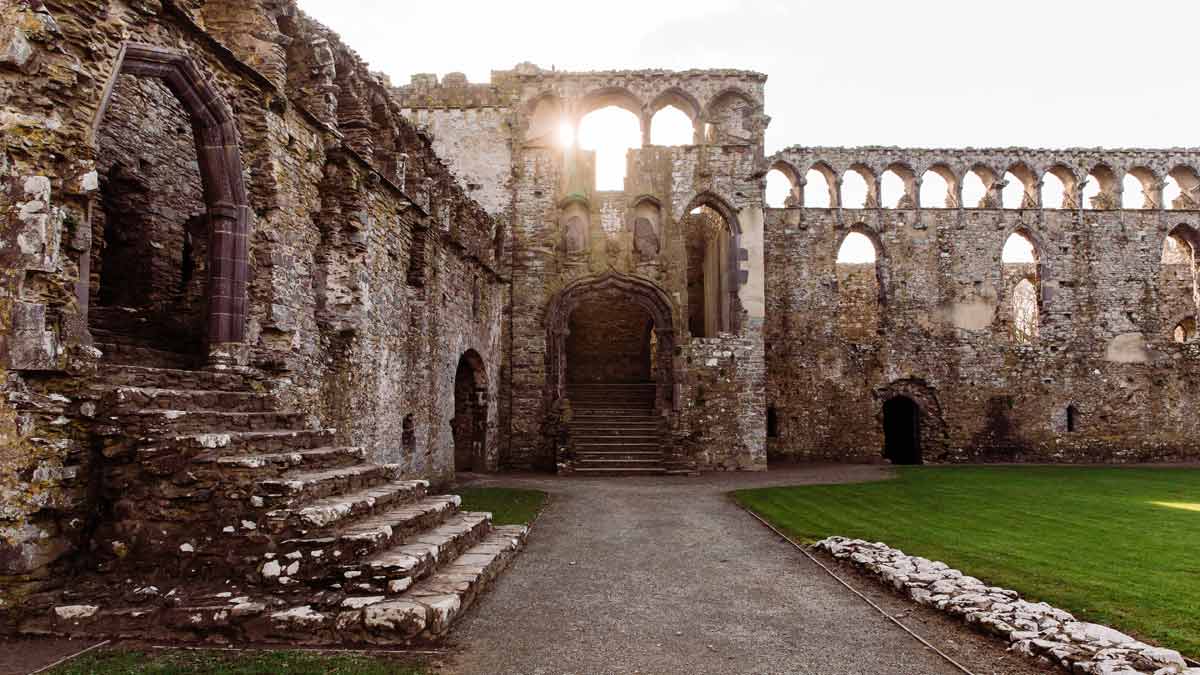
Across the river lie the Gothic ruins of St Davids Bishop's Palace, a reminder that this tiny city once wielded enormous ecclesiastical power. Built in the 13th century, Bishop Henry de Gower’s palace combined private quarters with a vast great hall designed for lavish banquets. Today, grass grows where feasts once unfolded, and swallows dart through empty windows. On summer evenings, Shakespeare is performed here under open skies, with the ruins forming a naturally dramatic stage.
Nature never far away. A short walk away lies Caerfai Bay, ideal for bracing swims, and St Non’s Chapel, the atmospheric ruins marking Saint David’s birthplace. The Pembrokeshire Coast Path loops past Porthclais Harbour and out towards St Justinians, where seabirds fly free and the Atlantic waves flow endlessly to the west.
The food reflects Wales’s working roots: hearty, resourceful and shaped by availability. Traditional Welsh cooking grew out of the lives of miners, farmers and fishermen, built around humble staples like leeks, cabbage, meat, fish and flour. On St David’s Day, it’s tradition to enjoy cawl, the country’s unofficial national dish: a slow-simmered stew dating back to the 14th century. I follow it up with griddle-cooked Welsh cakes, slightly sweet and dusted with sugar. Other popular items include laverbread, the briny seaweed paste often called “Welshman’s caviar”, and giant oggies, oversized pasties traditionally filled with lamb and leeks.
History and culture come into sharp focus on March 1 as St David’s Day transforms the city. Daffodils and leeks are pinned proudly to lapels; bunting flutters between stone buildings; children walk to school in traditional Welsh dress. The Welsh national anthem rings out with extra fervour as runners line up for the gruelling Ras Dewi Sant marathon along the coast path. Celebrated since the 12th century, the feast day blends devotion with joy; the singing, dancing, feasting are expressions of hwyl, that untranslatable Welsh mix of passion, emotion and enthusiasm.
In 2025–26, as Wales marks its Year of Croeso, a year of welcome, this smallest of cities feels welcomes travellers ready to slow down, to take their time, to look at the blue skies and smell the roses. As I enjoy Welsh ice cream from The Bench, I realise that little things do matter, in the biggest possible way.
