



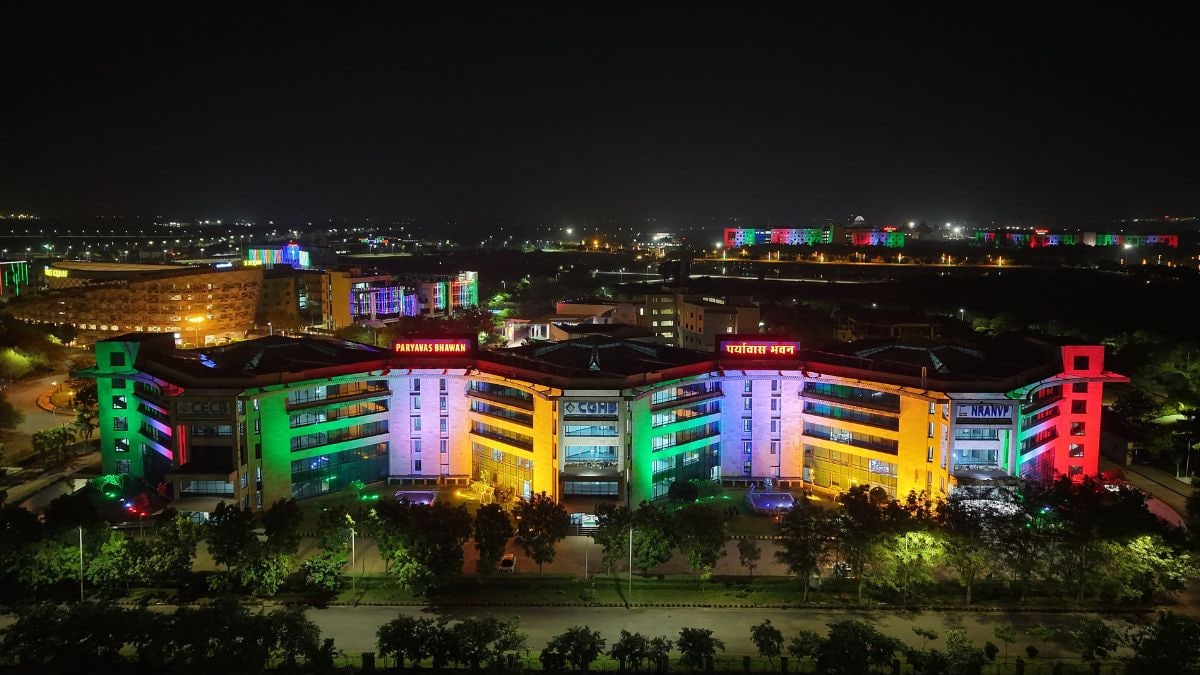
As Chhattisgarh readies to celebrate 25 years of statehood next month, its showcase capital Nava Raipur, officially ‘Nava Raipur Atal Nagar’, is set for a fresh burst of development. Billed as India’s first debt-free planned city, Nava Raipur is now moving beyond wide avenues and underground utilities into a new phase marked by high-tech industry, cultural tourism, and green energy.
In fact, urban planners are looking at the Nava Raipur experiment with anticipation. Could this be India’s new-age city?
The officials argue that if the investments translate into reality, by the end of the decade, Nava Raipur could well become the template for how a planned Indian city can integrate governance with green living, and global industries with cultural tourism.
In recent months, Chhattisgarh Chief Minister Vishnu Deo Sai-led government lined up a semiconductor fabrication plant worth Rs 1,143 crore, a Rs 147.66 crore Film City and Convention Centre, a new National Institute of Fashion Technology (NIFT) campus, and a 10MW solar project that is expected to save Rs 14.5 crore annually in electricity bills.
Officials say these projects are part of a broader push to position Nava Raipur as a hub for governance, technology, tourism, and sustainability.
Spread across 237sqkm, with 80sqkm designated as the core zone, Nava Raipur is larger than the other two planned urban cities in India, Chandigarh and Lutyen’s Delhi.
According to officials, nearly 27 per cent of its land has been set aside for green cover, lakes, and open spaces, making it one of the few climate-resilient planned cities in the country.
The new capital’s master plan envisions six lakh residents by 2031, supported by planned zones for governance, IT, education, industry, and housing. The capital already hosts the state secretariat (Mahanadi Bhawan) and new residential complexes for ministers and MLAs.
Moreover, in March 2025, the state government declared it had cleared liabilities worth Rs 1,788 crore, giving Nava Raipur the distinction of being India’s first debt-free planned city. Officials said the repayment allows fresh investment into infrastructure and industry.
New city, new AI push
As the country races to achieve semiconductor self-reliance, Chhattisgarh too would have a role.
On April 11 this year, Chief Minister Vishnu Deo Sai laid the foundation stone for Chhattisgarh’s first Gallium Nitride (GaN)-based semiconductor facility in Nava Raipur. Being set up by Polymatech Electronics Ltd at a cost of Rs 1,143 crore, the plant aims to produce 10 billion chips annually by 2030, with applications in telecom, defence, AI, and power electronics.
“This will not just be a factory but a symbol of Chhattisgarh’s transition into the high-tech economy,” an official said.
Betting on tourism and entertainment
Alongside semiconductors, the state is betting heavily on tourism. Fourteen land parcels covering 163 acres have been identified, including a 93-acre site in Mana, Raipur, reserved for a Film City and Convention Centre.
The Government of India sanctioned Rs 95.79 crore for the Film City and Rs 51.87 crore for the Convention Centre, with tenders already issued.
With its natural beauty and untapped potential, the state is preparing to offer excellent facilities for filmmaking and holding conventions, which will further boost its economy.
So, to cater to tourists and visitors, Nava Raipur is set to go beyond conventional hotels. According to the government officials, “Tent Cities” are to be developed along rivers and reservoirs such as Kodar, Nisda, Samoda, and Dudhawa dams, bringing luxury camping and water sports to eco-tourists.
The Ghungutta Tree House in Korea and Sarna Ethnic Resort in Jashpur—already operational—showcase the model of blending local culture with high-end experiences.
Tourism officials say PPP projects could bring in Rs 150–200 crore private investment in the hospitality sector, generating 5,000+ jobs in the next five years.
Other sanctioned projects include the Bhoramdeo Corridor in Kabirdham (Rs 145.99 crore), the Mayali-Bagicha eco-tourism project in Jashpur (Rs 9.96 crore), and a Wellness and Yoga Centre at Dongargarh.
Under a public–private partnership (PPP) model, tent cities, eco-resorts, and upgraded state-run facilities are also planned.
Nava Raipur has already become home to institutions such as IIM Raipur, Hidayatullah National Law University, IIIT, and AIIMS.
In 2025, the state cabinet approved Rs 271.18 crore for a NIFT campus and cleared plans for a Medical College and Research Institute.
Together, these institutions are expected to host one lakh students by 2030, boosting both academic and economic activity. It will be the country’s new education hub.
Urban planning
Not just that, Nava Raipur marks another unique feature in urban planning. Chhattisgarh has tried to be different; unlike other Indian cities, Nava Raipur was designed with underground corridors carrying power, water, and telecom lines.
Its Integrated Command and Control Centre (ICCC) manages CCTV feeds, traffic signals, water supply, and street lighting. This means that those managing these facilities can “see” and manage the city from a single dashboard.
The city is also pushing a solar transition, with a 10 MW solar plant under construction and rooftop panels being rolled out on government offices. The administration has set 2035 as the target for achieving net-zero carbon emissions.
Officials, hard-selling Nava Raipur as the next destination in the country worth exploring, say that it is merely 15 km from Raipur airport, linked by a six-lane expressway. “A metro-lite project connecting Raipur, Nava Raipur, and Durg-Bhilai is under feasibility study, while the state has also announced a Capital Region Authority to integrate Raipur, Durg, Bhilai, and Nava Raipur into a unified urban cluster.”
Spec sheet of Nava Raipur
Land bank: 163 acres across 14 parcels for tourism; 93 acres in Mana, Raipur, for Film City
GoI-sanctioned projects: Rs 95.79 crore (Film City), Rs 51.87 crore (Convention Centre), Rs 146 crore (Bhoramdeo Corridor), Rs 9.96 crore (Mayali-Bagicha)
Semiconductor plant: Rs 1,143 crore, 10 billion chips by 2030
Tourism investment (PPP/Direct): Rs 150–200 crore private inflow projected
Jobs: 1 lakh+ across IT, semiconductors, tourism, and services by 2030
