



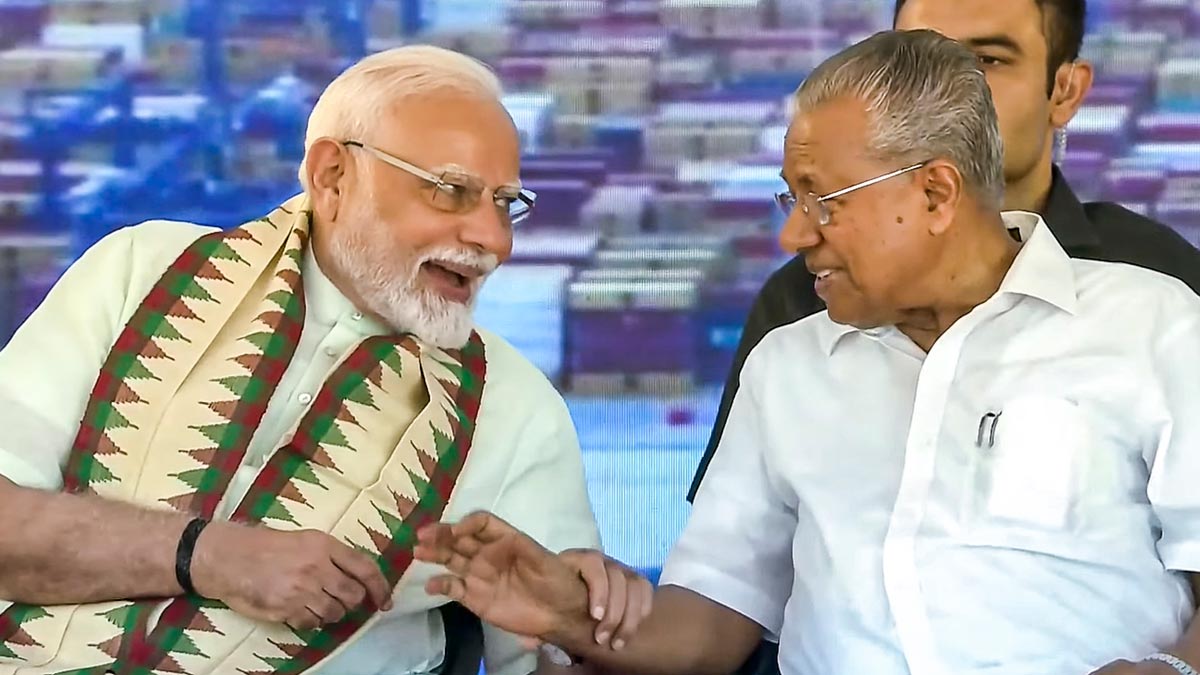
Kerala Chief Minister Pinarayi Vijayan insists that his government-backed Global Ayyappa Sangamam—an initiative to bring together Ayyappa devotees from across the world and promote Sabarimala as a global spiritual centre—should not be viewed through a political lens. However, his opponents argue that the chief minister and his party are engaging in a calculated form of politics, with their counter-narratives once again dragging Lord Ayyappa into the thick of Kerala’s charged political controversies.
Big plans behind?
The Global Ayyappa Sangamam is set for September 20, 2025, at Pampa, the base station for the Sabarimala temple. Jointly organized by the Kerala government and the Travancore Devaswom Board (TDB), it is being packaged as part of the TDB’s 75th anniversary celebrations. The Board, which manages 1,248 temples in the erstwhile princely state of Travancore, promises an event that will spotlight rituals, traditions, and devotee welfare, with around 3,000 participants expected. The official line is that the event is 'not political'.
Yet, politics has already seeped in. The Vijayan government extended an invitation to Tamil Nadu Chief Minister M.K. Stalin to be the chief guest. Stalin declined, citing prior commitments, but deputed two of his ministers—Hindu Religious & Charitable Endowments Minister P.K. Sekarbabu and IT Minister Palanivel Thiaga Rajan—to attend on his behalf.
Sangh Parivar organizations and the BJP have come out strongly against inviting Stalin and his representatives to the event in the name of Lord Ayyappa, alleging that the Dravida Munnetra Kazhagam (DMK) has a history of anti-Hindu rhetoric. Udhayanidhi Stalin’s statements, likening Sanatana Dharma to "dengue and malaria", that need to be "eradicated," to historical comments by Dravidian philosopher E.V. Ramasamy (Periyar), are cited as part of this campaign.
Organizations like the Vishwa Hindu Parishad (VHP) have also put forward narratives that the event is intended to “threaten Sabarimala's sacred traditions,” while accusing the Left Democratic Front (LDF) of misusing state machinery and temple funds for electoral gains. They cite the LDF’s actions during the 2019 Sabarimala protests, when the government enforced the Supreme Court ruling allowing women of all ages entry into the temple—leading to arrests of devotees and accusations of police repression.
Interestingly, activist Bindu Ammini, who entered Sabarimala in 2019 amid the controversy, has urged the government to allow women participants in the upcoming event and ensure their safety, highlighting the continuing debates over gender entry at the shrine. Meanwhile, Hindutva outfits have threatened protests and legal action, arguing that “non-believers” (a reference to the CPI(M)) have no right to organize such events.
Nevertheless, the CPI(M)-led government is moving forward with the Sangamam. The main opposition in Kerala, the Congress-led UDF, has already branded the event as politically motivated—an attempt by the LDF to woo Hindu voters in the wake of its setbacks in the 2024 Lok Sabha elections. UDF leaders, particularly Leader of Opposition V.D. Satheesan, have described it as an opportunistic shift towards “majority communalism,” accusing the LDF of exploiting religious sentiments for electoral mileage rather than genuine devotion. They also highlight the exclusion of opposition parties from the event, questioning the CPI(M)’s sudden “affection” for Sabarimala traditions after years of perceived antagonism, especially during the women’s entry controversy.
Calculations and countermeasures
In the 2024 Lok Sabha elections, the CPI(M)-led LDF in Kerala suffered a major setback, winning only 1 out of 20 seats. In the aftermath, the party admitted in its self-critical review that one of the key reasons for its poor performance was the erosion of traditional support bases. The CPI(M) is particularly concerned about the “rightward drift” among Hindu voters—especially the Ezhava community, a long-time CPI(M) stronghold—towards the BJP. Many believe that the Global Ayyappa Sangamam is part of the party’s strategy ahead of the local body polls and the 2026 assembly elections to halt further erosion of its core vote base and reclaim Hindu supporters lost over the past few years.
Observers point out that, in the run-up to the Lok Sabha elections, the LDF had championed minority issues in an attempt to expand its voter base. But after the polls, the CPI(M) seems to have made an about-turn—directing its attacks at what it calls “Muslim fundamentalist” groups, blaming them for consolidating votes behind the Congress-led UDF and contributing to the Left’s defeat. This shift was visible in the recent Nilambur bypolls as well. Analysts interpret this as a tactical recalibration: the CPI(M) appears to be softening its stance on Hindu concerns while hardening its rhetoric against perceived minority extremism in an effort to hold its core ground.
And, with its current moves, critics argue that the CPI(M) risks eroding its secular credentials and undermining its own accusation that the Congress is playing the soft-Hindutva card, while at the same time, handing a second 'suvarnavasaram' (golden chance) to the Sangh Parivar.
The BJP has historically struggled to gain a foothold in Kerala. But ever since the Sabarimala women’s entry controversy, it has had some limited success in tapping into Hindu sentiments. BJP leaders, including Kerala state president Rajeev Chandrasekhar, have already launched a campaign framing the Sangamam as hypocritical, citing the LDF’s crackdown on Ayyappa devotees during the 2018 protests.
As the BJP is highlighting what it calls the LDF’s “hypocrisy,” many believe the LDF is, in effect, giving the BJP an opportunity to rekindle memories of the 2019 women’s entry controversy.
