



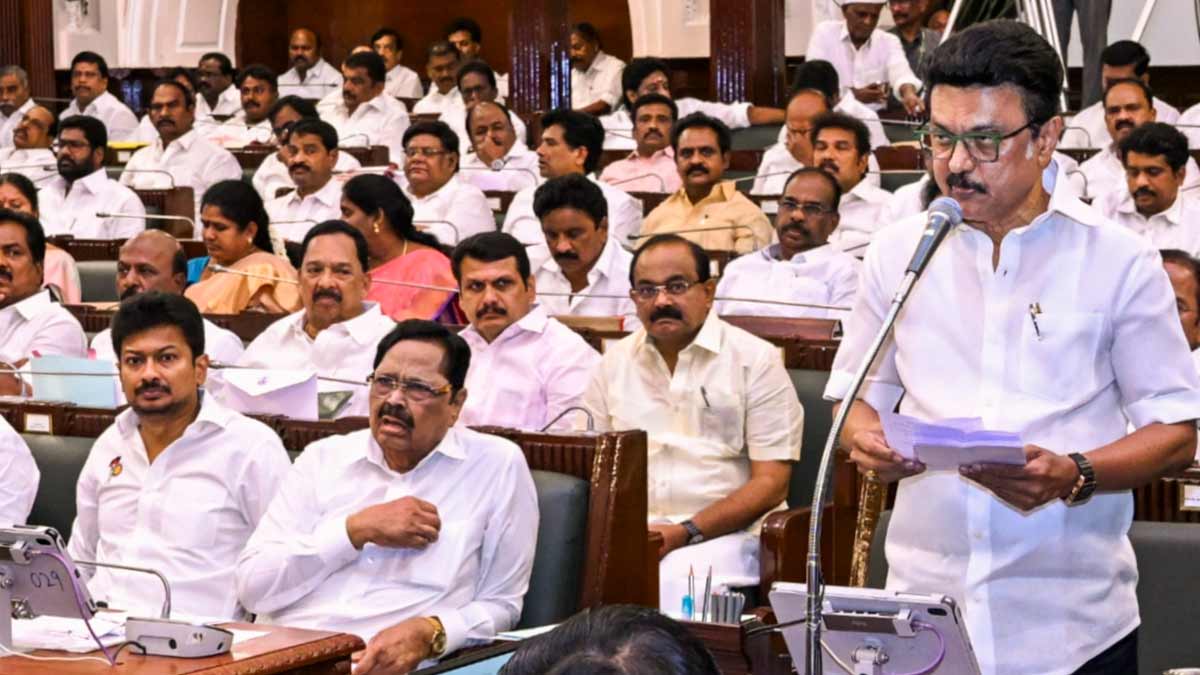
Rejecting the three-language formula proposed by the National Education Policy 2020, Tamil Nadu will retain its own two-language formula. Unveiling the State Education Policy (SEP) 2025, at the Anna Centenary library in Chennai, on Friday, Tamil Nadu Chief Minister M.K. Stalin positioned it as a clear alternative to the Centre’s National Education Policy (NEP) 2020.
Prepared by a 14-member committee formed by the Tamil Nadu government, headed by retired Justice D. Murugesan, the report was submitted in 2024. The SEP 2025 is deeply anchored in Tamil Nadu’s unique cultural, linguistic and social heritage and firmly endorses the two-language formula. The SEP argues that teaching only Tamil and English will preserve Tamil Nadu’s linguistic heritage while preparing students for the future.
With the introduction of the SEP, Tamil will be made compulsory across all boards in Tamil Nadu. “Till 10th standard, across all boards, including CBSE, ICSE and the State Board, Tamil will be made compulsory and students will study Tamil,” School Education Minister Anbil Mahesh Poyyamozhi told the media after releasing the SEP.
The policy shifts focus from memorisation to nurturing creative and critical thinking, aiming for 100 per cent higher education enrolment among students completing Class 12. “The state plans to nurture every child’s potential, ensure holistic development and uphold social justice and empower learners of the 21st century to thrive as compassionate, confident and responsible citizens in an evolving world.”
As of now, the state has a Gross Enrolment Ratio (GER) of 102.6 per cent at upper primary level, which is higher than the national level. Though the state GER is higher than the national level, the policy says that there are persistent disparities in GER, dropout rates and learning outcomes among the SC, ST, minority and tribal students in specific districts.
Addressing the challenges in Basic Literacy and Numeracy (BLN), the policy says that a mission-mode programme will be operationalised to ensure that children in Classes 1 and 3 acquire age-appropriate reading, writing and numeracy skills. “All children entering Grade 1 will be assessed for language readiness and cognitive development using student workbooks and age-appropriate tools.”
The SEP also proposes to optimise the content for critical thinking, conceptual clarity and life skills. It also pushes back the NEP’s proposal for public exams in Classes 3, 5 and 8. Calling it regressive, anti-social justice and a potential cause for higher dropout rates and commercialisation of education, the SEP battles for in-depth learning science, artificial intelligence and English along with substantial investment in state-run institutions.
The SEP also recommends bringing education back under the state list from the concurrent list. While recommending teacher capacity-building and professional development, the SEP reaffirms the state’s commitment to invest in equipping the teachers. It also recommends an art-integrated learning approach.
The release of the SEP comes months after protests against the NEP introduced by the Union government. Tamil Nadu has been vociferous against the Centre by calling it “anti-social justice”. The state has also been opposing the three-language formula suggested by the NEP.
In May, the state government moved the Supreme Court, seeking a direction to the Centre to release the ₹2,291.30 crore due to the state through the Samagra Shiksha Abhiyan (SSA) scheme. The money has been withheld as a consequence of the state refusing to implement the NEP and the three-language formula proposed by the Centre. The state, also in its petition, sought to direct the Centre to comply with the Right of Children to Free and Compulsory Education Act 2009, by compulsory disbursal of 60 per cent of its share in the grants-in-aid, before the academic year.
