



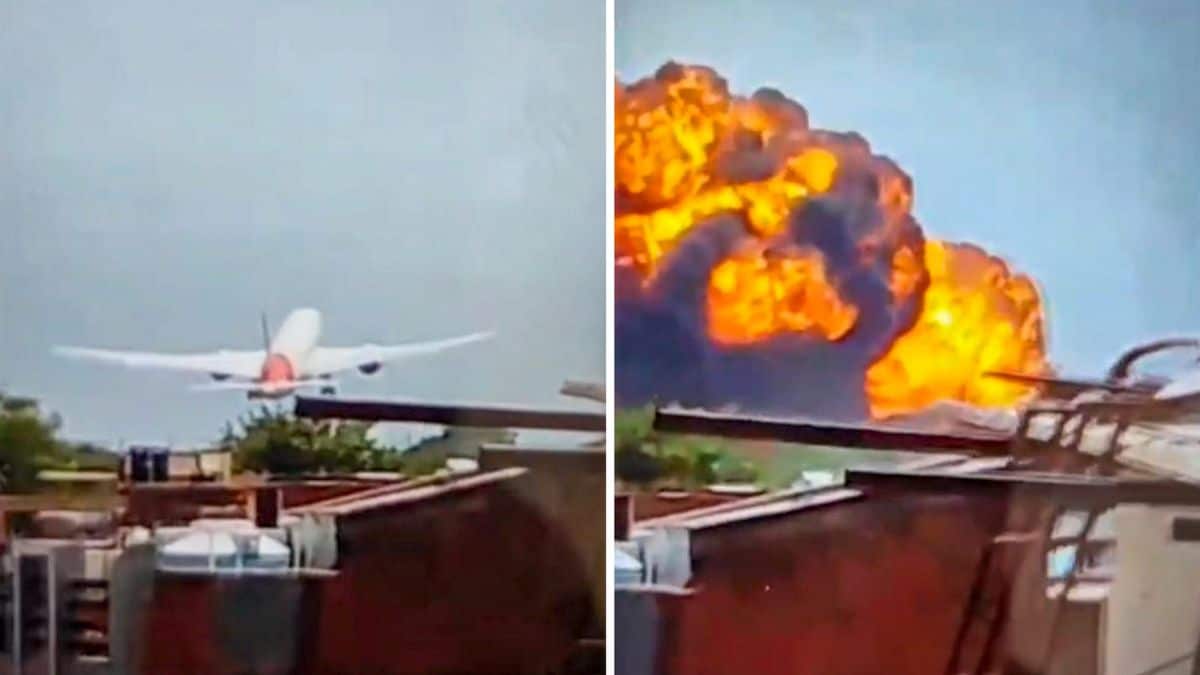
While the mystery over the cause of the Air India flight crash is under investigation, aviation expert and journalist Jacob Philip has shed light on what could have transpired in the moments leading up to the deadly accident.
Analysing the videos available, the expert pointed out on social media about three key issues to note from the final moments of the Boeing 787-8. The first problem was that the wheels remained low even when the aircraft was flying at an altitude of above 600 feet, he posted on Facebook, adding that usually, the wheels are raised by the time the flight reaches a height of 200-400 feet.
Another issue he noted was that the flaps behind the wings appeared to be straight in the videos captured from a distance. The final problem he pointed out was the flight trying to climb right before the fall.
Pointing out these issues, he said there are many possibilities for this. It could be:
- Fault in the hydraulic system that moves the landing gear
- Pilots' negligence
- The pilots realised the problem and attempted to land the aircraft
However, he pointed out that the flaps appearing to be straightened (if the vision in the video is true) further complicates the problem. “During takeoff or while trying to climb, these flaps behind the wings are lowered to provide more upward thrust for the aircraft. But this lift is reduced, neither of these things will happen,” he wrote.
Philip said it was certain that the flaps of the Boeing 787-8 were lowered during the climb as it took off after covering just under 1,900 metre of the 3,505-meter-long runway at Ahmedabad Airport,.
He pointed out that that the flaps should be straightened only after climbing an altitude of about 1,000 feet and “gaining a good amount of speed”.
“The first suspicion that may arise is this - could the pilots have pulled the lever to straighten the flaps, thinking it was the lever to retract the landing gear? But this is unlikely to happen on the Dreamliner. The two are not close enough to be interchangeable. The flap lever is to the right of the engine throttle on the pedestal between the pilots. The landing gear lever is located on the main instrument panel, below the flight display panel, on the captain's side (left),” he explained.
“Flaps up and wheels down - the combination of these two is the most dangerous situation,” he said, adding that the upward thrust required for the plane to rise decreases when the flap is up while the airflow gets obstructed when the wheels are down.
