



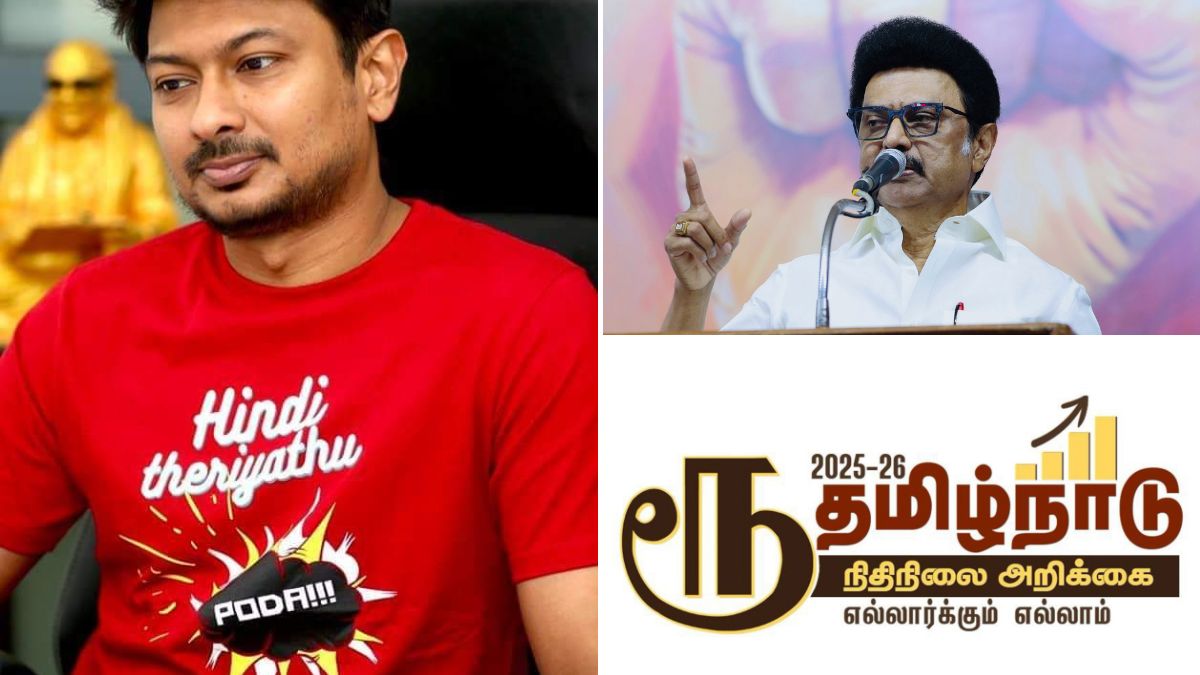
As the Dravida Munnetra Kazhagam (DMK)-led Tamil Nadu government presents the state budget today, there is a notable omission that has made quite the headline in the country—the omission of the rupee symbol ₹.
DMK mouthpiece Murasoli, in its Friday edition, featured the photo of the new symbol, stating it was noteworthy that one of the instances from the preview video of the budget released by Chief Minister M.K. Stalin has become the talk of the whole country.
Perhaps, that was exactly what one of the oldest regional political parties in India, the Dravida Munnetra Kazhagam, wanted—a national discussion on the recent move by the BJP-led Union government, widely criticised by vernacular language supporters as a political arm-twisting to impose Hindi.

Ever since the BJP government under Narendra Modi came to power, every two-three years, there has been a move to bring Hindi to the fore as a “national language”. This is not new to Tamil Nadu. Attempts to make Hindi a mandatory language in the state’s education system were met with opposition, and even agitations between 1938 and 1940, and in 1948 and 1965.
In 2020, a plan to impose Hindi backfired, with celebrities and prominent public figures from Tamil Nadu sporting T-shirts that said ‘Hindi theriyathu, poda’ (Don’t know Hindi, get lost).
In 2022, Home Minister Amit Shah asserted that Hindi needs to be accepted as an alternative to English. Leaders from Tamil Nadu were caught off-guard, some even reacting with disbelief. For, the language debate was a settled issue in Tamil Nadu—something that was decided even in the pre-Independence days.
Back then, Stalin told DMK workers, “We are not against Hindi. We are against the imposition of Hindi.” Invoking the ideological guru of Dravidian politics, E.V. Ramasamy (Periyar), Stalin asserted that the fiery soul of the language struggle that began in 1938, will not be doused even in 2022.
Three years since, here we are, once again.
It all began with the National Education Policy (NEP) 2020, which sought to reintroduce the three-language formula. This move, which Tamil Nadu sees as a covert move to introduce Hindi as a mandatory language in education, was also shot down back in the NEP 1968. While the earlier NEP mandated Hindi as a compulsory language after English, the 2020 one advised English and two regional languages.
South Indian states like Tamil Nadu, which was happy with a two-language formula, now see it as a way to impose Hindi. For, in a three-language formula, the third language after English and Tamil automatically defaults to Hindi, unless the state finds another regional language to substitute and find teachers for it. Therefore, Tamil Nadu shot down the NEP 2020.
The Centre retaliated, withholding ₹2,152 crore under the Samagra Shiksha scheme, stating Tamil Nadu’s unwillingness to join the Union government-sponsored programme to uplift 14,500 model schools with a focus on a more holistic, inclusive and sustainable education called the PM SHRI initiative. The irony is that Tamil Nadu is willing to participate in PM SHRI, as long as the non-negotiable condition of implementing NEP 2020 is struck down.
This stand-off has now escalated, pouring fuel into the fire on the Tamil-Hindi struggle. And Stalin-led DMK was quick to make a statement—striking down the rupee symbol made using the Devnagiri script, in its latest state budget presentation, in what can be viewed as an open protest against Hindi.
Thursday night, Finance Minister Nirmala Sitharaman took to social media to shun the gesture by the Stalin government.
The Union finance minister added that the ₹ symbol was designed by D. Udaya Kumar, son of former DMK MLA N. Dharmalingam. “By erasing it now, the DMK is not only rejecting a national symbol but also utterly disregarding the creative contribution of a Tamil youth,” she added.
“The ₹ is internationally well-recognized and serves as a visible identity of India in global financial transactions. At a time when India is pushing for cross-border payments using UPI, should we really be undermining our own national currency symbol?,” asked Sitharaman.
Calling the gesture by Tamil Nadu government under Stalin as “more than mere symbolism”, the finance minister, who also hails from Tamil Nadu, said that it signalled “a dangerous mindset that weakens Indian unity and promotes secessionist sentiments under the pretence of regional pride”.
A completely avoidable example of language and regional chauvinism, Sitharaman stressed.
An issue that began with the NEP quickly escalated into a political and ideological battle. Tamil Nadu is unlikely to back down unless the ₹2,152 crore owed to the state under the PM SHRI initiative is settled without the state implementing the three-language formula. The Centre will not include Tamil Nadu in PM SHRI unless it implements the NEP 2020, thereby implementing the three-language formula that comes with it.
Who will blink first, is the million-dollar question.
