



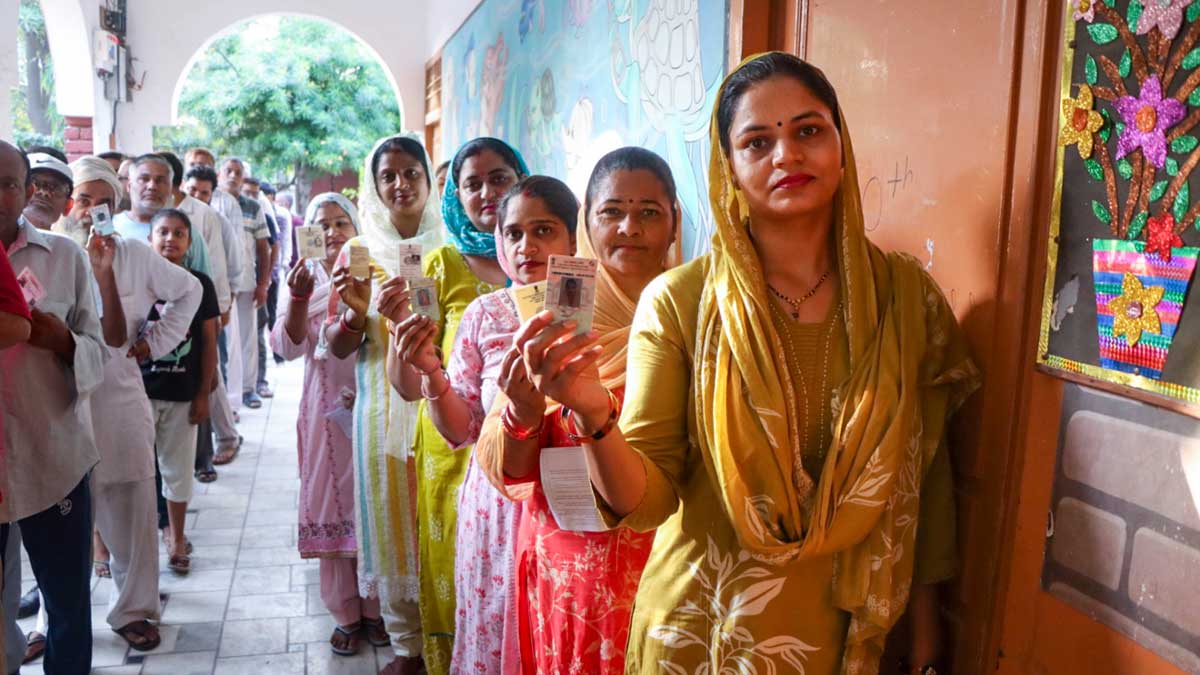
Jammu and Kashmir went to polls in three phases on September 18, September 25, and October 1 while in Haryana, the elections were held in a single phase on October 5.
Counting of votes in both the states will take place on October 8.
In Haryana, the BJP hopes to retain power for a third consecutive term while the Congress eyes a comeback after a decade-long hiatus. The Aam Aadmi Party (AAP) is the thir major player.
There was a pre-poll alliance between Indian National Lok Dal-Bahujan Samaj Party (INLD-BSP) and Jannayak Janta Party (JJP)-Azad Samaj Party (ASP).
In 29019, the BJP had won 40 of the 90 seats and formed a coalition government with the JJP, which won 10 seats. The JJP later broke out of the coalition. The Congress bagged 31 seats.
The BJP is contesting the polls under the leadership of Nayab Singh Saini who became chief minister in March this year replacing Manohar Lal Khattar. The Congress, meanwhile, hopes to wrest back power riding on anti-incumbency, and issues of farmer protests and wrestlers protest.
Issues related to women, youth, farmers and the poor formed the core of respective poll manifestos of the two main contesting parties.
Results of Jammu and Kashmir, which goes to assembly polls for the first time after the abrogation of Article 370 and bifurcation of the state, will be a litmus test for the BJP.
The saffron party hopes to become the single largest party in the union territory while the National Conference-Congress alliance aims to form government with the support of like-minded parties. The PDP, meanwhile, chose not to be part of any pre-poll alliance.
In the 2014 Assembly polls, the PDP won seven of the 15 seats in north Kashmir, while the NC and Congress secured three and two seats respectively.
