



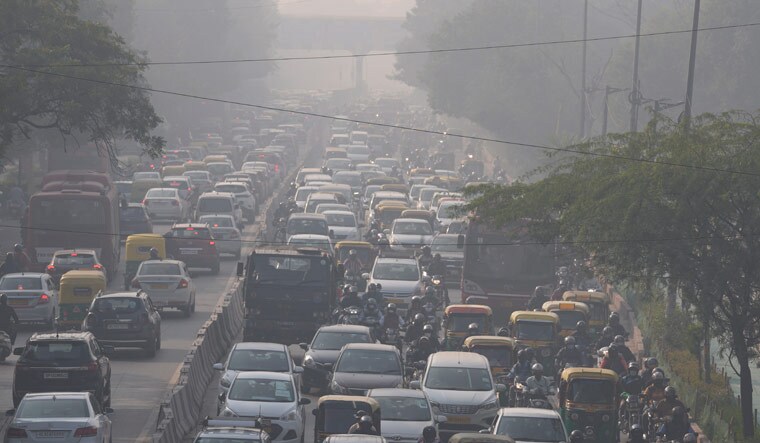
Noida woke up to 'poor' air quality on Monday morning as its Air Quality Index (AQI) hit 204. But, things were looking better for Delhi after four days after its AQI improved from 'poor' to moderate'.
The AQI for Delhi on Monday morning was 199. An AQI between 0-50 is considered 'good', 51-100 'satisfactory', 101-200 'moderate', 201-300 'poor', 301-400 'very poor', 401-500 'severe' and above 500 'severe plus'.
Other parts of the NCR region, including Ghaziabad, also saw 'poor' AQI. According to the System of Air Quality and Weather Forecasting And Research (Safar-India) the AQI at the Loni area in Ghaziabad has been recorded at 229.
The IMD has also forecasted a partly cloudy sky with a possibility of very light rain or thundershowers in Delhi on Monday. The maximum and minimum temperatures are expected to settle around 32 degrees Celsius and 20 degrees Celsius respectively. The current rise in temperature is also owing to an approaching western disturbance, which has made the sky cloudy and might bring rain on Monday and Tuesday, the IMD said.
This comes as early harvest triggered farmers to resort to stubble burning in Punjab and Haryana, despite the efforts of the state governments to rein them in.
According to the data from the Indian Agricultural Research Institute, an increase in farm fires was witnessed in the states of Punjab and Haryana this year from September to October compared to the same time in 2022. This hints that an early withdrawal of the southwest monsoon resulted in early harvest this year, thereby advancing the dates of stubble burning as well, Hindustan Times quoted experts.
The situation forced Delhi Lt Governor V K Saxena to write to the chief ministers of Punjab and Haryana, urging them to take remedial measures to protect the national capital from increased air pollution during the winter season.
In his letter to Punjab Chief Minister Bhagwant Mann, Saxena said it is "extremely worrisome" that the incidents of stubble burning between September 15 and October 11 have reached 1,063 -- 300 more than the figure for the corresponding period last year.
"I am sure that you are seized of the matter and urge you to galvanise all available resources and make the farmers willing partners in defeating this deadly menace and help the capital as indeed the entire NCR breath easy," he wrote in the letters.
The paddy stubble (parali) left in the fields after harvest is set on fire by the farmers in many states primarily Punjab, Haryana, and Uttar Pradesh leading to a smoke cover shrouding Delhi in winter when the temperatures plummet.
Though the state governments of Punjab and Haryana provided subsidized stubble management machines to farmers in these districts, reports indicate most of these machines are not being used.