



Ahead of a crucial election season, the Congress on Monday raised the pitch of its demand for a caste census several notches, with the highest decision making body of the party unanimously resolving that if the party’s government is formed, it will conduct a nationwide caste census as part of the normal decadal census which was due in 2021.
The main issue on the agenda of the Congress Working Committee, which met under the chairmanship of party president Mallikarjun Kharge, was caste census. The meeting, which took place in the backdrop of the release of the report of the caste survey conducted by the state government of Bihar, sought to place emphasis on the Congress’ support for a caste census and also project it as an issue that former party chief Rahul Gandhi has been highlighting in his speeches.
The resolution adopted unanimously at the end of the four-hour-long meeting stated that the CWC welcomes the release of the caste survey or headcount conducted by the state government of Bihar. It said the disparity between representation and share in population revealed by the final figures of the survey highlights the urgent need to take effective steps to ensure social justice.
Significantly, the CWC resolution stated that it welcomes the objective of the Justice Rohini Commission of sub-categorisation within OBCs, which was set up by the Narendra Modi government, but it also said that it underlines that it will remain incomplete without detailed data on the socio-economic position of various communities, which can be obtained either from the still unreleased data from the 2011 Socio Economic and Caste Census or a fresh caste census.
“The Modi government has cheated the OBC communities and other deprived sections of the country by not releasing the data of the 2011 Socio Economic and Caste Census and not carrying out a fresh Caste Census; it has also failed in its Constitutional duty by inordinately postponing the decadal Census that ought to have been conducted in 2021 or soon thereafter. It is a matter of shame that India remains the only country in the G20 that has failed to carry out the Census,” the resolution stated.
The CWC resolution stated that the party promises that a government led by it will conduct a nationwide caste census as part of the normal decadal census which was due in 2021 and also implement the 33 per cent reservation for women in the Lok Sabha and state legislative assemblies at the earliest, ensuring adequate representation for women belonging to Scheduled Castes, Scheduled Tribes and including OBCs as well. “The unnecessary obstacles of Census and delimitation imposed by the Modi government will be removed,” it said.
The party has also resolved to remove the cap of 50 per cent through legislation for the reservation of OBCs, Scheduled Castes and Scheduled Tribes, in line with the commensurate share of population.
This is, however, a slightly different formulation of the party’s stand on the reservation format as compared to the demand for proportionate reservation made by it in recent months or the ‘Jitni Abadi, Utna Haq’ slogan raised by Rahul in the Assembly elections in Karnataka earlier this year.
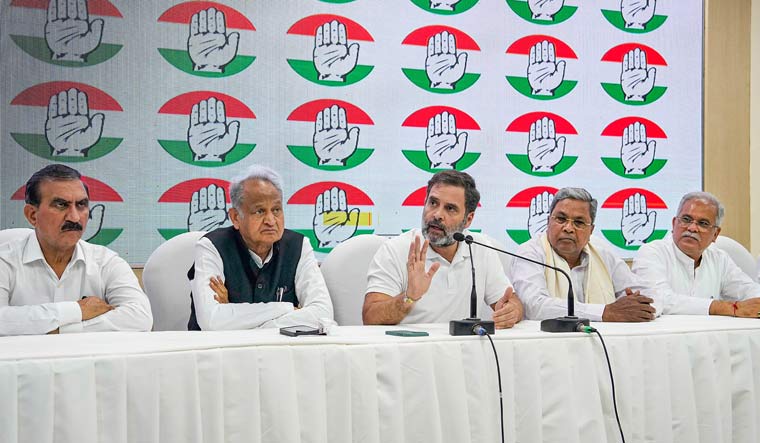
It was clear that the party has Rahul at the forefront of the demand for a caste census when the former party chief briefed the media about the CWC meeting. He was accompanied by the four Congress chief ministers, three of whom belong to the OBC community, at the press conference. The usual practice after a CWC meeting has thus far been that the AICC General Secretary in-charge of Organisation and the head of the Communications Department have addressed the media on the committee’s deliberations and decisions.
Addressing the media, Rahul said the CWC had taken a historic decision with regard to caste census, stressing that the decision was unanimous and there was not a single person in the room who did not support the concept of caste census. He also said that the Congress-ruled states would conduct caste census at the state level.
“It is not about caste or religion. It is about poverty. Caste census will open a new development paradigm,” he said.
Questioning the BJP’s credentials with regard to commitment to the OBC cause, Rahul said that while three of the four Congress chief ministers belonged to the OBC category, out of the ten BJP chief ministers, only one was from the OBC community, and quipped that he, too, would soon be defeated.
“The Prime Minister is incapable of doing the caste census...Why can’t he declare in his speech that the data of the caste census would be released or that the next census would have a caste count? The PM does not work for the OBCs. His main task is to distract the attention of the OBCs, the Dalits and the Adivasis,” he said.
Congress leaders made an effort to connect the demand for caste census with Rahul’s discussions with the people during the Bharat Jodo Yatra. The CWC resolution too said that the demand for caste census was repeatedly expressed state after state by multiple delegations during the yatra, and it found voice in the Raipur declaration at the 85th Congress Plenary Session.
Kharge, in his opening remarks at the meeting, set the tone for the discussions, saying the Congress has been consistently raising its demand for nation-wide caste-based census and the demand has gained widespread public support especially after the Bihar government’s release of caste survey.
“For proper implementation and delivery of Government programmes and welfare schemes, it is important that we have scientific socio-economic data of the marginalised sections including their numbers, representation, and economic and social condition. Thus, it becomes important that we must deliberate upon the issue of caste-based census,” he said.
According to sources, former party president Sonia Gandhi said at the meeting: “I am 100 per cent with the caste census. We must get it done.”
