



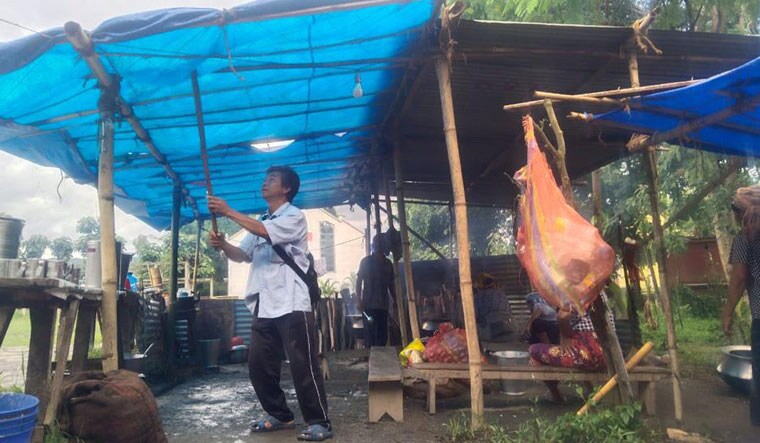
Manipur violence has rendered many tribal people helpless and homeless. Families have lost their loved ones, and many tribal people in the state are bearing the brunt of the political hostilities and ethnic violence.
While the opposition parties are using the Manipur violence issue to strengthen their position against the ruling party, the Union government is maintaining a stoic silence.
The outcome of this apathy and silence is the continued senseless violence affecting many innocent tribal women and children. A huge area of concern is the large number of relief camps functioning out of schools in various districts, where food and basic amenities are either not reaching or are insufficient to meet the needs of the affected. The Kangpokpi district has around 52 relief camps with nearly 1,717 inmates; Lamka district has 105 relief camps catering to around 20,486 displaced people, and the Moreh camp has two shelters where 160 people live. Relief camps are also set up in Mizoram, Guwahati, Shillong, and Ukhrul.
Data shows that there are as many as 42,616 people living in 207 camps. The internally displaced Zomi-Kuki-Hmar people and victims of assaults are living without sufficient food, basic amenities and medical care in these camps.
In June, the central government approved a relief package of nearly Rs 102 crore for the displaced people, but the financial aid has still not reached the far-flung corners of the state. The money should ideally come directly to the people, but this is hardly the case.
Many schools have been shut for more than 80 days. Soon it will be a 100. Only a few select schools have been reopened. Some schools are functioning only for a few hours. As many of the schools are functioning as relief camps, the question is if they should continue as camps at the risk of the future of the children. There are no easy answers. On the one hand, there is a huge number of people who are dependent on these relief camps which are short of basic amenities like mosquito nets and baby food. On the other hand, the future of Manipur, just like any other state, is its children who are now deprived of education. For example, in Lamka, out of the 105 relief camps, a few operated out of community halls and government offices, while all the others are schools.
Various institutions and organisations within the country and even abroad are offering aid, but this is barely enough to meet the needs of those living in relief camps. The Union and state governments should pay urgent attention to the situation in the temporary relief camps in the hilly districts (Kangpokpi and Churachandpur) of Manipur. They should also initiate steps to provide permanent settlements for the internally displaced people in the hilly districts and allocate adequate funds to take care of the victims living in harsh conditions.
The law and order in the state have failed completely. The state and the Union government must take cognizance of the atrocities committed against tribal women and children. The culprits behind these abhorrent crimes should be brought to justice. Immediate relief should be provided to tribal women who are caught in the crossfire of violence, and living in fear and trauma.
The governments should also act swiftly against false propaganda and those within the establishment or outside who are colluding with mobs, orchestrating attacks, looting, and burning houses and entire villages of Zomi-Kuki-Hmar localities in Imphal and in the peripheral areas. At the same time, dealing with the humanitarian crisis should be the top priority. Justice delayed is justice denied for the victims who have suffered a great loss.
The lost lives will not come back, the trauma will never disappear and the ‘home’ is lost forever!
(Mercy Vungthianmuang Guite teaches literature and culture studies at Jawaharlal Nehru University in New Delhi.
The opinions expressed in this article are those of the author's and do not purport to reflect the opinions or views of THE WEEK.)
