



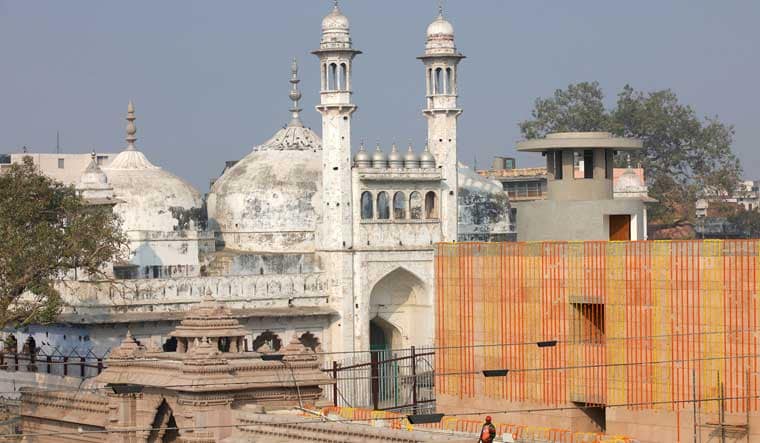
The Allahabad High Court on Thursday is likely to pronounce the final verdict on the Archaeological Survey of India (ASI) conducting a survey of Gyanvapi mosque in Varanasi.
The HC had reserved its verdict till August 3 on the plea against the ASI survey by the mosque committee.
Earlier, Varanasi district court had directed the ASI to conduct scientific survey/excavation of the mosque based on the plea filed by four Hindu women petitioners. The plea was to determine if the mosque was built at a place where the temple existed earlier.
As per the district court's direction the ASI survey began on July 24, however, it was immediately stayed by the Supreme Court after the mosque committee sought more time to appeal against the Varanasi court's order.
The committee had raised the objection to the survey saying that the survey would damage the structure of the mosque. However, the Centre had assured that there won't be any damage.
Later, pleas were filed in the Allahabad HC seeking protection of the "Hindu signs and symbols" in the Gyanvapi mosque complex.
Rakhi Singh, a petitioner filed the plea accusing the Muslim side of destroying the Hindu symbols and demanding protection of the same.
While hearing the plea by the mosque committee, Chief Justice of India D. Y. Chandrachud said: "Let there be a status quo for the time being. No excavation, no invasive method until we hear it.”
The court directed the Solicitor General Tushar Mehta, who was representing the Uttar Pradesh government, to inform the ASI team, who were in the mosque complex preparing for the survey.
Senior counsel Huzefa Ahmadi, appearing for the Gyanvapi mosque management committee, had argued that it had earlier stayed the carbon dating of the structure, claimed as "shivling" by the Hindu side. "What is the tearing hurry, this place has been a mosque since the 1500s? there must be a status quo order," Ahmadi told the SC.
"The truth of Gyanvapi will only come out after the survey of ASI. The high court will decide the matter unaffected by any observations of the Supreme Court, Allahabad HC will decide the matter on its own merit," the Hindu side had argued.
According to the Hindu litigants, the mosque was built on the site of the original Kashi Vishwanath temple. But, the Muslim litigants argue that the mosque was built on Waqf premises and that the Places of Worship (Special Provisions) Act, 1991, barred changing the character of any place of worship as it existed on August 15, 1947.
