



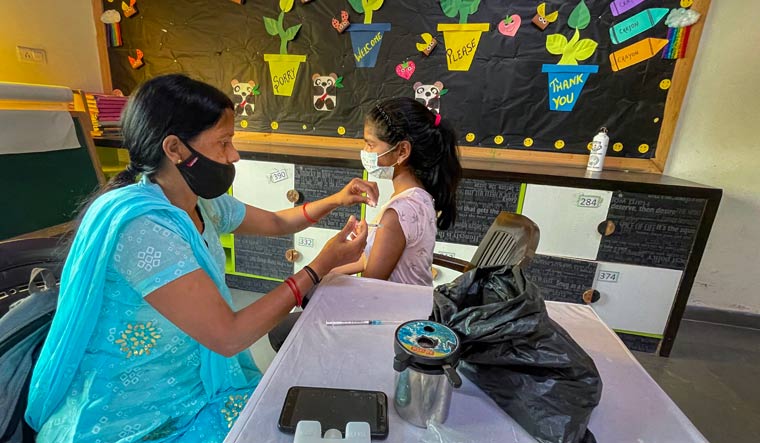
India is among the only three of 55 countries studied, where popular perception of the importance of vaccines for children has held firm or improved during recent times, a global report published by the UNICEF has said.
UNICEF India released the global flagship report ‘The State of the World’s Children 2023: For Every Child, Vaccination,’ highlighting the significance of childhood immunization, on Thursday. In Bhopal, the report was shared by UNICEF office of Madhya Pradesh.
With only three countries - India, China and Mexico - among those studied showing positive change in perception, the report has warned of the “growing threat of vaccine hesitancy due to factors such as access to misleading information and declining trust in vaccine efficacy”.
Madhya Pradesh improves full immunization by 6%
Speaking after the sharing of the global report, Dr Santosh Shukla, Director Immunisation, National Health Mission, Madhya Pradesh said that due to additional efforts during past two years in the form of three special campaigns in addition to routine immunisation drives, an increase of 6 per cent in full immunisation coverage (all vaccines received) of children – from 88 to 94 per cent - has been reported. Also, due to the efforts of the State, its partners like UNICEF, WHO, UNDP and other development partners, there has been an increase in confidence level on immunization in the state, he said.
Margaret Gwada, Chief, UNICEF Madhya Pradesh, said that UNICEF stands committed to support the state government’s vision of ensuring that every child receives timely and complete vaccination. “As UNICEF releases the global report, we urge all parents and stakeholders to continue with the tireless efforts to ensure that no eligible child is left behind and is protected against vaccine preventable diseases.”
98% Indians have vaccine confidence
The report quotes data collected by The Vaccine Confidence Project of the London School of Hygiene and Tropical Medicine in 2022, to say that as high as 98 per cent of the population in India showed confidence that vaccines were important for children. This was around 3 per cent positive change compared to before and after of COVID-19 pandemic.
Other two countries which showed improved confidence in vaccines are China and Mexico where population showed 95 and 93 per cent confidence in vaccines with a positive change of about 8 and 2.5 per cent before and after the pandemic.
The report expresses worry that the vaccine confidence has shown a decline in over a third of the studied countries (e.g., in the Republic of Korea, Papua New Guinea, Ghana, Senegal and Japan) after the start of the pandemic. The decline in vaccine confidence globally comes amid the largest sustained backslide in childhood immunization in 30 years, fuelled by the COVID-19 pandemic. The pandemic interrupted childhood vaccination almost everywhere, especially due to intense demands on health systems, the diversion of immunization resources to COVID-19 vaccination, health worker shortages and stay-at-home measures, the report says.
“The State of the World’s Children 2023 report highlights India as one of the countries with the highest vaccine confidence in the world. This is a recognition of the Government of India’s political and social commitment and demonstrates that the largest vaccine drive during the pandemic has paid off in building confidence and strengthening systems for routine immunization to vaccinate every child,” Cynthia McCaffrey, UNICEF India Representative, in a statement released to media.
“Immunization allows children to live healthy lives and contribute to society. Routine immunizations and strong health systems can best prepare us in preventing future pandemics and reducing morbidity and mortality,” added McCaffrey.
67 million kids missed vaccines during pandemic
The Report warns a total of 67 million children missed out on vaccinations between 2019 and 2021, with vaccination coverage levels decreasing in 112 countries. In 2022, for example, the number of measles cases was more than double the total in the previous year. The number of children paralysed by polio was up 16 per cent year-on-year in 2022. When comparing the 2019 to 2021 period with the previous three-year period, there was an eight-fold increase in the number of children paralysed by polio, highlighting the need to ensure vaccination efforts are sustained.
Despite an increase in the number of zero-dose (unreached or missed out) children to three million – between 2020 and 2021 – during the pandemic, India was able to arrest the backslide and bring down the number to 2.7 million, which represents a smaller proportion of the India’s under -5 child population given its size and the world's largest birth cohort.
This achievement can be attributed to sustained evidence-based catch-up campaigns initiated by the government, including the Intensified Mission Indradhanush (IMI), continued provision of comprehensive primary health care services, a strong Routine Immunization programme and dedicated health workers. Continued progress is being made to reach the last mile and the last child, the media note said.
The pandemic also exacerbated existing inequities. For too many children, especially in the most marginalized communities, vaccination is still not available, accessible or affordable. Even before the pandemic, progress on vaccination had stalled for almost a decade as the world struggled to reach the most marginalised children.
New data produced for the report by the International Center for Equity in Health found that in the poorest households, 1 in 5 children are zero-dose while in the wealthiest, it is just 1 in 20, the UNICEF report mentioned.
