



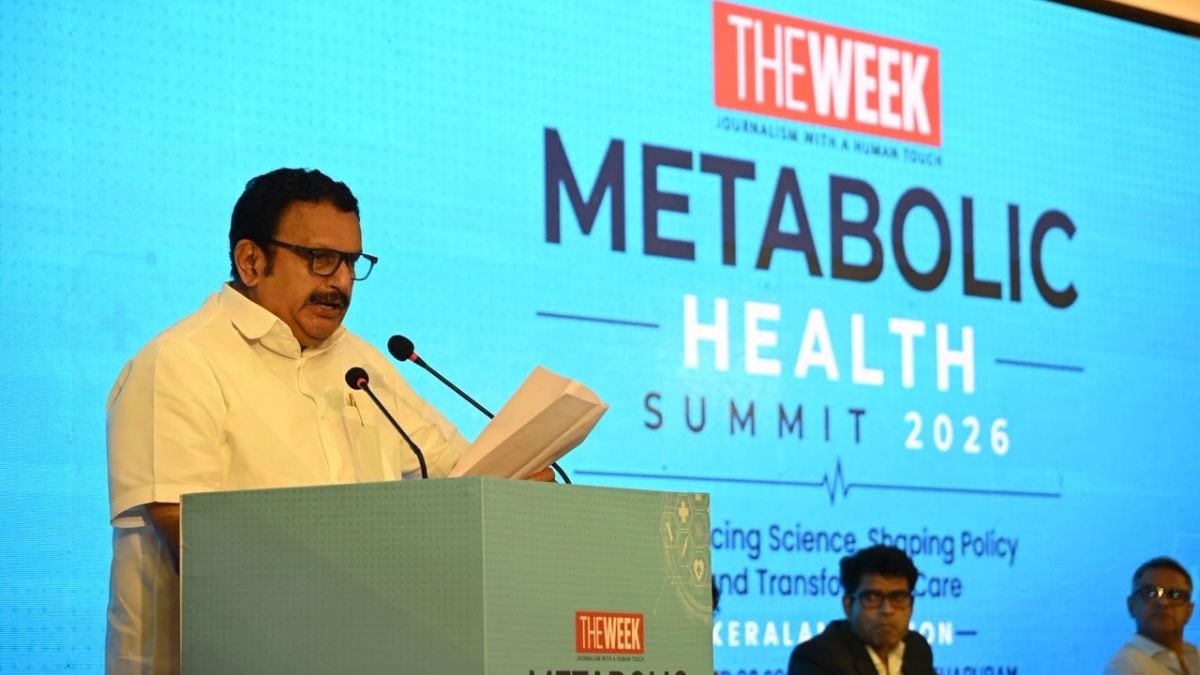
Kerala is dedicated to supporting policies that promote preventive health, lifestyle interventions, and equitable access to modern metabolic care, said state Health Minister K. Muraleedharan while delivering his inaugural address at THE WEEK Metabolic Health Summit Keralam edition, held at Hyatt Regency, Thiruvananthapuram.
“I extend my warm appreciation to THE WEEK and all the organisers for bringing together medical experts, policymakers, and health leaders to focus on one of the most critical public health imperatives of our time: cardiometabolic health,” said the minister.
The Metabolic Health Summit Keralam is the second of the three-part regional metabolic summits conducted by THE WEEK. The first was held in Maharashtra, while the final edition will be held in Lucknow on October 10.
The minister noted that Kerala has long been recognised as a model for public health in India. However, as society transitions, the state’s public health priorities must also evolve to meet new challenges.
“Today, we face a rising wave of non-communicable diseases, especially diabetes, hypertension, and cardiovascular conditions, collectively creating a heavy burden of cardiometabolic risk across our population,” he said.
Muraleedharan also pointed out that the latest findings from the National Family Health Survey underline the need for decisive action now.
“The data highlights that conditions like diabesity—the dangerous intersection of diabetes and obesity—are no longer distant threats; they are actively shaping the health outcomes of our families and communities,” he said.
The health minister noted that the state’s policy vision for building a healthier Kerala must be backed by a clear roadmap and sustained public action.
“We must shift our focus from late-stage treatment to early detection and management. Early screening at the primary care level is essential to bend the cardiometabolic curve before complications arise,” he said.

“Through the Directorate of Medical Education (DME) and the Directorate of Health Services (DHS), alongside the National Health Mission, we are strengthening our administrative and clinical framework. From our medical colleges to our grassroots health centres, we are committed to equipping healthcare professionals with updated clinical guidelines and multidisciplinary care models.”
He added that the Health Ministry has submitted a proposal to the Chief Minister and the Finance Department to create 1,700 new posts for doctors—around 1,200 for casualty care and 500 for specialities—along with 500 posts for nurses and support staff.
The estimated cost is an additional ₹ 200 crores. "But compared to our Health Ministry's position, ₹ 200 crores is not a big amount. Because we want to give the medical companies more than ₹ 900 crores, so compared to that, ₹ 200 crores is not a big amount," he said.
"We hope that the CM will approve the proposal. Then, there will be a big change in the government hospitals in the State of Kerala," he added.
The minister also added that tackling metabolic disorders requires a unified effort. "Government agencies, clinical experts, academic researchers, and industry leaders must work in unison to foster innovation, improve access to therapies, and create sustainable health outcomes," he said.
The Keralam edition brought together stakeholders from various sectors of Kerala’s health ecosystem. Dr Sharmila Mary Joseph, Principal Secretary, Health and Family Welfare, addressed the summit on the NFHS-6 findings specific to Kerala and highlighted the disease burden and public health priorities of the state.
Meanwhile, Dr Renu Raj, State Mission Director of the National Health Mission, Kerala, spoke on a collaborative action framework to address the metabolic disease burden facing the state.
