



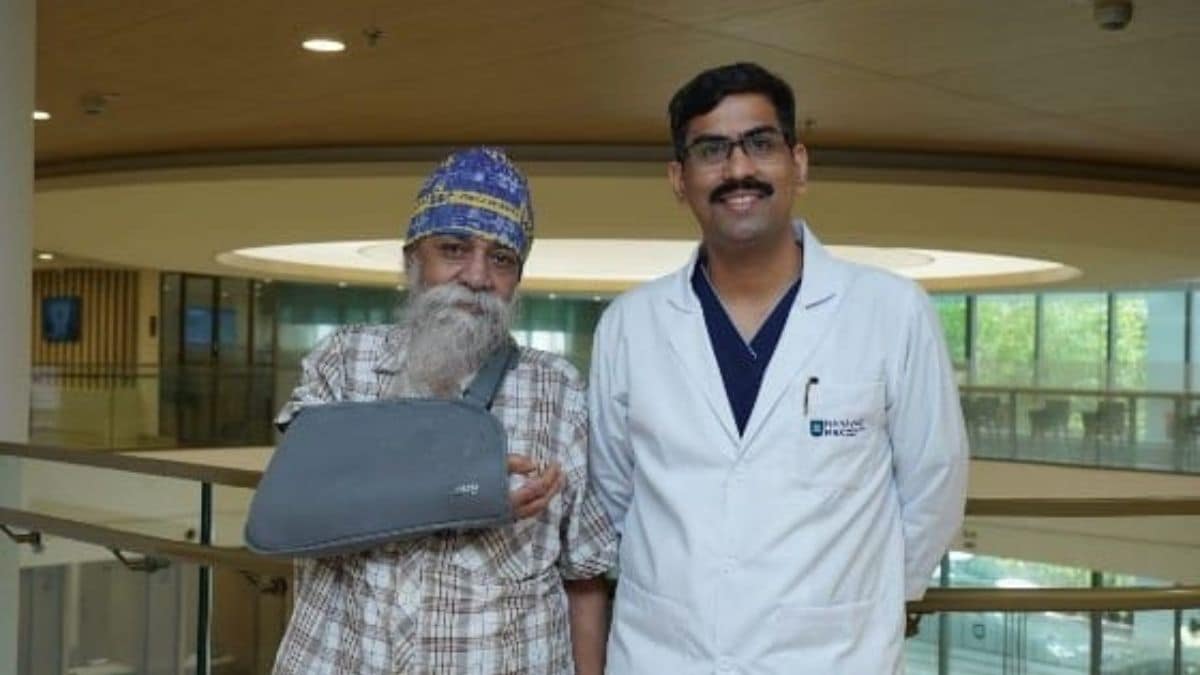
A 69-year-old Mumbai taxi driver who lost his thumb in a freak lift accident has had the digit successfully replanted following an eight-hour microsurgical procedure at Nanavati Max Super Speciality Hospital in Mumbai.
The man, Ahinderpal Singh Alag, from Sion, sustained a severe avulsion injury when his hand became trapped in a lift door as the lift began moving. His thumb was completely severed, with extensive damage involving the skin, muscles, tendons, ligaments and bone, as well as the surrounding soft tissue.
What happened immediately after the accident proved crucial. His family placed the amputated thumb in moist gauze, sealed it inside a plastic bag and cooled it with ice before taking him for medical care. He was subsequently brought to Nanavati Max, where doctors assessed him for possible replantation.
A team led by Dr Bharat Saxena, principal consultant at the hospital’s Centre for Plastic, Aesthetic & Reconstructive Surgery, proceeded with microsurgery to restore blood flow to the amputated thumb.
Unlike a clean amputation, an avulsion injury can cause extensive damage to blood vessels and other structures, making it particularly difficult to reconnect the severed part. In this case, surgeons first stabilised the thumb and then used an operating microscope to repair its artery and veins. Nerves, tendons and muscles were also repaired, followed by reconstruction of the skin and soft-tissue covering.
“The thumb is critical to hand function because it allows us to grip and oppose the other fingers,” Saxena said. “Its loss can significantly affect everyday activities and, for a working individual, could potentially impact his ability to return to his livelihood.”
The thumb remained viable after the operation, with no reported tissue loss or infection. Alag was discharged within a week and has since begun physiotherapy. Doctors have observed early movement in the replanted thumb, although recovery of useful function will depend on the healing of the repaired nerves, tendons and other structures over time.
In cases of traumatic amputation, what happens at the accident site can influence whether replantation is possible or not. The amputated part should not be placed directly on ice or in water, as freezing can damage tissue. Instead, it should be wrapped in clean, moist gauze, placed inside a sealed plastic bag or container, and the container cooled with ice.
The amputated part should accompany the patient to the hospital, while emergency medical care is sought as quickly as possible.
“Correct preservation of an amputated part and timely referral to a centre with microsurgical expertise can significantly influence the possibility of successful replantation,” Saxena said.
Replantation is not suitable for every amputation. Doctors have to consider factors including the type and extent of injury, the condition of the amputated part, the time since amputation and the patient’s overall health. Avulsion injuries, in particular, can be technically challenging because the blood vessels may be stretched, torn or damaged over a larger area, explained doctors.
For a thumb injury, however, preserving the digit can have substantial functional implications as the thumb accounts for a major part of the hand’s ability to grasp, pinch and manipulate objects. For the patient, Alag, whose livelihood depends on using his hands, retaining even partial function can help him immensely.
Alag’s case highlights two time-sensitive aspects of traumatic amputation: one being appropriate preservation of the amputated part and the second being rapid access to a centre equipped to perform microsurgical replantation.
