



There are many pressures that shape the behaviour of youth today, and some of these adversely affect their mental health. These include parental expectations and uncertainty about the future.
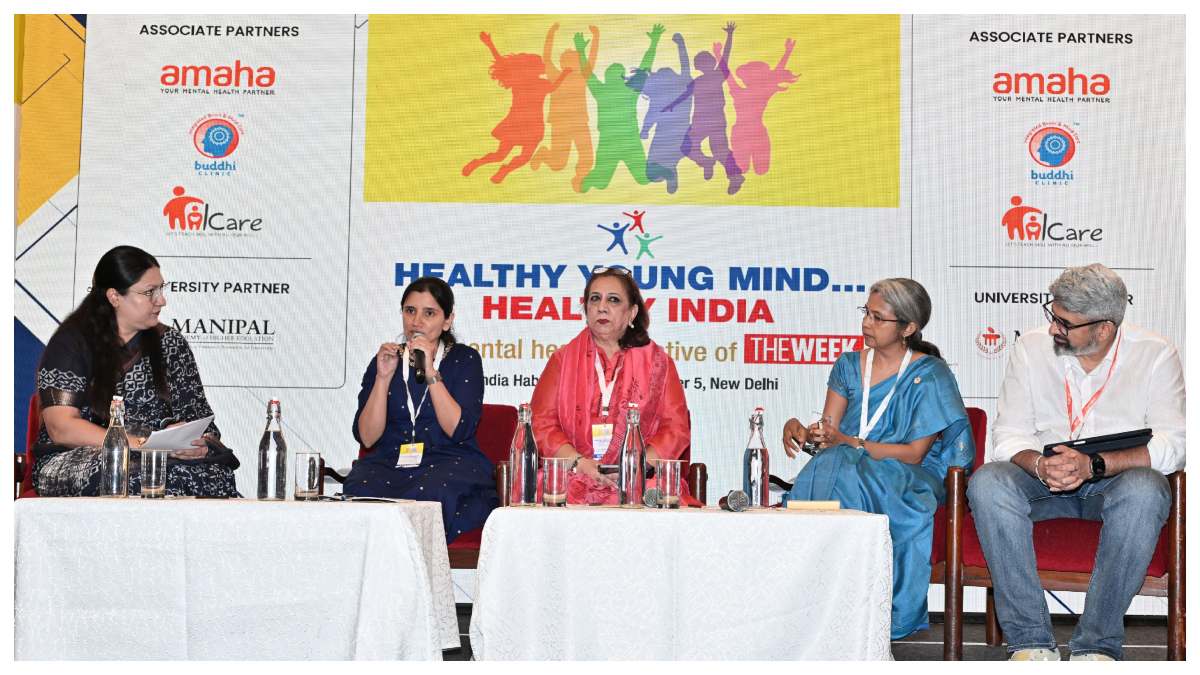
This was the central theme at a panel discussion on ‘Understanding the Stressors and the Solutions’ moderated by Kanu Sarda, senior special correspondent, and organised as part of THE WEEK’s ‘Healthy Young Mind, Healthy India’ summit at India Habitat Centre in New Delhi on Saturday.
Dr Eesha Sharma, associate professor of child and adolescent psychiatry at NIMHANS, said it is important to distinguish between the ordinary challenges of growing up and distress that requires professional intervention.
“The essence of needing clinical help is whether a diagnosis or therapy is needed,” Sharma said. The important question, she added, is whether a young person is experiencing such intense distress or worry that it begins to interfere with their ability to do what they are expected to do. That, she said, is an indicator that professional help should be sought.
Sharma placed the problem in the context of adolescent development. Young people, she said, are going through a period when the brain itself is still “fine-tuning”, even as the world around them begins presenting increasingly complex challenges.
While young people are still learning to understand and interpret the cues around them, technology has multiplied those challenges.
“What has technology done? It has thrown these challenges in an exorbitant amount,” she said, pointing to the way constant connectivity has amplified both the frequency and intensity of pressures faced by young people.
But recognising distress is itself a challenge. Dr Amit Malik, founder and CEO of Amaha, said that before a young person can reach a mental health professional, there are several barriers to overcome, including the ability to identify and name what they are experiencing. “In our culture, the nomenclature for mental stress is not there,” Malik said.
A young person may know that something is wrong without having the vocabulary to explain it. Talking about it with parents can be another hurdle, particularly when families may interpret emotional difficulties as something that needs to be overcome through greater resilience.
There is also the question of access. Even when young people recognise that they need help, financial constraints and the availability of mental health professionals, particularly outside major cities, can determine whether that help is actually received.
For educators, meanwhile, the change in the nature of student stress has become increasingly visible.
Dr Neeta Bali, director of MVM Schools, said the education system had traditionally placed overwhelming emphasis on academic achievement. But parental expectations have also intensified, particularly around getting into the best institutions and colleges.
“I have seen immense change in the education sector,” Bali said.
She said schools were increasingly recognising the need for counsellors and support systems for students who were struggling. The concern is not limited to students who are unable to perform academically, but also those who feel they are failing to meet the expectations placed on them by their parents.
Schools, she suggested, need systems that allow them to identify such students and provide support before their difficulties become more serious.
Prof Gayatri Prabhu of MAHE pointed to another dimension of the problem: accessibility and privacy.
She recalled that in 2017, they had set up an institution as an anonymous and accessible system through which students could seek help. Since then, it has conducted around 35,000 one-to-one sessions.
The growing willingness to talk about mental health, particularly after the Covid-19 pandemic, is encouraging, she said. But she cautioned against assuming that greater conversation has automatically translated into greater access to care.
Young people may know they need help, but questions remain about where they can go, whether they can afford consultation, whether their privacy will be protected and whether they have someone they trust enough to speak to.
Prabhu also questioned the growing emphasis on “resilience” as a universal answer to distress.
“We ask a lot of certainty from young people,” she said, noting that young people are often expected to have a clear map of their lives.
But life, she argued, is made up of “tours and detours”, and each person has to determine what resilience means for them.
The discussion went beyond the question of how to treat mental illness. It raised a larger question about what India expects from its young people—and whether the institutions surrounding them are equipped to support them when they struggle.
The challenge, the panellists suggested, is no longer simply to tell young people to be resilient. It is to create families, schools and systems where asking for help is itself seen as a sign of strength rather than failure.
