



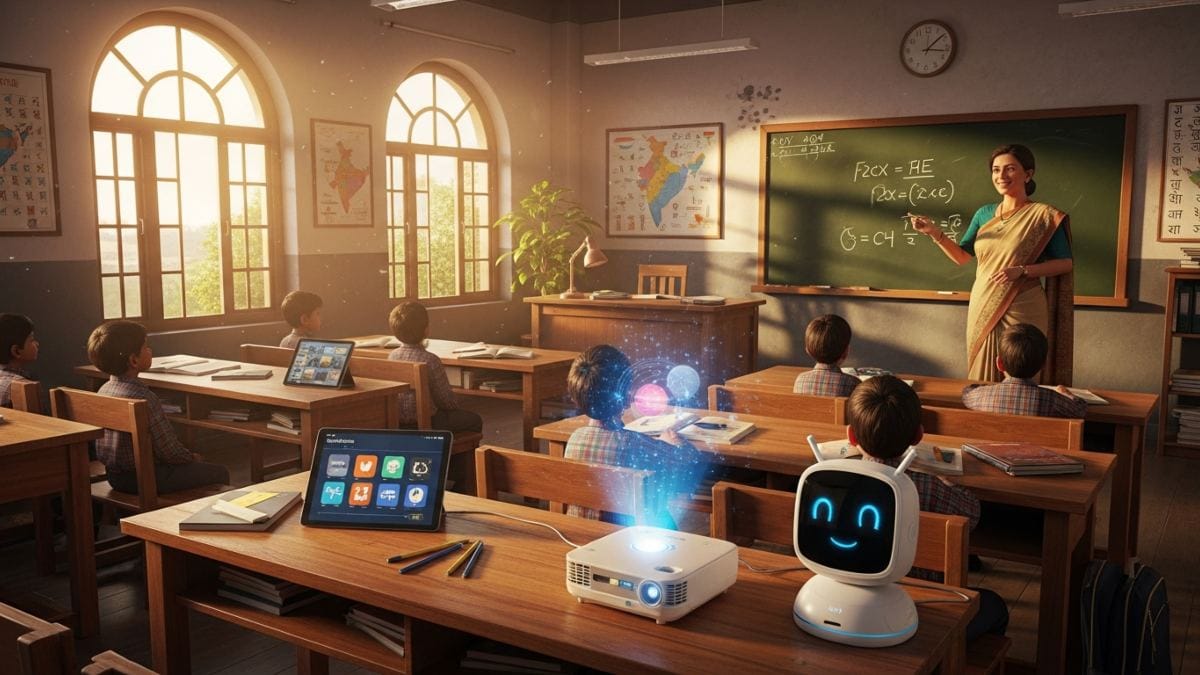
With the introduction of artificial intelligence in classrooms and healthcare, researchers have been exploring whether it helps in identifying ADHD at an earlier stage. But healthcare experts have highlighted that a behavioural diagnosis cannot be limited to just an algorithm.
A child who constantly fidgets in class, finds it hard to complete assignments and is unable to pay attention might be quickly labelled as distracted”, “undisciplined”, or simply “not interested in studies”. But the cause of these behaviours could be attention deficit/hyperactivity disorder (ADHD), which is a neurodevelopmental condition that can hamper learning, relationships and day-to-day functioning.
In India, the early detection of ADHD continues to be a major challenge. A 2022 study found that about 6.32% of children in India have ADHD, although the rate varies across different studies and settings. Another study that involved more than 7,000 school-going students in Kerala found clinically significant self-reported ADHD symptoms in a proportion of students and connected them with poorer academic performance and psychological distress.
The issue is not just about identifying the symptoms. ADHD doesn’t have a single diagnostic test. Conducting proper clinical assessments requires information from different settings and people, including parents, teachers and healthcare professionals, while also understanding the conditions that can produce similar symptoms.
This is where artificial intelligence comes into the picture to attract attention.
From classroom behaviour to brain signals
Researchers have been exploring whether machine learning can be useful for identifying the patterns that are associated with ADHD in data that might be difficult for humans to interpret consistently. One area which has been receiving a lot of attention is electroencephalography (EEG), which records electrical activity in the brain.
A 2025 study analysed the use of conventional machine learning and deep learning for ADHD detection and treatment -response prediction with the use of clinical information and neuroimaging techniques like EEG, MRI and fNIRS. Another study examining EEG and machine learning identified 57 studies that attempted to classify people with and without ADHD using EEG data.
The research has started to emerge from India. A recent study conducted at Navi Mumbai in 2025 highlights the importance of developing a framework that supports earlier identification.
The focal point is quite clear: AI can quickly analyse huge chunks of data and flag children who might need further assessment, potentially enabling early detection. This can be quite vital for India, where access to child psychiatrists, psychologists and developmental specialists remains uneven, particularly outside major cities, making AI-assisted screening an emerging tool for addressing gaps in mental healthcare.
But screening is not diagnosis
The major risk lies in confusing an AI-generated risk score with a medical diagnosis. Inattention can rise from improper sleep, anxiety, depression, learning difficulties, language barriers or other developmental and environmental factors. While children might also behave a lot differently at home and at school. Any assessment therefore needs to consider the child's broader context rather than relying on a single behavioural pattern.
AI systems may also perform differently across populations if they are trained on limited or unrepresentative datasets. The differences in language, schooling, socioeconomic background and culture are likely to increase the risk of false positives and might make screening more accessible while also creating misdiagnosis. An ADHD label can influence how teachers and parents perceive a child, and as the American Academy of Paediatrics notes, inappropriate diagnosis can lead to inappropriate labelling or cause another condition to be overlooked.
The classroom could become an important first filter
Schools do not necessarily need to stay away from AI but should use it as a screening aid rather than a full-fledged diagnostic tool. Teachers are usually the first ones to notice persistent challenges with attention or impulsivity, and digital tools can help in tracking such patterns more systematically before suggesting professional help.
This distinction is extremely crucial with AI becoming a part of Indian education, with CBSE introducing Artificial Intelligence and Computational Thinking as compulsory elements from Classes 3 to 8 from 2026–27. However, the greater use of AI also raises concerns around consent, privacy and the storage of sensitive behavioural data, particularly when the information concerns children.
Human judgement still matters
The most powerful role of AI is neither in replacing clinicians nor in making schools into diagnostic centres. It can function as an early-warning system.
A teacher might be able to notice a pattern, and a digital screening tool might be able to flag it. A healthcare professional could then examine the child's developmental history, behaviour across settings and possible alternative explanations before reaching a conclusion.
The ideal model would use AI for processing patterns and supporting large-scale screening while leaving interpretation, diagnosis and medical responsibility to professionals. The main question is not if AI can diagnose ADHD better than humans, but whether it can help in detecting kids who might otherwise be missed without turning normal variations in childhood behaviour into medical labels. For Indian schools, this distinction could determine whether AI becomes a tool for earlier support or another source of misdiagnosis.
By Dr Ankit Desai, Paediatric Anaesthetist and Founder & Director, Children's Anaesthesia Services.
The opinions expressed in this article are those of the author and do not purport to reflect the opinions or views of THE WEEK.
