



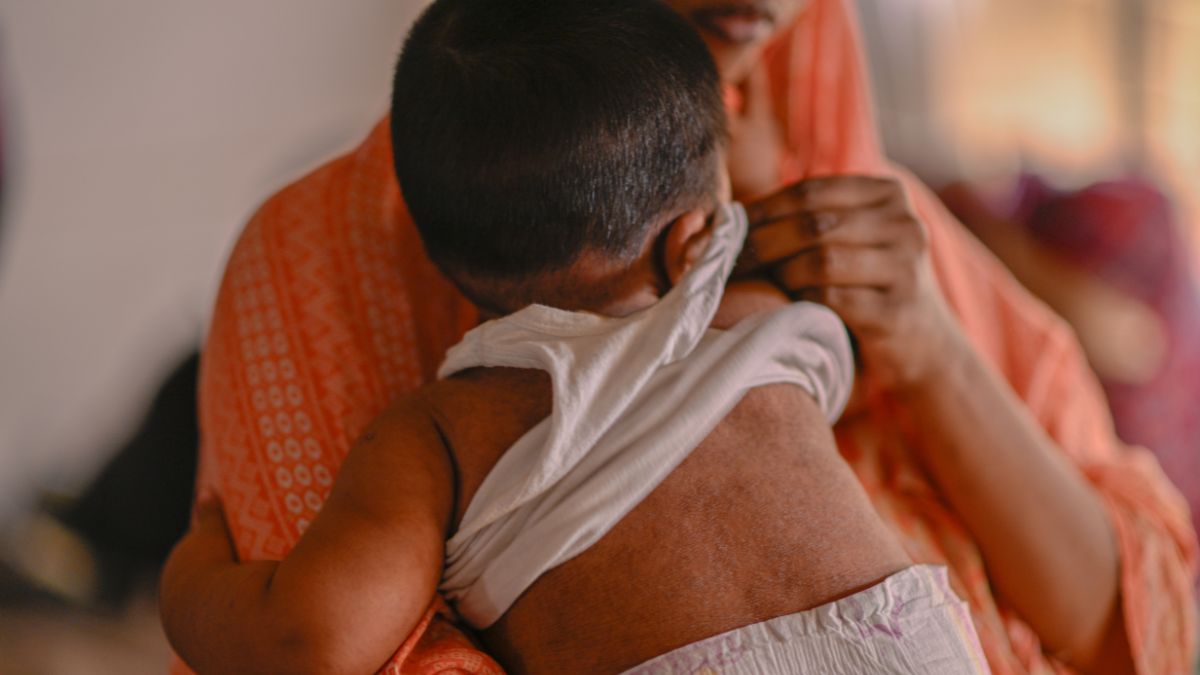
Bangladesh’s measles outbreak, which has been spreading rapidly since March, has left 712 confirmed and suspected deaths by June 30, 2024, overwhelming hospitals with daily admissions of infected children. As the health crisis deepens, it is being compounded by a parallel surge of misinformation, with Rumor Scanner reporting 383 false claims in May alone, including 26 directly linked to measles.
Bangladesh has one of the fastest-growing digital populations, with Facebook serving as the primary news source for millions of users. During major political and public health events, misinformation spreads through screenshots, edited photocards, and reposted satire. This allows false narratives to reach large audiences before corrections can catch up.
When government officials got it wrong
For thousands of families, the outbreak has become a painful public health emergency. But as the disease spread through communities, another thre0at spread alongside and it is misinformation.
False claims, fabricated statements, misleading political narratives, and satire presented as fact have flooded social media feeds and public discourse. In many cases, misinformation came not only from anonymous online sources but also from prominent political figures and government officials. This has all contributed to create a parallel information problem developing at the same time the outbreak was unfolding.
When the health minister’s claim proven false
One of the most widely discussed misinformation incidents occurred on March 29, when Health Minister Sardar Md. Sakhawat Husain told journalists in Dhaka that Bangladesh had administered the measles vaccine eight years ago and that no government had provided the vaccine since then. The statement was quickly challenged by multiple fact-checking organizations (1, 2, 3). Their investigations found that the claim was inaccurate. Bangladesh had conducted a nationwide measles-rubella vaccination campaign in 2020, which continued into 2021. Routine vaccination efforts also continued through the country's public health system during this period.
Prime Minister Tarique Rahman’s statement also contained false information
Less than three weeks later, a similar narrative emerged from an even higher office. Speaking at the Upazila Health and Family Planning Officers Conference on April 18, Prime Minister Tarique Rahman criticized previous administrations and suggested that the country's two preceding governments had failed to vaccinate children against measles.
Prime minister said at one point in his speech, “The failure of the previous immediate two governments to vaccinate children against measles across the country appears to be an unforgivable crime that cost lives.” In other words, he claimed that the previous two governments the interim government led by Dr. Muhammad Yunus and the Awami League government led by Sheikh Hasina had not provided measles vaccinations to children.
Fact-checkers again found the claim to be false(1, 2).
The digital investigative news outlet The Dissent, citing documents from UNICEF and the World Health Organization (WHO), reported that Bangladesh conducted a major measles-rubella mass vaccination campaign between December 2020 and January 2021. During the campaign, approximately 36 million children were vaccinated. Cox’s Bazar was designated a “red zone,” and nearly 800,000 children there were vaccinated separately. The outlet also reported that vaccination records were found in documents from the Dinajpur and Jamalpur Upazila Parishads.
The incidents highlighted a troubling reality: inaccurate information was not only circulating online but was also entering public discourse through official statements.
Misinformation targeting the government
Misinformation during the outbreak did not flow in only one direction.
Government officials became targets of fabricated claims and politically motivated falsehoods that spread widely on social media.
On April 9, a Facebook page affiliated with the banned Awami League claimed that the government had instructed hospitals and clinics across the country not to disclose information about child deaths caused by measles. However, according to a report by the Bangladesh Sangbad Sangstha (BSS), citing BanglaFact, the fact-checking team of the Press Institute of Bangladesh (PIB), no such directive exists. The report stated that the Directorate General of Health Services has been regularly publishing measles-related data at both divisional and national levels.
At the same time, a fabricated statement attributed to the Prime Minister’s Political Adviser (Ministry of Industries) and BNP Senior Joint Secretary General Ruhul Kabir Rizvi also circulated on social media. The false claim alleged that he had said, “When attempts are made to turn a minor issue like measles into an issue, it becomes clear that the government is on the right path.” However, fact-checking reports found that Ruhul Kabir Rizvi had made no such comment. In reality, a post originating from a satire-based Facebook page was later circulated on Facebook as a genuine claim.
Another claim falsely attributed to Education Minister ANM Ehsanul Hoque Milon alleged that he had announced the temporary closure of all schools, colleges, and universities nationwide due to measles. However, Rumor Scanner reported that the education minister had made no such statement.
When satire becomes "news"
Perhaps the most striking trend during the outbreak has been the transformation of satirical content that were shared as real news.
One such post featured a photocard with an image of Nahid Islam, convener of the National Citizens Party (NCP) and Opposition Chief Whip in the National Parliament, falsely attributing this quote to him: “To those making noise over a mere 300-400 measles child deaths, I say — had we not liberated the country on August 5, fascist Hasina would have killed and disappeared a thousand times more people.” A fact-check later confirmed that Nahid Islam never made any such statement. The post originated from a satire page and was passed off as genuine news.
Similarly, another photocard circulated on social media attributed this remark to Dhaka University professor Dr. Chowdhury Sayma Ferdaus: “There's no reason to make such a fuss over me, and there's no need to blow the measles situation out of proportion either. If a child dies from measles, it's not something I can stop.” This too turned out to be a satirical post that was picked up and spread as though it were a real statement.
The issue points to an increasing challenge for digital information systems. Satirical content, which usually depends on audiences understanding humor and exaggeration, can easily turn into misinformation when it is separated from its original context and presented as factual news.
When there's a public health emergency, the effects of misinformation don't stop at just the political debate around it.
Conflicting messages from public health officials can erode trust in government institutions. Misinformation about vaccines can increase vaccine hesitancy and confusion. False claims about the government can create panic, and misleading statements that minimize the seriousness of an outbreak can lead to complacency.
When there is fear and uncertainty around the events, this makes it more difficult for people to differentiate between fact and fiction because of misinformation.
Lessons for Bangladesh and South Asia
The 2026 outbreak of measles provides valuable lessons not only for Bangladesh but for all of South Asia.
Countries are becoming more connected with social media, which suggests that the spread of misinformation will be more common with future health crises. Governments, politicians, traditional and online media and fact-checkers will significantly influence how societies react to future health crises.
This is a clear indication that combating a contagion requires not just medical intervention but also protecting the integrity of public information.
Political leaders must ensure that their statements to the public are accurate; representatives of institutions must communicate clearly and consistently; fact-checkers must respond quickly to new disinformation. And social media users must become more cautious about sharing unverified claims.
The measles outbreak in Bangladesh shows that responding to a public health emergency includes both medical response and information response. While vaccines can protect people from certain illnesses, trusted information is what will protect individuals and communities from confusion and panic. Governments preparing themselves for future outbreaks must also take proper actions to protect the information ecosystem.
This story is done in collaboration with First Check, which is the health journalism vertical of DataLEADS
