



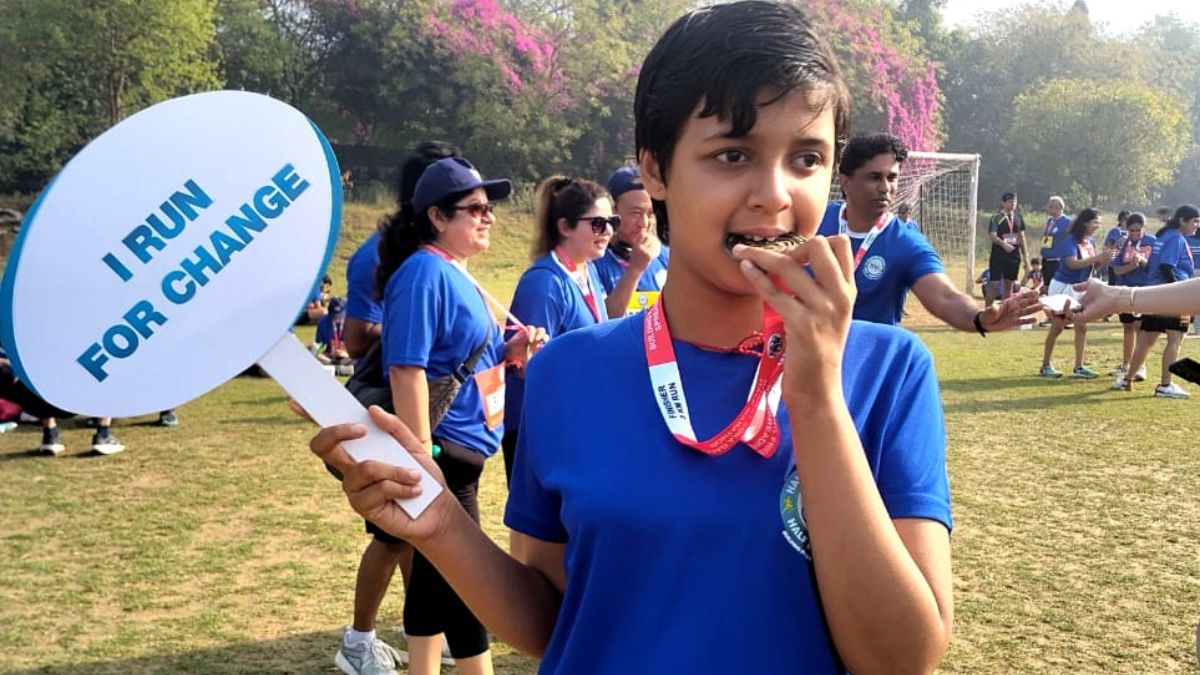
Meehr is 11. She is on the autism spectrum. And she is thriving—in her own quiet, determined way. Diagnosed at 2.8 years, her early childhood was marked by frustration, meltdowns, and an inability to communicate her needs. For her family, especially her mother Sonia, it was a journey of confusion, fear, and relentless hope. What changed her trajectory was not a miracle cure, but something far simpler—structure.
With the support of her educator, Uma, who introduced visual routines, Meehr began to find predictability in her day. That predictability brought calmness, built trust, and slowly unlocked her learning potential. What her family calls “productive predictability” became the foundation of her growth. Productive predictability in autism guides autistic individuals to channelise their energy on their strengths rather than coping with chaos. Structure, routines and environmental consistency are used as tools to bring down anxiety and optimise cognitive function.
Today, Meehr begins her day with a structured physical fitness routine—an anchor that brings focus, stability, and confidence. Her coach, Arun, describes her as “quietly determined”. She takes time, but once she understands, she commits fully. In high-pressure tournament environments, where sensory overload can overwhelm children on the spectrum, she persists—with patience, encouragement, and trust. The results speak for themselves.
An ace skater and a swimming enthusiast, Meehr has already won multiple state-level championships—not just medals, but moments of victory over barriers that once seemed impossible. But this is not just a story of achievement. It is a story of struggle and access because Meehr’s journey remains out of reach for many children with autism in India. Across the country, thousands of children remain undiagnosed or are diagnosed too late, missing the critical window for early intervention. For families with limited means, therapy, special education, and structured support are often unaffordable. Where awareness is missing, stigma fills the gap.
Autism is still widely misunderstood—not as a neurodevelopmental condition, but as a burden or even a punishment that this child is a burden. We must have committed some sins to deserve this! Such beliefs isolate families and harm children. In extreme cases, they lead to neglect and abuse. There are accounts of children being restrained in classrooms because they are considered “too difficult” or shut away at home. These are not isolated incidents—they reflect a systemic lack of awareness, training and support.
At the same time, autism is rising—and India is not well prepared to face the challenge as it's been spreading slowly and still lacks awareness. Globally, about 1 in 36 children is on the autism spectrum. In India, millions may be living with autism, many undiagnosed—especially girls, who are often overlooked. Due to a lack of awareness, those on the spectrum practice what is called autistic masking or autistic camouflaging. It involves consciously hiding natural autistic traits to avoid bullying, stigma and social exclusion. This is not a marginal issue. It is a public health and education priority as it requires nationwide campaigning by the government and the private sector to create awareness, like what is planned for visual impairment, deaf and mute and many other categories of differently abled.
Despite some basic interventions by the government, our systems—schools, healthcare, community spaces—continue to treat these children as exceptions rather than as part of the mainstream. That is where the role of counselling comes in, because people just do not recognise their presence or treat them with a sense of disarray.
Meehr’s story compels us to ask: What happens to children who never receive early support? What happens to those excluded from schools? And what happens when parents are no longer around? The answers depend on what we choose to do now. Because the difference between struggle and possibility is not the diagnosis—it is the ecosystem around the child.
When we provide structure, children find stability. When we invest in early intervention, they learn. When we train educators, classrooms become inclusive. When we create safe spaces in sports and communities, children participate and excel.
Meehr’s journey is not extraordinary because she is exceptional. It is extraordinary because she was given a fair chance by a family who refused to give up, an educator who adapted, and a coach who believed. Today, she is more aware and connected. And sometimes, progress reveals itself in the simplest ways:
“Mumma loves Meehr… and Meehr loves Daadi.”
A sentence built over years of effort, patience, and love. As we observe Autism Awareness Month, India must move beyond awareness to action. We need acceptance in classrooms, affordability in therapy, accountability in systems, and dignity in every interaction. Inclusion is not charity; it is a right. When we open doors—in schools, in communities, in policy—we do not just change one child’s life, we reshape the future of our society. Children like Meehr are not asking to fit into the world. They are showing us how to build a better one.
Jeevesh Gupta is the founder of 'Campaign For Differently Abled' ( www.colorsofdarkness.com ).
The opinions expressed in this article are those of the author and do not purport to reflect the opinions or views of THE WEEK.
