



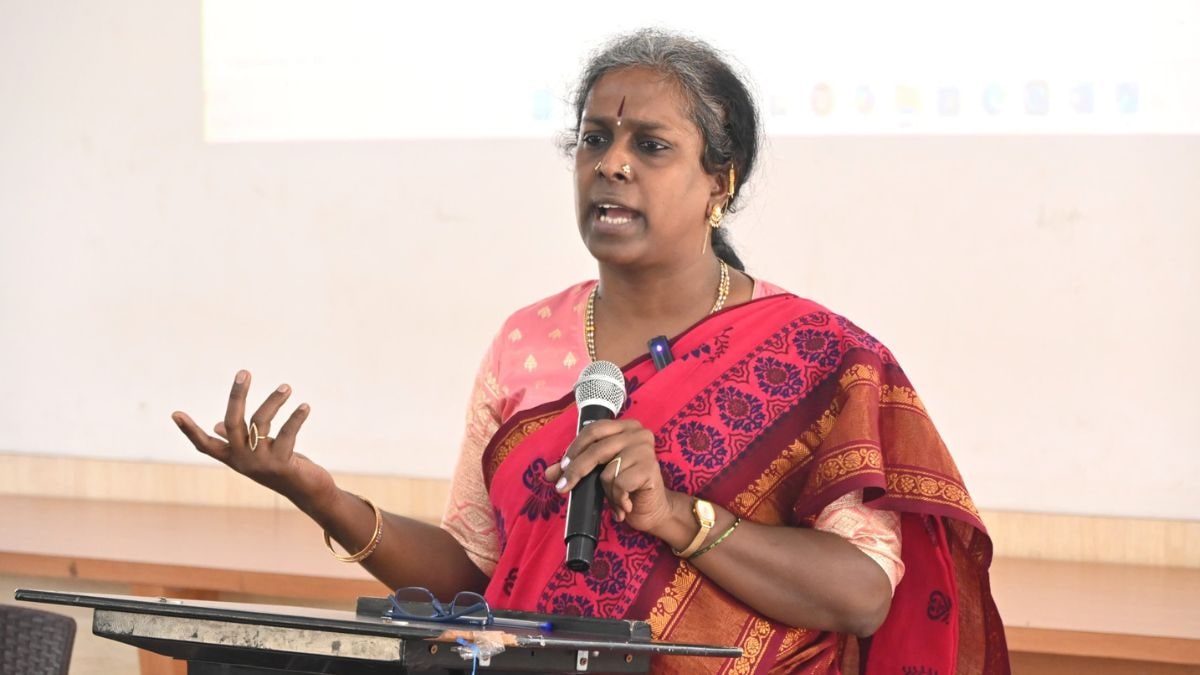
“I am fine. You are not fine.”
With this stark line, activist Akkai Padmashali turned the lens back on society, on families, institutions and systems that refuse to accept transgender identities during her address on sexuality and social exclusion at the 'Mpowering Minds: Women's Mental Health Summit at Bengaluru by Mpower'.
Beginning her talk by addressing the unspoken issues of sexuality, Akkai located her journey within a deeply restrictive social framework. “Your social construct, your economic construct, your tradition, your culture, everything is bound for you to accept and behave the way they want,” she said.
Born male into what she described as a “ministerial family,” she grew up feeling effeminate in an environment that valued social prestige over personal truth. “My father was concerned about his dignity and position,” she recalled. “When I was born male, I was feeling effeminate. My family did not accept.”
Akkai’s early ambition was to become a Supreme Court advocate. Instead, rejection pushed her to the margins.
“I was introduced to the profession of sex work and begging. Being on the streets as a sex worker and beggar is not easy,” she said, bluntly describing the economic vulnerability faced by many transgender persons.
For years, she tried to conform. “You are born a male, you have to behave like a man, walk like a man, speak like a man, act like a man. I did so. One month, one year, five years, ten years. Continuing the same for the rest of my life was so difficult.”
The psychological conflict between assigned sex and lived identity became unbearable. Akkai revealed that she attempted suicide twice. “When I put my head in the rope, in a fraction of a second, I crushed the rope,” she said. “I am fine. You are not fine — my family, my system, my teachers, the so-called society. Everybody is so judgmental.”
“I am not just sharing Akkai’s story,” she asserted. “Akkai is a movement across the country.”
Referring to the 2014 Supreme Court NALSA judgment, which legally recognised transgender persons as equal citizens, she reminded the audience that rights were not granted out of benevolence but through sustained agitation. “Because of our constant fight against social exclusion, the Supreme Court recognised transgender persons as equal citizens before the Constitution of India.”
Yet legal recognition has not translated into social acceptance. Akkai pointed out that a significant portion of the transgender population continues to survive on the streets.
She also spoke about her role as a petitioner in the 2018 challenge to Section 377. “How can a system of justice be so reluctant to accept one identity?” she asked, recalling Justice Indu Malhotra’s historic apology to the LGBTQIA+ community.
Before the verdict, she said, any sex outside procreation was considered “against the order of nature,” effectively criminalising millions. “I am not a criminal. I am a dignified woman,” she declared to applause.
Perhaps the most forceful part of her speech was her challenge to biological essentialism.
“You may say, you don’t have a vagina, you don’t have breasts… But I challenge the notion of a woman. A woman is not about four boxes. A woman is beyond everything.”
For Akkai, gender is not confined to anatomy. It is lived experience, identity and autonomy.
She framed rights in unequivocal terms: “Right to marriage is my haqq. Right to adoption is my haqq. Right to inheritance is my haqq. Right to mobility is my haqq. Right to divorce is also my haqq.”
Her own life reflects that assertion. Akkai married, later sought divorce citing violence, and today identifies first and foremost as a mother to her adopted child, Avin.
“People ask me, ' What is your child’s sex and gender? As a mother, I don’t want to decide. Let my child decide. I will accept whatever my child says.”
In that statement, she reversed the very imposition she endured — refusing to assign rigid gender expectations to the next generation.
Akkai also spoke about her organisation, which brings together movements across child rights, women’s rights, caste and class struggles, and sexual minorities.
“We want to build a movement to stand in support of the most marginalised sections of society,” she said.
While welcoming the Karnataka government’s decision to include transgender persons under five welfare schemes after sustained demands, she made it clear that inclusion cannot stop at policy announcements. “Does five schemes justify everything? No. We want to enjoy the liberty and dignity of constitutional morality as a community.”
She ended with a direct appeal to institutions, urging them to extend support beyond English-speaking, urban queer circles to “working-class, non-English speaking, poorest of the poor sexual minorities” who remain invisible.
“I should not be judged. And you don’t have the right to judge my identity,” she concluded.
