



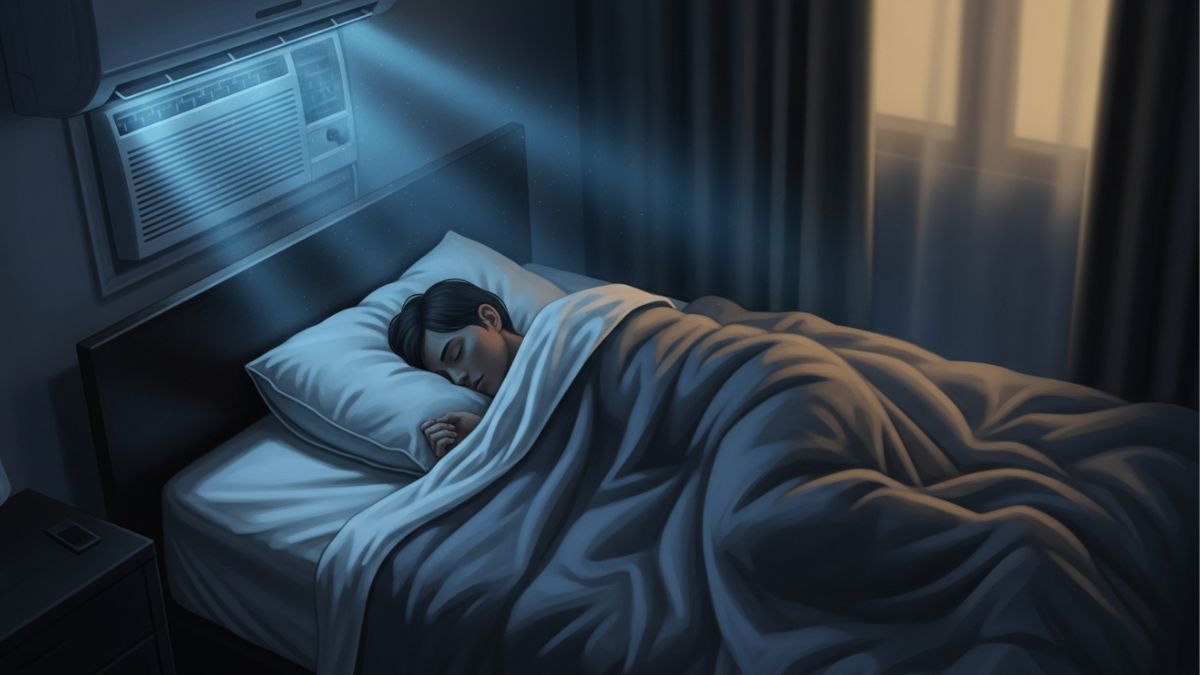
CLAIM:
Sleeping in a cold AC can slow down the liver’s detox and repair processes at night, affecting recovery and overall health.
FACT:
False. There is currently no human scientific evidence proving that sleeping in a cold, air-conditioned room disrupts liver detoxification or recovery. Research linking cold exposure to liver stress is largely based on limited animal experiments. Experts emphasise that sleep quality and overall lifestyle have a far greater impact on liver health than room temperature.
In a viral Instagram reel posted by fitness coach and influencer Priyank Mehta, who has around 1 million followers, the question of whether sleeping in a cold AC affects the liver’s detox process is discussed. The reel, which has garnered over 3.25 lakh views, 3,307 likes, and 5,502 shares, unfolds as a dialogue between Mehta and a woman.
In the reel, the woman notices the chilly air and asks, “Babe, why is the AC so cold?” Priyank smiles and explains that he just wants to cuddle and sleep. She then raises a health concern, “If you sleep in this cold, how will you detoxify your liver?” Priyank laughs it off, thinking it’s nonsense, and asks her what exactly the problem is with cold.
The woman clarifies, “At night, the liver goes through a repair and detox phase. The body's ideal internal temperature is 36–37 degrees, and liver enzymes work best when the body is calm and warm.”
Priyank points out that the AC only cools the room, not the body’s core temperature. She nods, “Exactly. When the room temperature drops below 18–19 degrees, the body's first focus is to save heat.” Priyank, still curious, asks what she means. She explains that blood flow moves away from the liver and digestion to maintain core temperature, which slows down the liver’s detox process. Priyank remarks that this must be why people feel a little dull in the morning. The woman agrees, “You sleep well, but the recovery is compromised.”
When Priyank asks if he should turn off the AC, she shakes her head and says, “No, no. For the solution, read the caption.”
The caption accompanying the reel explains that using an AC itself is not harmful, but sleeping in extreme cold can affect the body’s recovery processes. It begins with, “AC is not the problem. Extreme cold is.” The caption goes on to explain that at night, the body’s main work is repair and recovery, and the liver plays a key role in this process.
It adds that when the room temperature drops too low, around 18–19°C, the body goes into survival mode. “Its focus shifts to preserving heat and maintaining core temperature. Blood flow may slightly divert from the liver and digestion. The result: Sleep feels complete, but you wake up feeling dull, heavy, and sluggish,” the caption notes.
The caption also stresses that this doesn’t mean you should turn off the AC. “Balance is key. Keep AC at 22–24°C, avoid direct airflow on the body, use a light blanket, and avoid very late or heavy dinners,” the caption advises. It concludes with an important note: “The liver doesn’t need ‘detox hacks’. It needs stable temperature and stress-free sleep. Cold for comfort is fine, but extremes are harmful for recovery; balance is necessary.”
What does scientific research say?
At present, there is no direct human clinical evidence showing that sleeping in a cold room or using air conditioning at night impairs liver “detoxification” or overnight repair. Most of the scientific data examining the effects of cold exposure on liver function comes from animal studies conducted under controlled laboratory conditions, often involving prolonged or extreme cold stress that does not reflect typical bedroom or AC environments.
A 2022 animal study examined how chronic cold exposure affects liver health by exposing mice to prolonged low-temperature conditions. The researchers noted that when the body is exposed to cold, it must generate extra heat to maintain basic life functions, and the liver plays a central role in this process because it is the body’s largest glycogen storage organ and a major source of heat production at rest.
The study reported that cold stress triggered visible pathological changes in liver tissue. According to the authors, “inflammatory cell infiltration and other pathological changes in liver cells and the activity of liver enzyme evidently increased in the serum and liver of cold-exposed mice, suggesting cold stress may result in liver injury.” They also observed higher levels of cellular stress markers, including heat shock proteins, which confirmed that the animals were under physiological cold stress.
Further analysis showed that cold exposure activated multiple cell damage pathways. The researchers found increased expression of proteins involved in apoptosis, oxidative stress and pyroptosis, a form of inflammatory cell death. As the study notes, cold exposure “activated apoptosis, oxidative stress and pyroptosis, and released inflammation cytokines,” indicating that prolonged cold stress placed significant strain on liver cells in the experimental animals.
Building on this evidence, a 2023 study investigated whether acute extreme cold exposure could also damage the liver and explored the underlying biological mechanism. In this experiment, rats were exposed to –10°C temperatures for eight hours, simulating severe cold stress conditions. The researchers measured liver enzymes commonly used as indicators of liver injury, including ALT and AST, along with tissue damage and cellular changes.
The findings showed that extreme cold exposure led to clear signs of liver injury. The study reports that “cold stress caused liver damage partially by inducing ferroptosis through the p38 MAPK/Drp1 pathway,” a process linked to iron-dependent cell death and mitochondrial dysfunction. Importantly, when the animals were given ferroptosis inhibitors, liver damage markers were significantly reduced, further confirming the role of this pathway in cold-related liver injury.
The researchers also highlighted the broader physiological context. They explained that the liver contributes nearly 25 percent of total heat production under basal metabolic conditions and plays a crucial role in supplying metabolic fuel during cold exposure. “The liver provides metabolic fuel to thermogenic tissues by activating gluconeogenesis, ketogenesis and lipid metabolism during cold exposure,” the authors noted, underlining how heavily the organ is involved in maintaining body temperature under stress.
At the same time, the study emphasized that extreme cold exposure is not limited to surface-level effects such as frostbite. According to the researchers, “acute extreme cold exposure can not only cause frostbite of body surface tissues, but also lead to cardiovascular diseases, digestive system organ diseases and metabolic dysfunction,” reinforcing that cold stress affects multiple internal systems.
It is important to note that this was also an animal study.
What experts say
Dr Chetan Kalal, Associate Director, Department of Hepatology, Gleneagles Hospital, Mumbai, and Maharashtra’s first DM Hepatologist, explained that the liver’s metabolic and repair processes follow the body’s circadian rhythm, or biological clock. This means that sleep timing and sleep quality play an important role in maintaining optimal liver function.
“Disrupted sleep can impair liver metabolism and lead to metabolic dysregulation. However, there is no scientific evidence to suggest that ambient temperature, including sleeping in an air-conditioned room, directly affects liver detoxification or regeneration,” he said.
According to Dr Kalal, no human study to date has demonstrated that low room temperature or AC exposure slows liver repair or detox processes. “To the best of my knowledge, there is not a single human study showing that cold temperatures or AC air can impair liver regeneration or detoxification,” he added.
He further clarified that the liver is a self-sustaining detox organ that works continuously. “The liver functions like a factory that operates tirelessly. Detoxification is its primary job, it filters, stores, and metabolises substances around the clock. The idea that cold air can ‘stop’ liver detox is scientifically incorrect,” Dr Kalal noted.
Addressing ways to support liver health, he emphasised that external products or hacks are not required. Instead, lifestyle choices play a critical role. “If you really want to help your liver, don’t overload it with excess carbohydrates, sugary drinks, alcohol, unnecessary over-the-counter medications, or chemical toxins. Regular physical activity, stress management, and adequate sleep, at least seven to eight hours, are far more important,” he said.
Dr Kalal also stressed that a healthy lifestyle naturally supports the liver’s detoxification function. “You don’t need to give the liver anything extra. Just don’t overburden it. If you maintain healthy habits, the liver will do its job efficiently on its own.”
Agreeing with this view, Dr Amit Gupta, Senior Neonatologist and Paediatrician at Motherhood Hospitals, Noida, also dismissed the claim, stating that there is no scientific evidence linking cold AC exposure to impaired liver detoxification. “Liver detoxification is a continuous biological process. It does not stop or slow down just because the room temperature is changed,” he said.
He further explained that most studies often cited in such claims are not based on humans. “Many of these temperature-related liver studies are conducted on animals, especially reptiles or under extreme laboratory conditions. There is no solid human evidence showing that normal AC use pushes the body into ‘survival mode’ or diverts energy away from recovery,” Dr Gupta added.
Addressing concerns about reduced blood flow, he clarified that cold room temperatures do not meaningfully affect liver circulation. “Cold exposure may affect the skin or cause surface discomfort, but there is no proof that it significantly reduces blood flow to internal organs like the liver,” he said.
However, Dr Gupta noted that excessively cold environments can disturb sleep quality, which may explain morning fatigue. “Very low temperatures can disrupt sleep, and that can make people feel sluggish the next day. But this is related to sleep disturbance, not liver detoxification,” he emphasised.
This story is done in collaboration with First Check, which is the health journalism vertical of DataLEADS.
