



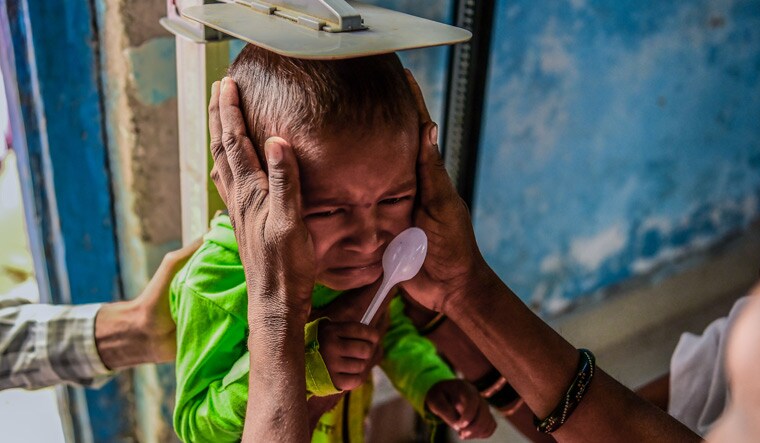
India is home to approximately 18.3 million wasted children which represents 37 per cent of the global burden of wasting. Evidence also shows that around 20 per cent of all deaths of children aged under five years in India were due to wasting.
Since 1975, the Union Government has taken numerous initiatives, with the most recent one being the POSHAN (Prime Minister’s Overarching Scheme for Holistic Nutrition) Abhiyaan to combat malnutrition. However, despite these targeted efforts, the country has made checkered progress. According to the National Family Health Survey (NFHS)-5 conducted by the Ministry of Health and Family Welfare, malnourishment in children (stunting, wasting and underweight) under 5 years has reduced from 38.4 per cent to 35.5 per cent, 21 per cent to 19.3 per cent and 35.8 per cent to 32.1 per cent respectively as compared to NHFS-4 (2015-16). While there has been marginal progress, it falls short as per government-set target per which POSHAN Abhiyan was to achieve reduction in stunting from 38.4 per cent (NFHS-4) to 25 per cent by 2022.
Malnutrition in children is caused by a complex interplay of multitude of factors. The primary reasons being lack of adequate nutrition available for the mothers during pregnancy, delayed initiation of breastfeeding, restricted access to diverse and nutrient-rich food due to social or economic factors, lack of age-appropriate complementary feeding of infants and children, and caregiving practices. Other factors may include low economic condition of parents, lack of awareness and limited access to healthcare.
Severe malnutrition is a condition that results from inadequate quality or quantity of food, mostly in combination with infectious diseases caused due to poor sanitation and hygiene practices that engulfs children in a vicious cycle of malnutrition. One of the fallouts of the Covid-19 containment measures is the potential worsening of an already “severe" malnutrition problem in India. With the closure of primary school and AWCs due to pandemic lockdowns, children in rural areas had to do without that one guaranteed school meal. Besides, the disruption in supply of essential services such as Take-Home-Ration which aims to reduce micronutrient deficiency in children in the age group of 6-36 months, has negatively impacted the nutritional intake, thereby contributing to food shocks which is expected to push more children into acute malnutrition. The less than satisfactory nutritional outcomes in most of the states surveyed, is a cause for concern and requires a change in approach to fix country’s structural fault lines, therefore mitigating the impact of Covid-19 or any such calamities in the future.
One such globally recognised approach that has the potential to turn the tide and overcome the lacunas brought to the fore by Covid-19, is the ‘Community Management of Acute Malnutrition (CMAM)’. Currently, in India, all SAM children, with or without medical complications, are treated at Nutrition Rehabilitation Centres (NRCs) or Malnutrition Treatment Centres (MTCs) operational at the district level and there exist no national level CMAM guidelines. However, according to the World Health Organization (WHO), around 70-80 per cent of SAM children do not face any medical complication and can be treated at home or community level with focused care and attention. As a matter of fact, if acute malnutrition is identified in the early stages, the treatment can be provided at the community level itself and medical complications in the children with SAM can be averted. Apart from this, CMAM also provides higher coverage through a regular community-based screening process and complete treatment by enabling the child to be fully cured. It also has many advantages over the facility-based treatment as community-based care has better cultural acceptance among rural populations, there are lower chances of hospital-acquired infections and lower relapse rates.
In the current pandemic scenario, when mobility has been restricted and access to healthcare has been distorted, CMAM as a transformational approach, would not only help in reaching out to children living in more remote and hard-to-reach areas, but would also lead to early identification and treatment of SAM children without complications while also accommodating complicated malnourished children, thereby reducing the burden on hospitals.
The announcement of POSHAN 2.0 in this year’s budget speech shows that nutrition remains a priority where the national leadership is invested. However, the absence of any CMAM guidelines and undue focus on facility-based treatment, the battle against malnutrition will be long drawn resulting in intergenerational malnutrition. Only if we can address child malnutrition today, can we expect the country to perform better in nutritional indictors in the future.
Madan Gopal is senior consultant-health, NITI Aayog
The opinions expressed in this article are those of the author’s and do not purport to reflect the opinions or views of THE WEEK.
