


One in 10 Indians will develop cancer in their lifetime— newspapers reported recently based on the WHO report on World Cancer Day (Feb 4). These are alarming numbers considering the challenge it imposes on health care in relatively resource-limited settings. The realisation though is not new. Most of us would relate to this through personal experiences or that of someone we know.
The challenge is stiff but presents an opportunity for specialists across domains—scientists, doctors, caregivers, data-technologists—to address this together in ways tailored for India. The good news is this is happening. Here is a glimpse of the 'why-what-and-how' of this and the hope that it inspires.
Affordable and Accessible: The A2 Challenge
For perspective, in 2016 there were more than 5 lakh breast cancer patients in India; a 39% increase between 1990 and 2016 (Dhillon et al., The Lancet Oncology). The cost of treatment remains substantial running to several lakhs in almost all cancers. In most cases, if detected early, costs decrease and chances of treatment improve. Early detection, therefore, is a key factor.
Detection costs for a typical biopsy range from 010,000 to 030,000 or more. Analysis of the specimen requires adequately trained pathologists. Thus, apart from the cost, requirement of trained specialists in semi-urban and/ or rural areas remains a challenge. In addition, the invasive nature of a biopsy is a deterrent for the patient.
Any solution with reasonable impact, therefore, needs to be affordable and the technology should be accessible to patients with relative ease.
Intense research to achieve these is providing solutions that might be a game-changer. Imagine a blood test, like for sugar in diabetes, that detects and diagnoses cancer. A breakthrough in 2016—when a blood-based test for detecting lung cancer was approved by the FDA—ushered this realisation into clinics worldwide. This test is aptly known as liquid biopsy or a biopsy from blood without surgery.
Liquid Biopsy: Cancer Biopsy without Surgery
Cancerous tissue release fragments of DNA into the bloodstream known as circulating tumour DNA (ctDNA). These ctDNA carry molecular prints of the cancer, which when detected, can reveal how 'good or bad' a cancer is considering available treatments. This is liquid biopsy.
Further, a detected signal from ctDNA can be followed with periodic blood tests to indicate whether a patient is responding to treatment or not.
The promise of liquid biopsy for cancer diagnostics, therefore, is noteworthy and is expected to open markets in unprecedented ways. But important challenges remain in fine-tuning the test to prevent false positives—when someone without cancer is detected to be so, causing much distress. Therefore, though clinical trials are on and several products are available for laboratory use, more than three years after the first liquid biopsy test further FDA approvals are awaited.
Many root issues contributing to correct detection—or the lack thereof —comes from the complexity of the disease. So, oncologists now prefer to look for ‘club(s)’ of signals, or multiple genetic disruptions within ctDNA. When combined, these make improved indicators of the disease, instead of a single point alteration that was used for the approved lung cancer test in 2016.
Moreover, other blood-based indicators in addition to genetic disruptions in ctDNA that can further improve sensitivity are increasingly being sought.
Use of multiple blood-based indicators is the approach that we plan to leverage. However, first, each indicator must be teased out and validated. Secondly, indicators can be specific to groups of individuals or populations. This led to the realisation that diagnostic tests need to be optimised for patients from respective populations—resulting in programmes like the million genomes project 'All of US' by NIH, United States, and 100000 genomes project by Genomics England, United Kingdom.
Intrinsic Complexity of Cancer: The Master Deceiver
Cancers constitute cells that have acquired super cell-like abilities to live longer and rapidly multiply. The healthy norm needs cells to perish after a defined time. And intricate checks are programmed into cells to ensure this. Yet, by chance or design—on which the jury is still out—cells sometimes breach the norm. And, intriguingly, use hundreds of different ways—while many are known, new ones are being detected with increasing frequency. Once a breach is identified, it can lead to a diagnosis and subsequent treatment.
There is another layer of intrigue though. A commonly asked question might help see this. Smoking is linked to lung cancer but all smokers are not affected. That is, the motley of issues involved does not affect everyone equally! Sometimes this is evident in whole populations where molecular paths are fortified or alternative checks triggered to annul a potential damage. Therefore, more granularity is necessary in making sense of variable factors that protect, impart vulnerability or are merely bystander abnormalities.
Need for more Granularity: Knowing the Normal to Find the Abnormal
The variability in genetic factors is deciphered from reading and comparing the whole book of three billion-odd alphabets constituting our DNA. The reading or genome sequencing— enabled by the rapid development of technologies that become more affordable with time—finds missing or an altered letter or sequence of letters. Such aberration(s) can then be linked to disease.
In parallel, one needs to know the normal book of DNA for a particular population or ethnicity, so that defects are not misjudged. This is particularly important for India and other countries, where different populations coexist. Efforts like the one in the US and the UK mentioned above and IndiGen in India are addressing this at an unprecedented scale.
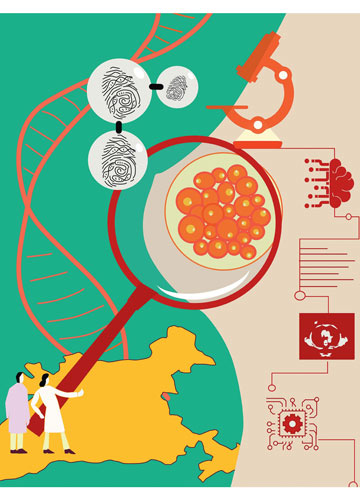 Image credit: LipsaPanda, CSIR-IGIB
The Drawing Board: Teasing out a Collaborative Plan
Meanwhile, at the CSIR-Institute of Genomics and Integrative Biology (IGIB) in Delhi, and the CSIR-Centre for Cellular and Molecular Biology in Hyderabad, research laboratories of the Council of Scientific and Industrial Research (CSIR), together with the Advanced Centre for Treatment, Research and Education in Cancer (ACTREC) in Mumbai and the Indian Council of Medical Research (ICMR) and other institutions across the country, we draw the contours of a plan— a design with all the above in mind.
The plan is to tease out a signature - a molecular fingerprint—that is associated with disease and the outcome of treatment. And then, track the molecular fingerprint from a blood-based test.
For now, the focus is on breast cancer—one of the most prevalent cancers in India. The first layer involves data from patients: tissue after surgery and a few ml of blood from patients would be analysed for genetic defects using genome sequencing, ctDNA, metabolic and immunological markers, to design a molecular fingerprint of the disease for each patient.
The second layer comes from followup during treatment—by tracking the molecular fingerprint from blood in combination with clinical update on how someone is responding to treatment.
Then, as part of a third layer, the molecular fingerprints remain to be tied to the disease severity and response to treatment. One needs to consider the millions of data points collected, similar or different treatments administered, and shades of response recorded, followed by analysing the molecular fingerprint tracked during treatment. And, finally, associate this to respective clinical outcomes with fine-combing algorithms that assign data patterns to respective outcomes. This is the setting that specialists in computational biology and artificial intelligence plan to leverage.
Integrative Biology at CSIR-IGIB
Tuning new understanding in biological function to population genomics, and integrating this with the rapidly upgrading landscape of computational techniques, has been a long-standing pursuit for IGIB. From generating the first populationlevel genomic data in India (IGVdb) followed by the first human genome sequence in 2009, to more recently genome sequencing of 1,008 Indians (IndiGen), IGIB has relentlessly built expertise and infrastructure in genomics and computational biology. A network of hospitals across the country is intricately connected to research at IGIB. For the current plans, both of these—clinical collaborations as well as hands-on knowledge of genome sequencing—are going to be key factors.
Affordable and Accessible: Back to the Questions
The relative ease of a blood-based test compared to obtaining tissue for biopsy makes liquid biopsy attractive. Though specific prices can vary based on the test, in general it is expected to be a fraction of the regular biopsy costs. As reliability increases, and in turn number of tests being prescribed increase, cost of a liquid biopsy might be within a few thousand rupees or lower, making it affordable. Second, and equally important, is access in an economically challenged setting. A widening network of pathology laboratories, including athome blood collection, might provide that extra-push necessary to take the test to people.
Among many factors that impact access, a primary issue is data privacy. The challenge would be to weave in tightly controlled modes that secure privacy, and at the same time clinicians, patients, and other stakeholders have access to data. Furthermore, generated data must be compared with other large-scale datasets from thousands of patients across the world as part of initiatives like TCGA, CRUK and likewise. We envisage active exchange with experts in data security, management and analysis as key components in enabling a deployment process for broad access.
Shantanu Chowdhury is a senior fellow, Wellcome Trust/DBT India Alliance Professor, Academy of Scientific and Innovative Research CSIR-Institute of Genomics and Integrative Biology, New Delhi
