



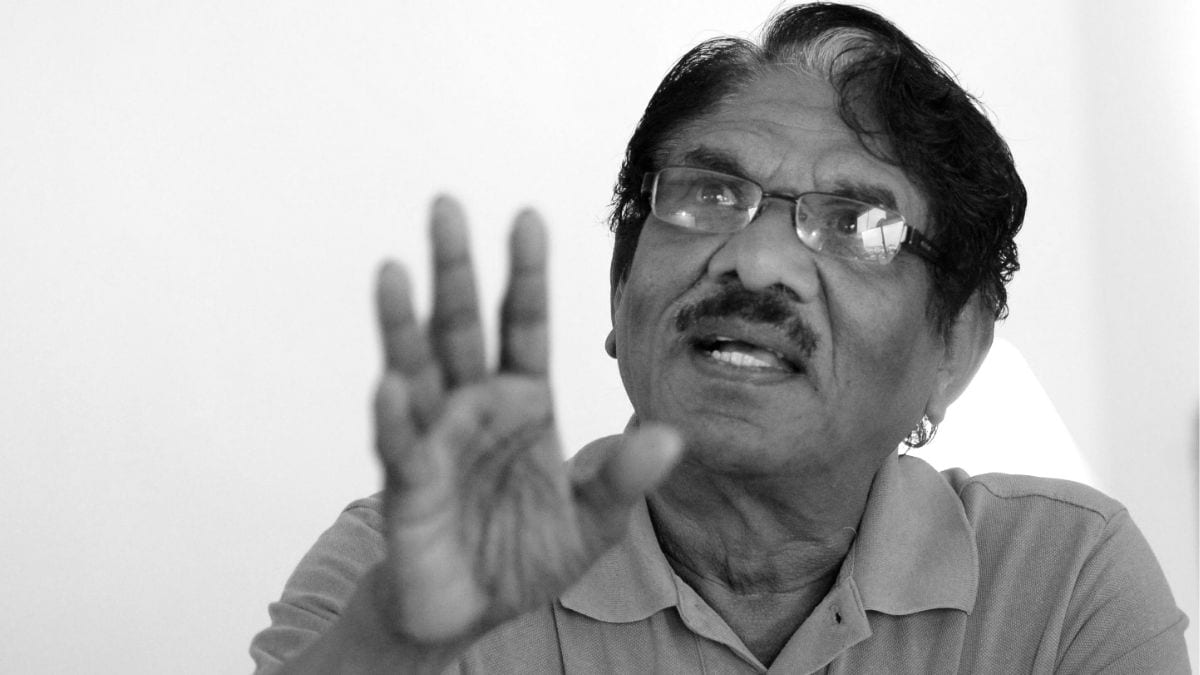
On June 10, 2026, the curtain fell on one of the most transformative eras in Tamil cinema with the passing of Bharathiraja in Chennai at the age of 84. Popularly known as Iyakkunar Imayam (the pinnacle among directors), his departure signals more than the loss of a filmmaker— making the end of a common-man movement that reclaimed the cinematic medium for the Tamil people. His distinctive greeting, “En Iniya Thamizh Makkale" (my sweet Tamil people), delivered in a booming, baritone voice, was far more than a stylistic flourish. It represented a fundamental shift in the industry's power dynamics.
Tamil cinema was gasping for air. For decades, the industry had been held captive within the "suffocating" confines of paint-smelling indoor sets, where storytelling was bound by the rigid artifice of studio walls. The medium was desperate for a powerful shot of adrenaline to break its tether from theatrical stagnation.
That surge arrived with the young and energetic team Bharathiraja. By dragging the camera into the open air and capturing the raw pulse of village life, he did more than just change the visual grammar of the screen—he infused the medium with life itself. This is the story of how an unlikely visionary brought the manvasanai (the scent of the soil) to the silver screen and established a legacy.
In an era dominated by the monolithic star power of M.G. Ramachandran (MGR) and Sivaji Ganesan, the man behind the camera was often an invisible technician. Bharathiraja, born P. Chinnasamy and once a humble health inspector in Allinagaram village, near Theni district, fundamentally upended this hierarchy. He shifted the spotlight from the actor to the director, becoming a hero in his own right. It was Bharathiraja who turned this, and his style made the directors in Tamil cinema emerge as a cultural hero, a creative auteur whose name on a title card could elicit the same roaring applause as any matinee idol. For the first time in Tamil history, audiences began scanning the credits specifically for directors, cinematographers, and editors. This was a necessity born of survival.
One of Bharathiraja’s most celebrated works, Mudhal Mariyadhai, is a magnum opus. With thespian Sivaji Ganesan in the lead, the film is a quintessentially Tamil tale of an ageing village head and a young boatwoman. But its creative genesis was decidedly global. The story was brought to the director by writer R. Selvaraj, who drew inspiration from the real-life relationship between the Russian literary giant Fyodor Dostoevsky and his stenographer Anna Snitkina, who was 25 years his junior.
Though there was initial scepticism and apprehension over the film, both producer Panchu Arunachalam and the legendary music director Ilaiyaraaja expressed misgivings. To silence the critics, Bharathiraja organised a unique screening for an audience of forty women. Only after they overwhelmingly validated the film's emotional depth did he proceed with a release that would ultimately redefine Sivaji Ganesan’s acting legacy with restrained, flesh-and-blood theatrics. The film is remembered for Sivaji Ganesan’s restrained theatrics and poetic literary touches, such as the heroine receiving a strand of the hero's silver hair as a memento. Selvaraj’s literary influence was a cornerstone of this era, characterised by lines like “Unga kaala pidichalum pidippene thavira kaiya pidikka matten” (I may even touch your feet, but I will not hold your hand).
Bharathiraja’s scent of the soil philosophy was a technical and, of course, an aesthetic rebellion. He rejected the artificial lights of the studio for the natural glow of mist-clad mountains and sparkling streams. This shift was fraught with risk—his debut, 16 Vayathinile—with Kamal Hassan, Rajinikanth and Sridevi—was originally slated to be a black-and-white film backed by the National Film Development Corporation (NFDC). But when NDFC withdrew its support at the last minute, Bharathiraja gambled on a colour production shot entirely in natural light. The result was a revelation of reinforced realism, capturing rural life in all its complexity—from rustic innocence to the undercurrents of villainy.
His camera always captured mist-clad mountains and sparkling streams in their organic glory rather than through artificial studio rigs. His sets with authentic villages grounded narratives in the roots of the audience. His proletarian humanism crafted the characters that reflected the agonies and ecstasies of everyday people.
Beyond his visual innovations, Bharathiraja was the industry's most prolific talent maker. He rechristened his leading ladies with names starting with the letter "R," creating a lineage of stardom that included Radikaa, Revathi, Radha, Ranjitha and Rekha. Not just that, his eye for talent extended far beyond this naming quirk. His instrumental role in introducing a new generation of male actors, of course, shaped the Tamil film industry for decades, including Karthik, Pandian, Chandrasekar, Napoleon, and Janakaraj.
Bharathiraja was far from a one-note filmmaker. He was equally adept at capturing the superficial sophistication of the elite. In Sigappu Rojakkal, he explored the mind of a psychopathic serial killer (inspired by Raman Raghav), a theme then unthinkable in Tamil cinema. He also utilised his platform to tackle the crushing weight of unfulfilled dreams and social decay. In a rare moment of academic self-critique, Bharathiraja once compared his film Nizhalgal (an uncompromising look at urban unemployment) to K. Balachander’s Varumaiyin Niram Sigappu. He admitted that while his own film was a scary and painful rendition of death, Balachander’s treatment was more mature, offering the optimism he felt his own work lacked.
Bharathiraja’s cinema acted as a potent social mirror, tackling casteism, gender inequality, and religious friction. His artistic philosophy was to make love the protagonist, smuggling radical critiques into the mainstream without "playing the caste card" explicitly. His 1987 film Vedam Puthithu, a scathing indictment of Brahmin hegemony and the caste structure, faced significant hurdles from the Censor Board. A special screening of the film was organised for Chief Minister MGR to watch. After watching the film, a teary-eyed MGR cleared it for release, validating Bharathiraja’s role as a social provocateur. Whether through the lens of female infanticide in Karuthamma or inter-religious love in Alaigal Oivathillai, he consistently challenged the status quo.
Spanning over 50 films up to his persistent 50th venture, Annakodi—Bharathiraja’s career was defined by a refusal to be softened by success or destroyed by the failures that began stalking him in the late 1990s. He is survived by his wife and daughter, Janani. His son, Manoj, tragically predeceased him. Ultimately, the legacy of Bharathiraja is the manvasanai—the scent of the soil—that continues to emanate whenever dark clouds float above a paddy field in a Tamil film. He did not just film the earth, but gave the industry back its soul.
