



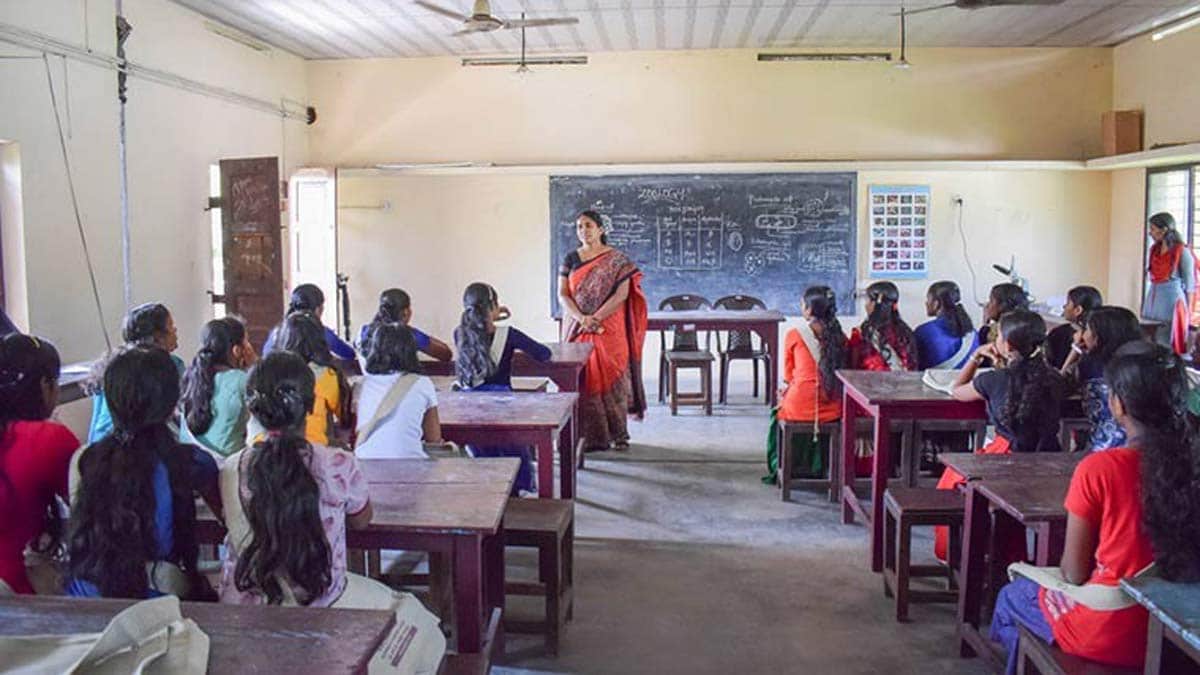
India's education journey has undergone a remarkable transformation over the past decade. The national conversation that once centred on getting every child into school is now evolving towards a far more important question: are children truly learning? With nearly 14.7 lakh schools serving over 24.6 crore students, India has one of the world's largest school education systems.
NEP 2020 reflects this shift by placing greater emphasis on learning outcomes and the development of competencies alongside access and participation. Recent reports, like NITI Aayog’s 2026 report titled ‘School Education System In India’, have also highlighted the need to strengthen teaching and school management.
Significant progress on access; the learning challenge remains
Despite the commendable progress made in enrolment and overcoming barriers to education, learning outcomes continue to differ for the same grade across different backgrounds. As per ASER 2024, it is evident that many students are struggling with age- and grade-appropriate levels of reading comprehension skills, numeracy skills, and conceptual understanding.
Strengthening foundational literacy and numeracy remains central to improving overall learning outcomes. Such gaps can become more difficult to address as students move to higher grades, thereby affecting their problem-solving skills, critical thinking skills, and the application of knowledge in real-life scenarios.
The success of India's education system can no longer be measured by the number of children sitting inside classrooms. It must increasingly be measured by what students know, understand, and are able to do at different stages of their education.
Competency-based learning is strengthening the shift away from rote learning
NEP 2020 and the National Curriculum Framework have brought about one of the most significant changes by shifting from rote learning to competency-based, experiential, and conceptual learning.
The government recognises that learning goes beyond covering the prescribed curriculum and preparing for examinations. It extends to building conceptual understanding, developing practical skills, thinking critically, and learning through experience.
This transformation also requires classrooms to become more interactive and inquiry-based. It also requires assessments to move from testing the recall of information to assessing the application and problem-solving skills of learners. Assessment also needs to help teachers identify specific learning gaps and use these insights to adapt instruction. This makes assessment a part of the learning process rather than only a measure of what students have learnt.
Blended learning is becoming the new classroom standard
Technology is no longer an add-on to education. It is becoming an integral part of effective teaching and learning. Nevertheless, the real opportunities lie in creating blended learning environments instead of just making classrooms more digital.
Online learning, when combined with teacher mentorship, can help teachers spot learning gaps sooner and respond to different learning needs. It can also extend learning beyond the classroom, allowing students to learn at their own pace and revisit concepts when needed.
Research-based learning design must drive educational quality
Teaching quality depends on more than the technology used in the classroom. The quality of learning materials and teaching approaches also matters. Resources grounded in established educational theories and sound instructional design can help teachers present concepts more clearly and support meaningful learning.
In addition to the use of more diverse learning approaches and curricula, learning resources and classroom practices should be flexible enough to meet the objectives of NEP 2020 and the National Curriculum Framework. The alignment between curriculum, classroom pedagogy, and expected learning outcomes is equally important.
A curriculum can set the direction, but its impact depends on how effectively it is translated into classroom practice. Customised and research-based instructional practices, which include both theoretical and practical aspects, can help make learning more interactive and relevant among today's learners. The educational goal should be making learning meaningful rather than just fulfilling the curriculum.
Learner-centric teaching resources can empower every educator
Without making an investment in teachers, no education reform will be successful. Even though technology and digital tools can revolutionise the learning process, they should serve the purpose of empowering teachers, not replacing them. Teacher training and capacity building will guide teachers towards the effective personalisation of learning based on the testing and assessment results of each individual.
The need for continuous teacher training and having access to educational materials, as well as research-based pedagogy, will make it possible for educators to focus more on teaching and learning while reducing avoidable administrative demands. Teacher availability, working conditions, and professional development also need attention, as these directly influence the quality of classroom instruction.
Integrated hybrid learning ecosystems will shape the future
The future of educational reform presents an opportunity for schools to make the transition from fragmented education towards an integrated learning environment where everything works in synergy. Curriculum, assessments, teaching materials, and technologies have to work together in order to boost learning outcomes.
Besides, these solutions should be made accessible and affordable for all schools, regardless of their board, be it CBSE, ICSE, or any other state-aided institution, to guarantee that every student has access to a quality education.
Although great achievements have been made in the field of education in terms of providing opportunities for children to get a quality education, more initiatives and policies aiming at the improvement of teaching are needed in the upcoming years. Achievements in this sphere will happen as a result of strong cooperation between educational authorities, teachers, researchers, and developers.
(The author is CEO, AASOKA)
(The opinions expressed in this article are those of the author and do not purport to reflect the opinions or views of THE WEEK)
