



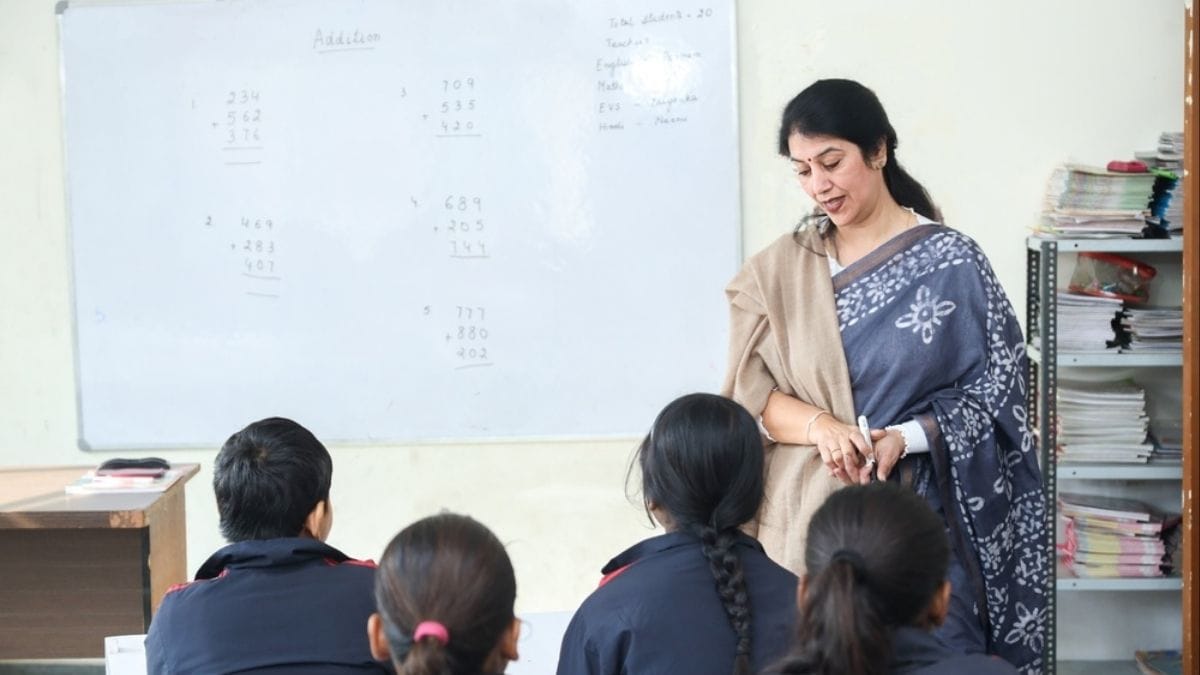
Education is the bedrock of all progress. We can build highways, airports, digital networks and industries, but none of these can sustain a nation unless there are people capable of using them wisely. Ultimately, the quality of a country is determined by the quality of its people. And if India has set itself the ambition of becoming a developed nation by 2047, then the preparation for that India must begin in our schools today.
The scale of our education system is almost difficult to comprehend. India has over 14.7 lakh schools, 24.7 crore students and more than one crore teachers. Behind these numbers are millions of young people who will, in the next two decades, become entrepreneurs, scientists, administrators, teachers, engineers, artists, soldiers and policymakers. The India of 2047 will, in a very real sense, be shaped by the children sitting in our classrooms today.
We also have an extraordinary demographic advantage. India is home to more than 382 million young people between the ages of 10 and 24. This generation has grown up differently from those before it. Gen Z does not merely consume information; it questions it, shares it, creates it and challenges it. It is comfortable with technology and naturally connected to the world. That confidence is a tremendous strength. But it also places a different responsibility on education.
We cannot prepare young Indians simply to find jobs in the economy of 2047. We have to prepare them to create the economy, institutions and ideas of 2047.
This is where Artificial Intelligence will fundamentally change the purpose of education.
AI will increasingly become part of everyday life. Children will use it to learn, write, design, translate, diagnose problems, analyse information and perhaps even make decisions. India has already demonstrated what technology can do when it is designed for scale. UPI, for example, processed more than 24,161 crore transactions in FY 2025–26, with over 700 banks connected to the platform. Platforms such as Aadhaar, DigiLocker and UPI have shown that digital public infrastructure can transform the everyday lives of hundreds of millions of people.
But the more intelligent our machines become, the more important it will be for us to understand human intelligence. A child who learns about AI will eventually ask a much bigger question: What is intelligence? If a machine can write a poem, solve a mathematical problem or hold a conversation, what exactly distinguishes its intelligence from ours?
And that question inevitably leads to another: What is awareness?
Are intelligence and consciousness the same thing? What makes us self-aware? What does it mean to be human?
I believe these questions will take education into fascinating territory. Neuroscience, philosophy, psychology, AI and even metaphysics may increasingly begin to intersect. Some of the most important intellectual breakthroughs of the coming decades may come not from asking what machines can do, but from asking what we are.
This is also where India's civilisational inheritance can offer something valuable.
Our philosophical traditions have spent thousands of years examining the nature of the self, consciousness and reality. The idea of Advaita, for instance, challenges us to look beyond the apparent separation between the individual and the larger whole. We need not turn our classrooms into philosophy seminars, but we should certainly give young people the confidence to engage with these questions. Our heritage can become a source of inquiry rather than simply something we preserve.
At the same time, AI will force us to rediscover something that technology cannot provide: ethics.
When information can be generated instantly, when a photograph can be fabricated, when a voice can be cloned and when a persuasive narrative can be created by a machine, knowing something is no longer enough. We must learn to ask: Is it true? Is it fair? Is it responsible? What are the consequences?
The speed at which narratives travel makes this particularly urgent. A false story can reach millions before a correction has a chance to catch up. Future generations will therefore need far greater media literacy, critical thinking and digital responsibility. Society will also need laws and institutions capable of dealing with technologies that can influence public opinion at unprecedented speed.
But laws can only take us so far. Character has to do the rest. That, to me, is the real purpose of education in the age of AI.
The leader India needs in 2047 may not necessarily be the student with the highest marks. It will be the young person who can think independently, question intelligently, collaborate generously and use technology without becoming dependent on it. Someone who can innovate without losing empathy, disagree without becoming intolerant, and exercise power without losing a sense of responsibility.
Schools therefore have to become more than places where children prepare for examinations. They must become places where young people learn to make decisions, take responsibility, live with differences, understand consequences and develop the courage to lead.
India has the numbers. We have the demographic strength. We have an increasingly sophisticated digital ecosystem and enormous economic ambition. Our greatest challenge now is to convert demographic potential into human capability, and human capability into human wisdom.
The India of 2047 is not a distant idea. It is already taking shape. And the people who will build it are, right now, sitting in our classrooms. That is why the most important investment India can make today is not only in technology or infrastructure. It is in the minds and character of its children.
The writer is director, schools and IT, at Jaipuria Group of Educational Institutions.
The opinions expressed in this article are those of the author and do not purport to reflect the opinions or views of THE WEEK.
