



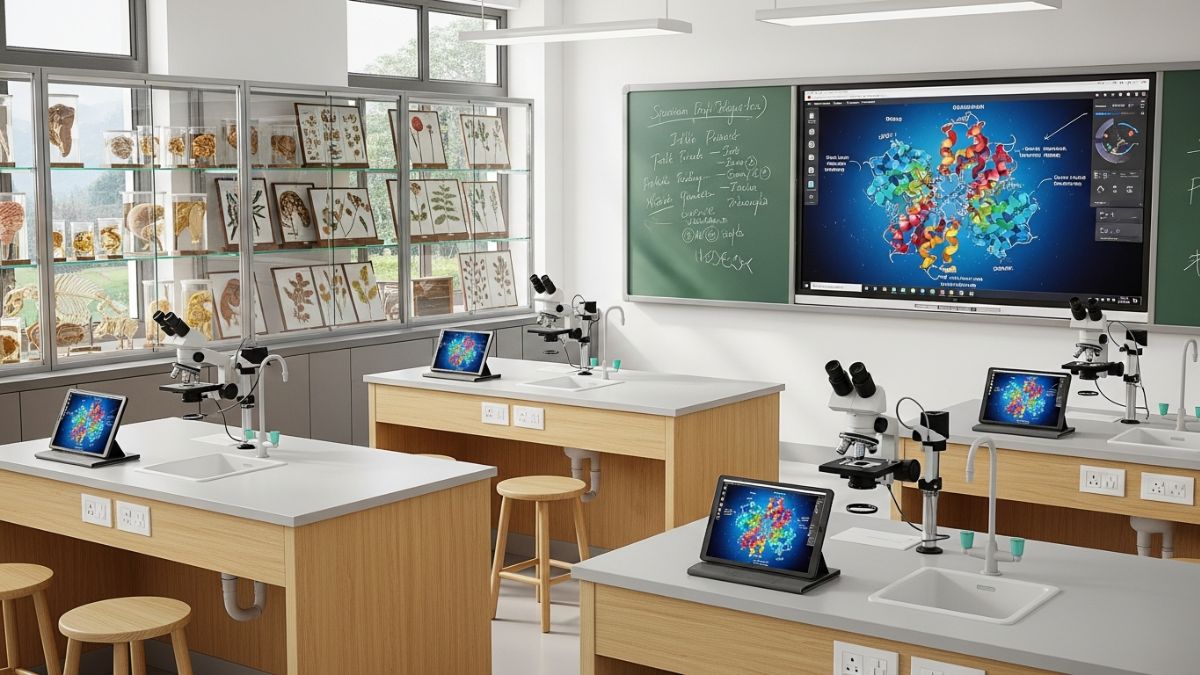
When a Class 8 biology lesson ended at The Indian Public School in Dehradun, the real test had just begun. Twenty students who had spent three days learning about health, microbes and disease prevention through an AI-assisted classroom sat for a final assessment. Their average score jumped from 49 per cent to 70 per cent. More importantly, they were not simply getting more answers right, they were thinking more carefully. Their reasoning confidence rose from 30 to 55 on a 100-point scale, and they took longer to complete the test, suggesting they were solving problems instead of guessing.
For teachers, the experiment offered something equally valuable. Instead of spending hours preparing lesson plans and assessments, AI helped reduce preparation time while highlighting exactly where students struggled. Rather than replacing the teacher, it became another tool in the classroom.
These findings form part of AI Ready School's early pilot programmes, which the company now wants to expand into a national research study covering 100 schools across India. The study aims to understand how artificial intelligence is changing teaching and learning across different school boards, geographies and classroom settings.
The timing is significant. India is preparing to integrate AI into school education beginning with Grade 3 under the 2026-27 academic session, in line with the National Education Policy 2020 and the National Curriculum Framework for School Education. Yet there is little India-specific evidence on what AI actually does inside classrooms.
According to AI Ready School, the gap between policy ambitions and classroom evidence is precisely what its research hopes to address.
In the Dehradun pilot, 15 of the 20 students improved their scores after AI-assisted instruction. Students also reported feeling more engaged, with 94 per cent, saying they wanted to continue using the platform and 94 per cent, saying they felt more confident after the sessions.
The platform did more than generate content. It identified misconceptions that teachers could immediately address. Some students believed antibiotics work against viruses, while others thought malaria is caused by bacteria or that sugar directly causes diabetes. By surfacing these gaps, teachers could tailor follow-up lessons instead of relying only on overall test scores.
Teachers, too, reported a positive experience. Both participating educators rated the overall classroom experience five out of five and said they would continue using the platform. They found AI-generated lesson plans reliable, interactive and capable of reducing preparation time without compromising classroom control.
“India's K-12 education market is already worth around $76.8 billion and is expected to cross $144 billion by 2030. That growth reflects how quickly school education is changing, but the next phase cannot simply be about adding more technology to classrooms. The real opportunity is to use AI in ways that help teachers respond to individual learning needs and help students learn with greater depth and confidence,” says Chiranjeevi Maddala, co-founder and CEO of AI Ready School.
He believes the early pilots demonstrate that AI works best when it complements teachers rather than replacing them.
“The bigger lesson is that AI should strengthen, not substitute, the teacher's role. It can help educators identify conceptual gaps, personalise instruction, develop interactive content and respond to different learning needs while preserving their teaching judgement and methodology,” Maddala says.
He also argues that introducing AI into classrooms is about more than giving children access to new technology.
“Equally important is teaching students about the responsible usage of AI, not simply allowing them to access AI tools. For AI to deliver lasting value in schools, adoption must be supported by knowledge mapping, intelligent orchestration, safety guardrails, audit trails and real-time insights. The idea isn't to push classrooms into being more dependent on technology; instead, it should make learning more personalised, more intentional, and more anchored in critical thinking,” he says.
