



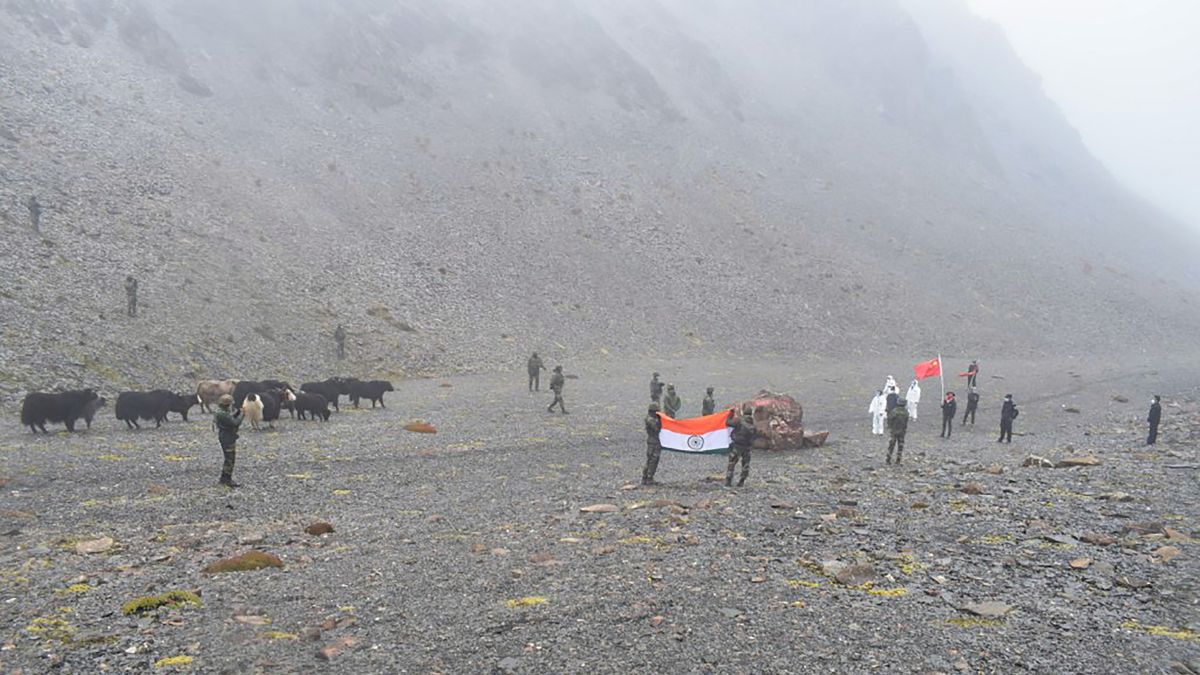
Traditional methods of warfare are no longer sufficient to counter China, according to the Indo-Tibetan Border Guarding Force, and India has deployed Shaurya commandos to beef up its presence along the eastern sector of the Line of Actual Control.
However, what is immediately being construed as a “face-off” between the two border guarding forces—following the remarks of ITBP Director General Shatrujeet Singh Kapoor—is not purely a military escalation but a direct fallout of China’s growing economic footprints and development projects that are necessitating a massive influx of the People's Liberation Army (PLA) and People's Armed Police Force (PAPF) personnel for logistics, security, and project management.
The outcome is a permanent increase in local troop density on the Chinese side along the LAC, and heightened security concerns on the Indian side where ITBP is deploying specialised commando force units to counter the threat.
But these concerns are merely the tip of the iceberg. ITBP’s own assessment shows that its troops have come eye to eye with the People’s Liberation Army at multiple locations along the LAC in Arunachal Pradesh in the last few months. The repeated face-offs, therefore, demonstrate that there has not only been a sustained increase in troop deployment on the Chinese side, but a possible shift has taken place in the tactical military balance along the eastern sector of the LAC, which is prompting India to bolster its own border defence and surveillance capabilities.
According to experts, the first concern comes from infrastructure projects in Nyingchi (Nyingtri), a strategic hub in the Tibet Autonomous Region, where development activities are being driven by two major plans: city development and the hydropower station. These plans are key to China’s economic development strategy and are mentioned in the five-year plan.
On June 8, the Nyingtri Municipal Development and Reform Commission issued the ‘Outline of the 15th Five-Year Plan for National Economic and Social Development of Nyingtri City’, which reflects a significant escalation in China's strategic footprint along the Line of Actual Control (LAC). “This has created substantial long-term security implications for India,” says Namrata Hasija, research fellow at the Centre for China Analysis and Strategy.
The Nyingchi Prefecture lies opposite India’s Arunachal Pradesh, and mega projects in this region are bringing heavily fortified Chinese state presence right on India’s doorstep.
For example, the Yarlung Tsangpo Hydropower Station project, dubbed as “project of the century” by the Chinese, has brought concerns of dual-use infrastructure by not only providing immense hydropower to the region but also justifying a massive influx of PLA troops for logistics and security, among other things.
According to Hasija, China’s air defence escalation is equally worrisome and possibly the next big concern for security strategists in New Delhi. Just as China deployed advanced surface-to-air missile (SAM) systems to protect the Three Gorges Dam in Hubei, Indian security officials are anticipating a similar heavy deployment of air defence and missile regiments in Nyingchi to safeguard this high-value asset.
“This militarisation under the guise of economic development shifts the tactical balance along the eastern sector of the LAC, requiring India to continuously adapt its own border defence and surveillance capabilities,” she says.
This explains why ITBP is not only deploying specialised commandos but also augmenting its technological capacity to increase surveillance on the tough border stretches. However, mere deployment of security personnel and monitoring the Chinese buildup may not insulate the LAC from Chinese threats completely.
Security officials say the LAC cannot be secured by military preparedness alone. “ While India must strengthen its border, defence and surveillance capabilities, a durable peace will also depend on a robust, diplomatic and economic strategy,” said a senior security official . “Speeding up efforts to strengthen the Northeastern states bordering the LAC, like Arunachal Pradesh, with equally robust infrastructure and development might just be the first step.”