



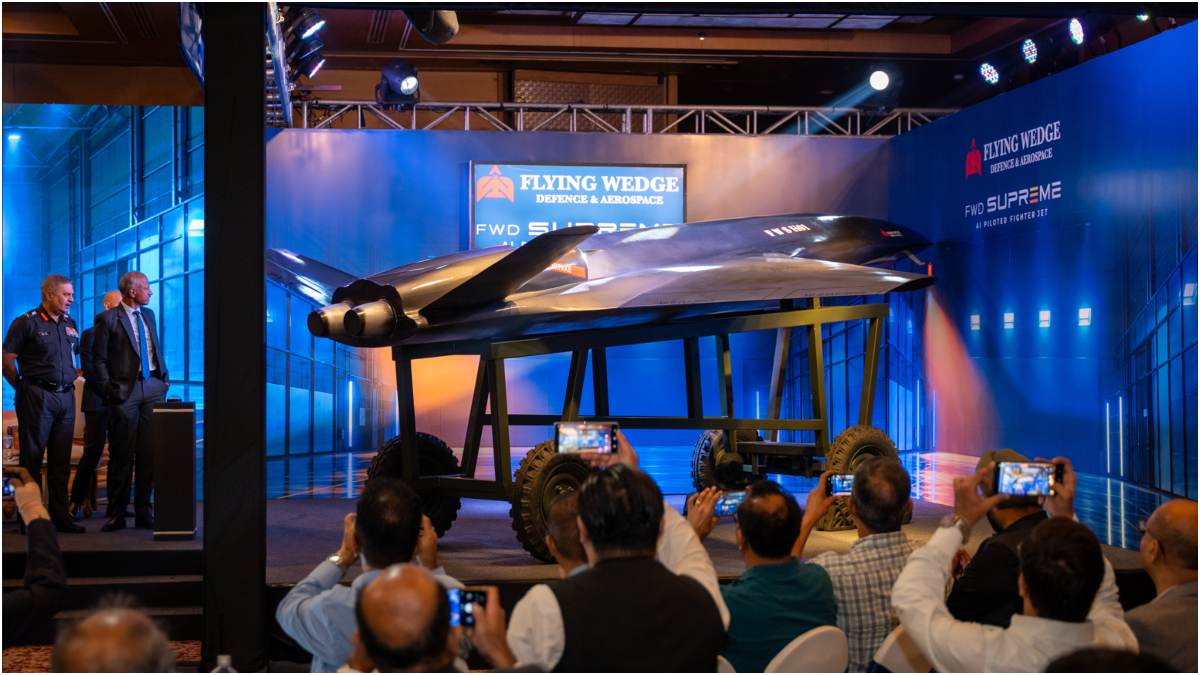
India's first AI-piloted fighter jet programme, FWD Supreme, aims to bring a new dimension to aerial warfare by combining autonomous flight, long-range combat capabilities and coordinated operations involving multiple unmanned fighter aircraft.
Developed by Bengaluru-based Flying Wedge Defence & Aerospace (FWDA), the programme seeks to change the way air combat is conducted by deploying AI-powered fighter jets that can share information, make coordinated decisions in real time and operate together as a formidable combat force.
The company unveiled a full-scale static prototype of FWD Supreme on Tuesday, marking a major step in its ambition to develop a family of affordable, AI-piloted fighter aircraft.
The FWD Supreme Heavy is being developed as an AI-powered autonomous fighter jet in the 1,500 kg-plus class, capable of carrying a payload of approximately 350 kg. According to the company, it is designed to incorporate a 5 kN propulsion system and achieve a maximum speed of Mach 0.8 to Mach 0.85. Its cruising speed is expected to be around 500–600 km/h.
The aircraft is expected to have a range exceeding 1,500 km, an endurance of more than two hours, and will feature a flying-wing configuration and an internal weapons bay. Its approximate dimensions are 10 metres by 10 metres. Together, these proposed capabilities are intended to give FWD Supreme the speed, reach, payload capacity and autonomy required for combat operations, the company stated.
The programme's defining feature is FWDA's Mobbing Doctrine, an approach that seeks to use multiple AI-piloted fighter jets as a coordinated combat force. Instead of relying on a limited number of expensive, high-value aircraft, the doctrine envisages deploying several autonomous fighters that operate together, much like a swarm of jets. These aircraft would share information and make coordinated decisions in real time, allowing them to function as a networked force rather than independent platforms. The objective is to create an operational advantage through numbers, autonomy and coordination.
Another important aspect is the ability to absorb losses without compromising the overall mission. By deploying capable autonomous aircraft at scale, the programme seeks to change the economics of air combat. This approach could allow a coordinated group of AI-piloted aircraft to continue operating even if some platforms are lost during a mission.
The programme is being developed in phases, beginning with a smaller variant called FWD Supreme Lite.
Designed for the Army, the Lite variant is a 250 kg-class demonstrator that also serves as a test bed for the larger programme. According to FWDA, the aircraft has already completed taxi trials and is being prepared for its first flight in the next two months.
The company says the Lite variant is already 90 per cent indigenous and is equipped with an Indian-made engine manufactured by UMS in Coimbatore.
FWDA also plans to integrate a Defence Research and Development Organisation (DRDO) engine into the programme to further reduce dependence on foreign components. “We are looking to integrate the DRDO engine to make it completely indigenous, reducing any delay and dependency on foreign components,” said FWDA's Suhas Tejaskanda.
According to the company, members of the team developing FWD Supreme have also worked on the Tejas Mk1 and Advanced Medium Combat Aircraft (AMCA) designs.
FWDA aims to develop a family of AI-piloted fighter aircraft that combines operational capabilities and affordability through Indian design, engineering and manufacturing. “FWD SUPREME represents our commitment to building advanced defence capabilities through Indian design, engineering and manufacturing. Our ambition is to develop a family of AI-piloted fighter aircraft that combines operational relevance with affordability,” Tejaskanda said.
He added that the company's Operation 777 initiative seeks to bring international partners into an India-led development and manufacturing programme while strengthening indigenous aerospace capabilities.
The company says the programme places India among four parallel initiatives of this kind globally and aims to make advanced combat aviation more affordable through indigenous development, AI-enabled systems and scalable aircraft production.
