



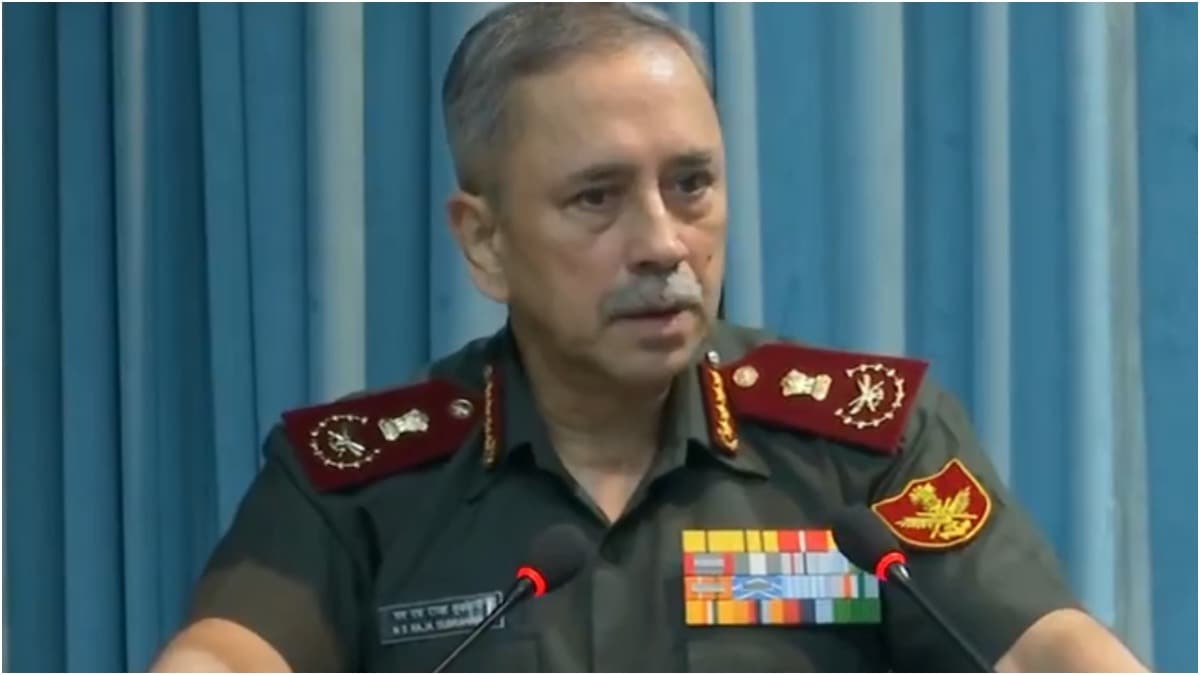
Chief of Defence Staff General N.S. Raja Subramani has called for a shift from individual platforms and service-specific capabilities towards a “system of systems” approach, pointing out that success in multi-domain operations will depend on how effectively different military assets can detect threats, share data and create battlefield effects.
Speaking at the Defence Forum on Model-Based Acquisition event recently, the CDS said multi-domain operations should not simply mean operating separately across different domains. Instead, the objective should be to use capabilities across several domains to create the desired effect faster than an adversary can understand and respond.
“Today, it is not about individual platforms, individual services, individual capabilities. It is about a system-of-systems approach,” Gen Subramani said, according to news agency ANI.
Explaining the concept, he said a satellite could detect something, other sensors could observe it and a capability operating in another domain could then target it to create the required effect.
For such an approach to work, networking and data sharing are crucial. The military must also be capable of sustaining these networks during operations, he said.
The CDS said the armed forces also need to move away from looking separately at what the Indian Army, Navy or the Indian Air Force requires.
Instead, the starting point should be the effect that needs to be created on the battlefield, followed by identifying the capabilities required to achieve it.
“It is not about what the Army needs, what the Navy needs, what the Air Force needs. It is about what are the effects that we need to create on the battlefield, and for those effects, what are the capabilities we require,” he said.
Gen Subramani cited C4ISR (Command, Control, Communications, Computers, Intelligence, Surveillance, and Reconnaissance) as an example of how the system-of-systems approach could function during multi-domain operations.
Space-based capabilities could be employed for Intelligence, Surveillance and Reconnaissance (ISR), Positioning, Navigation and Timing (PNT), communications and LNT to detect an adversary in real time.
Detection, however, is only the first stage. The military must be able to act on the information as quickly as possible.
Gen Subramani highlighted that possessing space-based assets alone would not be sufficient. Information from these systems needs to flow to capabilities operating across other domains. Space-based assets must communicate across aerial, naval, ground and electronic warfare assets.
“All assets have to communicate in near real time and be able to share the data,” he said.
The CDS said this interconnected approach would allow capabilities operating in different domains to contribute towards a common battlefield effect.
The main requirement, according to Gen Subramani, is not just adding more individual platforms, but creating an interconnected military architecture that is capable of detecting an adversary, sharing information rapidly and delivering the required effect before the adversary can respond.
