



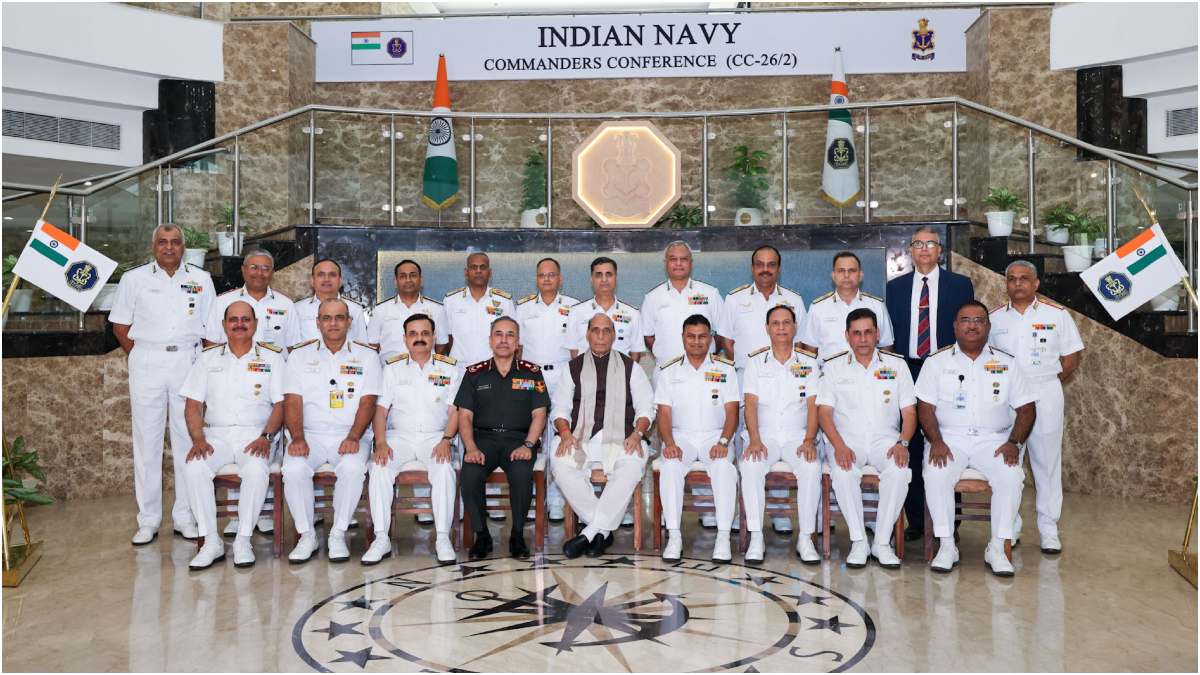
India needs a significant upgrade of its maritime surveillance architecture as congestion, deception and grey-zone activities make the maritime domain increasingly complex, Defence Minister Rajnath Singh said on Tuesday.
Addressing the second edition of the Indian Navy's biannual Commanders' Conference 2026 at Nausena Bhawan in New Delhi, Singh said the country's monitoring and response mechanisms must be taken to a new level.
“Today, issues such as congestion, deception, and gray-zone activities have made our maritime domain far more complex than ever before. Hence, we must elevate our monitoring and response mechanisms to a new level,” he said.
Singh called for a significant upgrade of India's maritime surveillance architecture. While recognising the importance of existing systems, he said the growing volume and complexity of maritime traffic demanded stronger analytical capabilities.
The push assumes importance as India expands its strategic presence at sea. According to the defence minister, Indian warships now operate as far as the South China Sea, Mediterranean and Atlantic Ocean, demonstrating the Navy's blue-water capabilities.
He said the Navy plays a crucial role in providing strategic depth and enabling regional power projection.
Singh also linked maritime security directly to India's economy, energy security and defence preparedness.
He pointed out that around 85-90 per cent of India's crude oil and about 50 per cent of its natural gas are imported through maritime routes, making the security of sea lanes particularly important.
The defence minister highlighted the Navy's role during the crisis in West Asia, particularly the safe passage of Indian-flagged merchant vessels, including LPG tankers, through the Strait of Hormuz under Operation Urja Suraksha.
Singh said India stands as the “First Responder” and “Preferred Security Partner” in the Indian Ocean Region, arguing that the country's growing strategic position has also brought greater responsibility.
The call for stronger maritime surveillance comes as the Indian Navy prepares for a major expansion of its capabilities.
Singh described 2026 as a historic year for the force, saying 18 warships are planned for induction or commissioning. This would represent the largest single-year addition to the Navy's force levels.
He said the development reflected the increasing maturity of India's domestic naval shipbuilding ecosystem, although further capability enhancement remained necessary.
The defence minister also highlighted the growing indigenous content of Indian warships. Recently commissioned vessels contain more than 75 per cent indigenous content, he said.
