



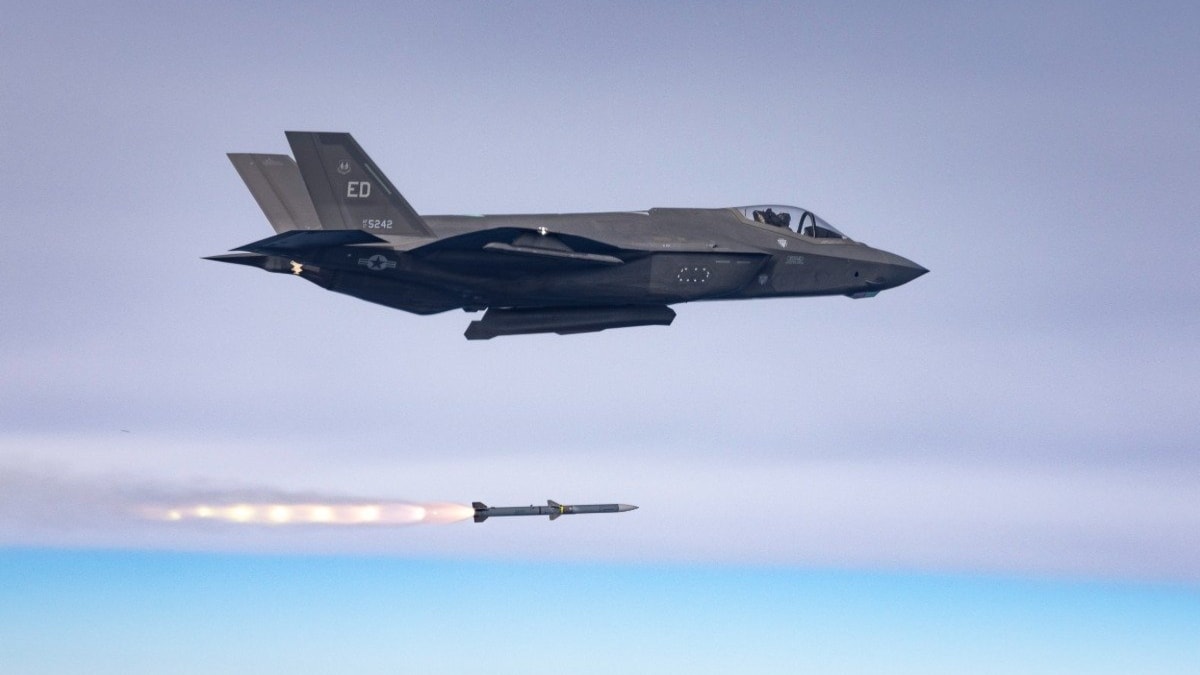
The Pentagon is looking into how parts from the F-35, the most advanced fifth-generation fighter jet of the US, ended up in Hong Kong, raising concerns over whether China could gain access to technology associated with the stealth aircraft.
The question that is on everyone's mind is how sensitive the components involved are, and whether there is reason for the US and the other countries that possess the fighter jet to worry.
According to media reports, the two components reportedly involved are a cockpit canopy and a weapons-bay door. The parts were being transported from Australia to the US by an intermediary for Lockheed Martin for repair or disposal when the shipment was unexpectedly diverted to Hong Kong while crossing the Pacific from Australia.
Australia is among several countries operating the F-35. It remains unclear how the diversion occurred.
The F-35 Joint Program Office has acknowledged a "shipment issue" involving F-35 components and said it was working with US authorities and industry partners to retrieve them.
"We are actively working with US authorities and industry partners to retrieve these components, investigate the incident, and place safeguards to avoid a future occurrence," the office said.
Australian Defence Minister Richard Marles had sought to play down concerns about the nature of the equipment. "My understanding is that there is a sense of comfort, and we're not talking about sensitive equipment here or sensitive parts," he was quoted as saying.
Marles said it was working with the US and prime contractor Lockheed Martin over the incident.
Does the US have reason to worry?
However, one of the components reportedly involved—the cockpit canopy—has a role in the F-35's stealth characteristics. The canopy is an acrylic bubble covering the cockpit and is coated with a thin layer of transparent radar-absorbent material that helps conceal the aircraft from enemy radar.
The fifth-generation fighter incorporates stealth, advanced radar and sensors as well as networking capabilities, and hence the presence of a cockpit canopy in the hands of China could be perceived as a cause for concern.
Politico had earlier reported that the incident prompted a congressional inquiry amid concerns that China could gain access to key components associated with highly classified technology.
While Australian authorities maintain that the shipment did not contain sensitive equipment, the Pentagon's decision to investigate the incident and work to retrieve the components shows that the issue is being taken seriously.
There have also previously been concerns about China obtaining information related to the aircraft. A Defense Science Board report released in 2013 alleged that Chinese cyberattacks had accessed data from several Pentagon programmes, including the Joint Strike Fighter programme.
However, Bradley Bowman of the Foundation for Defense of Democracies has previously pointed out that US military systems are continuously updated and improved, potentially reducing the usefulness of secrets obtained years earlier.
The immediate US priority is retrieving the F-35 components and determining how they ended up in Hong Kong.
Bloomberg reported that China has the parts after the shipment was diverted months ago. Hong Kong has been under tight control from Beijing since its return from British rule in 1997 and does not maintain its own military or conduct its own diplomacy.
More than 1,200 F-35s have been produced, and 19 countries have placed orders for the aircraft.
With agency inputs
