



Mike Newell’s 2018 film The Guernsey Literary and Potato Peel Pie Society is about a group of friends living on the island of Guernsey on the English Channel during its German military occupation in the 1940s. The Germans took all their animals away to feed their soldiers on the continent. It was against the law to keep even one. Pig farmers, for example, were asked to grow potatoes instead. Neither were the islanders allowed to meet together. That’s when one farmer—Dawsey Adams—gets an invitation to the home of an acquaintance, Amelia Maugery, asking him to bring his butcher’s knife. When he arrives, he realises that Mrs Maugery had kept a pig hidden away, and he was being invited to prepare and share a meal of roast pig with four others. By then, a proper meal was had only in memory, but what the five islanders realise is that what they were really hungry for was not the roast pig, but rather human connection. “For a few moments, we forgot the war, the occupation and everything we had lost, and remembered our humanity,” says Dawsey. The pig represented not just an act of defiance, but also the need for fellowship and the company of others.
Today in India, another animal—or rather an insect—is playing the same role that the pig did for Guernsey’s islanders. The cockroach has become the symbol of a rallying call for change, resistance and solidarity with other like-minded Indian youth. The Cockroach Janta Party was formed on May 16 as a satirical political movement protesting corruption, inequality and the abuse of power. It was formed in response to the CJI’s remark comparing youngsters to cockroaches, “who don’t get any employment or have any place in the profession. Some of them become media, some of them become social media, RTI activists and other activists, and they start attacking everyone.” The CJP calls itself a “political front of the youth, by the youth, for the youth: Secular, Socialist, Democratic and Lazy”.
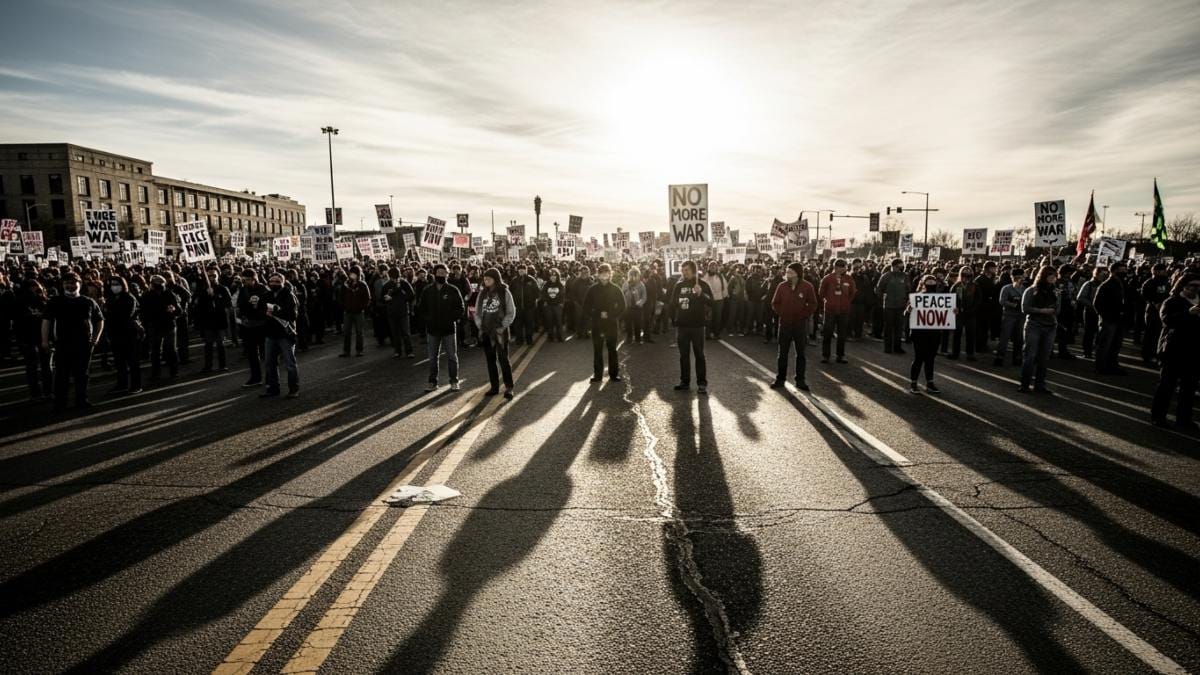
The CJP is not alone. A series of youth-led uprisings last year led to the fall of governments in countries like Peru, Madagascar, Nepal, Serbia and South Korea. According to the Carnegie Endowment for International Peace, in the last 12 months, over 127 significant anti-government protests have erupted worldwide in more than 70 countries.
The global conflict monitor ACLED states that demonstrations increased worldwide for a third consecutive year in 2025. The protests are mostly peaceful, but they have become more confrontational as counter-demonstrations have increased by 33 per cent compared to the first 11 months of 2024. Demonstrations in support of Palestine and against Israel’s war in Gaza were held in 104 countries and territories. Since October 2023, there have been more than 51,000 pro-Palestine protests, 18,000 of them in 2025 alone.
In The Guernsey Literary and Potato Peel Pie Society, the five friends are returning home after their meal of roast pig and gin when they encounter a group of German soldiers who accuse them of breaking curfew. They have no choice but to form a fictional book club as an excuse for meeting together, and thus the Guernsey Literary and Potato Peel Pie Society comes into being. Once it is registered, they have no option but to meet together and discuss books, which ends up becoming an emancipation. “Our Friday night book club became a refuge to us,” says Dawsey. “A private freedom to feel the world growing darker all around you, but need only a candle to see new worlds unfold. That is what we found in our society.”
Since time immemorial, man has been wielding art—books, music, theatre, dance—not just as a means of creating beauty, but also as a weapon to wage war. “For Palestinians, writing is resistance and culture has always been used as a tool of resistance,” writes Atef Abu Saif, Minister for Culture in the Palestinian Authority, in the introduction to the book Letters from Gaza—a collection of poems, stories and reflections from the people of Gaza after the war started in 2023. “Through poetry, fiction, singing, painting, [dances like] the dabke and traditional embroidery and clothing such as the keffiyeh, Palestinians have fought back against the efforts to eliminate them.” He remembers how, in the late 1970s and 1980s, they used to tease soldiers by dancing the dabke in the narrow alleys of the camp. The soldiers would grow angry and chase them away. Culture, he says, was their response to the enemy’s anger.
Mahmoud Jouda, a young writer who was trying to get out of Gaza at the time Letters from Gaza was published in 2025, writes of the Palestinian songs they wear as armour around their soul: Um Kulthoum’s ‘This Is My Night’, broadcasted from a radio inside a refugee tent; a young girl hauntingly humming a song of the singer Shadia—'Tell the sun not to blaze so bright, my darling is leaving in the morning….,’ “People still sing and I still walk on the streets, shuffling in my mother’s slippers, continually in song,” writes Jouda. “Because, as Victor Hugo said, ‘When hope is gone, song remains’.”
There is another weapon in the protesters’ armour: humour. If you cannot fight your way out of conflict, you can laugh your way through it. Pro-Iranian media groups, like the X account Explosive Media, are making memes and AI-generated videos—through rap, animation and pop culture references—bashing Americans and Israelis. Arab content creators are resorting to dark humour on social media; in one popular video, for example, a woman repeatedly opens and closes a sliding door, mocking the see-sawing decisions regarding the Strait of Hormuz. In Bahrain, an influencer asked Trump to stop the war so they could get some sleep. “I don’t like boom,” he said. In Ukraine, a meme of an Orthodox Madonna clad in green and cradling a Javelin anti-tank missile went viral and $10 stickers of the image sold in huge numbers in over 60 countries.
If humour is the sword, then hope is the shield keeping their souls buoyant. It is what gives the human spirit immense resilience. It is what makes children fly kites in the graveyards of Gaza, teenagers play volleyball in the war zones of Afghanistan, doctors perform surgeries using flashlights during blackouts in Sudan. With hope, what can be done to the body cannot be done to the soul. In Haiti, for example, the elders are passing down stories of a pre-war country—a place of dance, music and joy—afraid that youngsters will stop dreaming if they don’t know what to dream of. They tell them to cling to a famous Haitian proverb inspired by the resilient reed, wozo—a powerful cultural symbol there. “Nou se wozo/ Menm si nou pliye, nou pap kase.” (We are wozo/ We bend, but we do not break.)
