



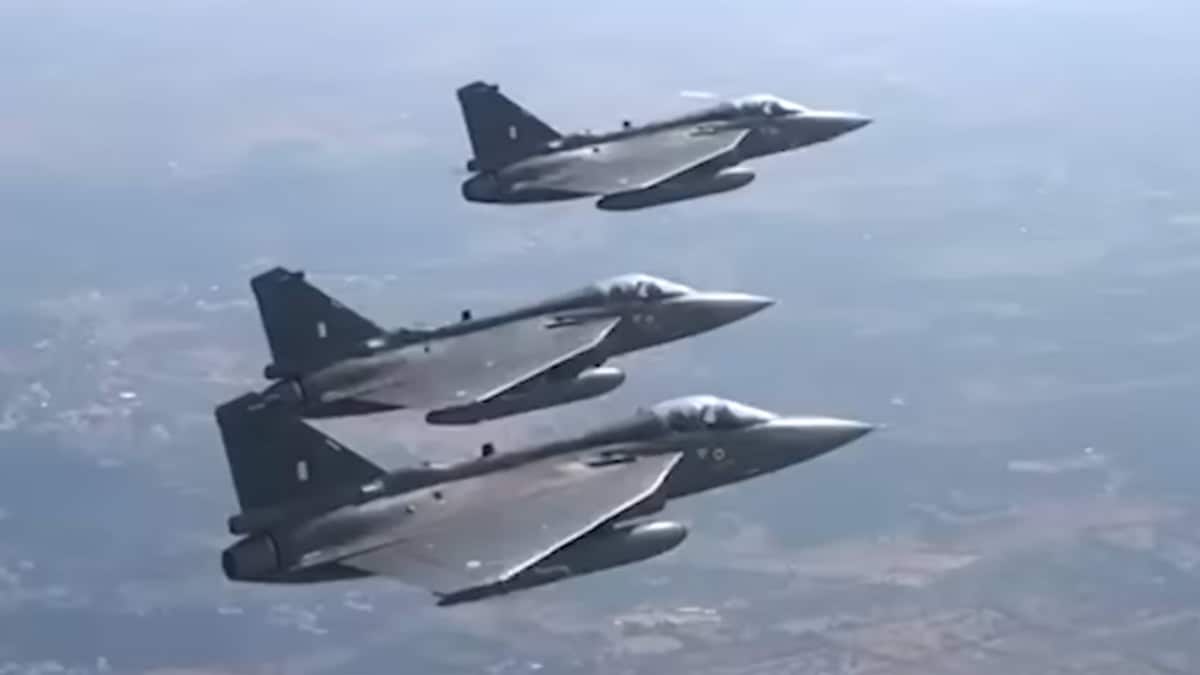
Every fighter jet that joins the Indian Air Force (IAF) strengthens the country’s defence. The Tejas Mk1A is one such aircraft that is fully designed and built in India. The IAF has ordered 83 of them from the Bengaluru-headquartered PSU Hindustan Aeronautics Limited (HAL), with more expected. Yet for a long time, one slow and demanding process had limited how quickly these jets can be delivered: the careful drilling of thousands of holes in the wings.
A Tejas wing is a complex structure. It is made by layering carbon fibre composite with metal. Carbon fibre is light and very strong, which helps the aircraft perform sharp turns and high-speed manoeuvres. To hold the different parts of the wing together—the outer skins, internal spars and various brackets—nearly 8,000 holes have to be drilled on each wing. A complete pair of wings therefore needs around 16,000 holes. Every hole must be precise. Even small mistakes can create fuel leaks or reduce the strength of the wing.
Until recently, much of this work was carried out manually by skilled technicians using hand-held tools. Drilling a single hole took between 25 and 35 minutes. With thousands of holes required for each aircraft, the process often stretched over several weeks for a single set of Tejas wings, emerging as a major bottleneck in production.
HAL has decided to solve the problem with modern technology. It invited companies to offer a robotic system that could meet strict standards. The machine had to drill and countersink each hole in less than 60 seconds.
“Countersinking creates a small cone shape at the top of the hole so that the rivet sits flush and the wing surface remains smooth. Accuracy had to stay within ±0.30 mm. The carbon fibre layers must not separate or peel during drilling. No liquid coolant could be used on the composite material, and every hole had to be inspected automatically. The system also needed the capacity to produce 20 wing sets a year, with the ability to increase output when required,” explained Girish Linganna, defence and space analyst and the MD of ADD Engineering Components (India) the Indian arm of Germany’s ADD Engineering GmbH which is one of the firms that has received the order for implementing the robotic system to fastrack the Tejas wing development process.
The project is being executed through a collaboration of industry partners. UK-based True Position Robotics specialises in automated drilling and inspection systems for the aerospace sector. Its technology features lightweight robotic systems, offline programming capabilities, and advanced positioning techniques that enable precise tool alignment before work begins. Robot-Technology GmbH from Germany provides industrial robots and precise measurement systems that use cameras and lasers. German tooling expert Norbert Kreller and aerospace specialist Werner Gryksa, who have experience connected to NASA and international fighter programmes, are also supporting the effort. Ripple Technologies in Bengaluru, linked to ADD Engineering, contributes expertise in aircraft tooling, jigs and structural components.
“In the factory, a six-axis robot mounted on a mobile platform will carry out the work. The robot can move and rotate in six directions, similar to the combined movement of a human shoulder, elbow and wrist. At the end of the arm is a specially designed tool that clamps the surface, senses the correct angle, drills the hole, shapes the countersink, measures the result and checks for any defects all in one continuous sequence. Vision cameras keep the robot aligned, and a dust extraction system keeps the workplace clean. HAL engineers will plan the location of every hole using CATIA design software. The same robotic system can later be adapted for the Tejas Mk2 and the future Advanced Medium Combat Aircraft (AMCA),” said Linganna.
The breakthrough comes at a crucial time for the Indian Air Force (IAF), which is seeking to replenish its dwindling fighter squadron strength. Faster wing production will enable HAL to deliver complete Tejas aircraft more quickly. The development also aligns with HAL's broader push to modernise its manufacturing processes and deepen collaboration with capable private-sector partners. Kota Ravi, the chairman and managing director of HAL has long been associated with the Tejas programme.
A similar trend is visible in the Rafale programme as well. After partnering with Tata Advanced Systems for fuselage work in India, Dassault Aviation is now looking for an Indian partner to manufacture wings locally. The change is simple but powerful. Work that earlier required thousands of careful man-hours can now be completed much faster while maintaining high and consistent quality. More wings mean more Tejas fighters ready.
