



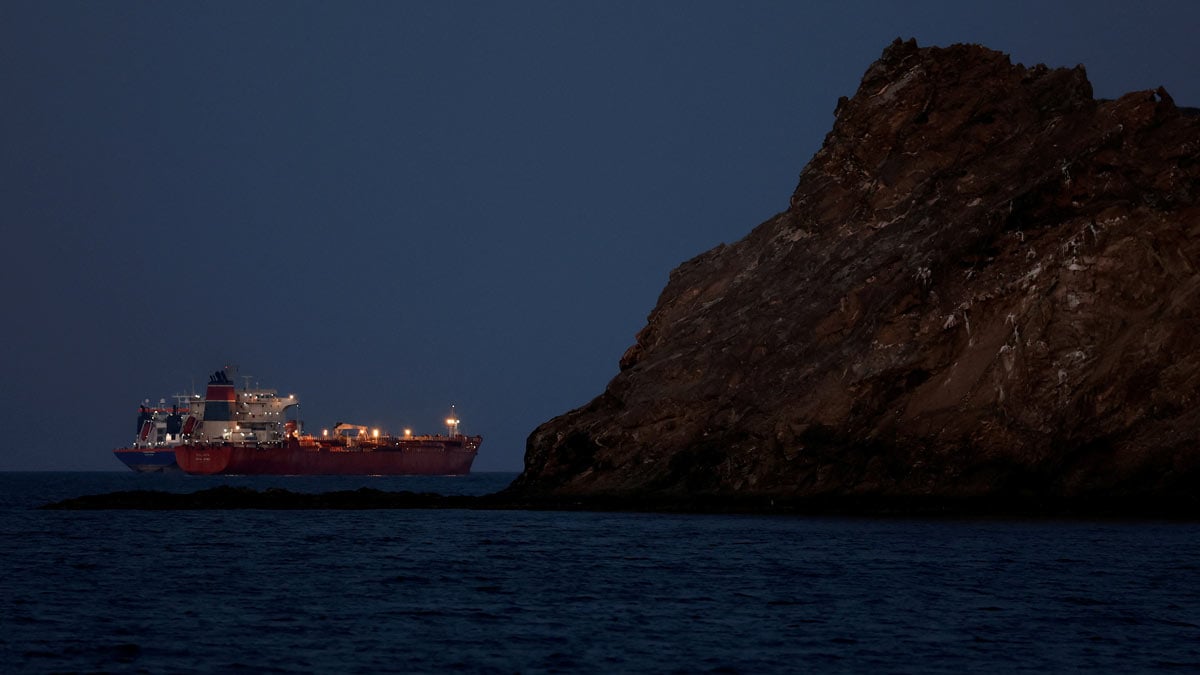
The instability caused by the continuing war in West Asia has moved from being a distant geopolitical risk to a direct economic and security stress test for India. The point is no longer whether the conflict in the Gulf, the Red Sea and the wider Eurasian arc affect India, but how deeply it does so — due to impacts on oil prices, shipping costs, fertiliser supplies, bitumen availability, investor sentiment and even defence production. India’s exposure is structural: its growth model still depends on uninterrupted seaborne imports of energy, industrial inputs and strategic materials.
The latest wave of disruption has made that dependence more visible than ever. A renewed flare-up around the Strait of Hormuz, continuing attacks on shipping in the Red Sea and the drag from the Russia-Ukraine war together have turned key maritime routes into zones of uncertainty, and uncertainty is always expensive. For India, the cost is not just higher freight and insurance premiums; it is slower growth, rising inflation and a more vulnerable strategic position.
Three corridors, one exposure
India’s economy rests on three major external trade corridors: the Gulf energy route, the Europe-Mediterranean route and the northern Eurasian route. The first carries crude, LNG, LPG, petrochemicals and fertiliser feedstock; the second links Indian exports and imports with Europe through the Red Sea and Suez Canal; the third has grown in importance because of discounted Russian crude, fertilisers and strategic commodities. When all three are under strain at the same time, the shock is no longer regional — it becomes systemic.
The numbers underline the scale of the exposure. India imported 242.4 million tonnes of crude oil in FY25, with import dependence at 89.1 per cent, according to government data reported in April 2025. That means even modest disruptions in Gulf shipping can ripple immediately into India’s refinery economics, fuel prices and industrial costs.
Fertiliser dependence is just as important, though it receives less public attention. Official economic survey tables show that India imported 8,836 thousand tonnes of Nitrogen, Phosphorus & Potassium (NPK) fertilisers in 2024-25, alongside large volumes of nitrogenous and phosphatic fertilisers. In a year when farm costs, subsidy burdens and Kharif-season planning already matter greatly, any shipping or price shock in this sector quickly becomes a macroeconomic problem.
Hormuz: India’s energy weak point
The Strait of Hormuz remains India’s most exposed energy chokepoint. Even a temporary tightening there raises tanker insurance, freight costs and delivery uncertainty, which then filter into refinery throughput and product pricing. Because India imports most of its crude, the real issue is not simply whether cargoes can be sourced, but whether they can be delivered on time and at tolerable cost.
This issue matters far beyond the petrol pump. Higher crude costs push up the price of diesel, aviation turbine fuel, plastics, lubricants, bitumen and a range of petrochemical intermediates. That, in turn, affects logistics, construction, aviation, manufacturing and public infrastructure spending. In other words, a geopolitical shock at sea quickly becomes a domestic growth and inflation problem.
The petroleum impact also has a fiscal dimension. When fuel and fertiliser subsidies rise, government room for manoeuvre narrows. When oil prices stay elevated, the current account worsens, and the rupee comes under pressure. In a globally uncertain environment, those pressures are difficult to offset with monetary policy alone.
Red Sea and Suez costs
The Red Sea crisis has created a second layer of vulnerability. Indian trade with Europe, North Africa and parts of the Mediterranean increasingly depends on safe passage through Bab-el-Mandeb and the Suez Canal, but intermittent attacks on merchant shipping have forced many operators to reroute around the Cape of Good Hope. That adds time, fuel burn, insurance costs and container shortages all at once.
For exporters, the effect is lower competitiveness and delayed receipts. For importers, the effect is higher landed costs and more inventory holding. Sectors that depend on timed deliveries — pharmaceuticals, machinery, electronics, engineering goods and auto components — are especially exposed because even short delays disrupt production cycles.
This is why the Red Sea crisis cannot be treated as a shipping story alone. It is a supply-chain story, an inflation story and, increasingly, a trade policy story. The more Indian firms are forced to absorb volatile logistics costs, the harder it becomes to maintain export momentum in a slowing global economy.
Russia-Ukraine and the Eurasian route
India’s Russia-related trade advantage has also become less certain. Since 2022, discounted Russian crude has helped soften India’s import bill, but the trade has come with rising logistical complexity, sanctions risk, payment issues and shipping constraints. The Black Sea theatre adds another layer of uncertainty to global freight and insurance markets, even where India is not a direct participant.
These developments matter because India’s energy strategy has increasingly relied on flexibility — buying from wherever the discount is best, and the route is feasible. That model works only if shipping lanes, payment channels and insurance markets remain functional. When those conditions weaken, India’s supposed diversification can quickly turn into a concentration of risk in new forms.
The deeper lesson is that strategic autonomy in trade requires redundancy. A cheaper barrel is useful only if it arrives on time and without triggering broader supply-chain shocks. In today’s environment, logistics security is part of energy security.
The domestic economic fallout
The effects of these external shocks are not evenly spread. Fertiliser shortages or cost spikes hit farmers first, then food prices, then subsidy budgets. Bitumen and petrochemical disruptions slow road building, housing and industrial production. Higher LNG prices raise power and city-gas costs. Shipping and aviation absorb the freight shock, but the broader economy pays through inflation and slower investment.
Market sentiment is affected as well. Foreign portfolio investors withdrew roughly ₹2.7 lakh crore from Indian equities in the first half of 2026, according to recent market reporting tied to official and depository data. While there are multiple reasons for such outflows, West Asia’s turbulence and the oil-price channel have clearly contributed to global risk aversion toward India.
The issue is not panic. India’s macroeconomic fundamentals remain stronger than in many emerging markets. But in a world where capital moves quickly, and valuations adjust instantly, geopolitical risk now enters the market through the back door. That makes energy security and financial stability inseparable.
Security and defence linkages
The security implications are equally serious. India’s defence modernisation depends on imported electronics, specialised metals, chips, machine tools, propulsion components and chemical inputs that are themselves vulnerable to shipping delays and sanctions-sensitive logistics. Even indigenous programmes become slower and more expensive if the upstream supply chain is fragmented.
That is why the old distinction between ‘economic’ and ‘security’ policy no longer holds. A delayed shipment of a critical alloy or electronic sub-assembly can affect production schedules for aircraft, missiles, vehicles or naval platforms just as surely as a delayed oil cargo can affect the energy market. Strategic self-reliance therefore means supply-chain resilience, not just domestic assembly.
It also means building buffers. Stockpiles of critical minerals, diversified sourcing for semiconductors and components, and more robust domestic capacity in key defence inputs are no longer optional. They are part of deterrence by economic endurance.
What India needs to do
India must utilise its unique diplomatic capital to reduce volatility and bring hostilities to a close. India draws respect and enjoys favourable relations with all parties in these conflicts. Thus, it should not shy away from using its benign influence to bring parties concerned to the table and work towards negotiated long-term solutions.
Also, India’s priority should be to reduce fragility rather than pretend insulation is possible. Energy diversification remains essential: more oil from the Americas and Africa, longer-term LNG contracts, greater strategic petroleum reserves and improved gas storage. India also needs more domestic processing capacity in petrochemicals, fertilisers and specialty chemicals so that every external shock does not immediately become a supply shock.
A third priority is logistics resilience. That means stronger port capacity, better shipping insurance mechanisms, alternative routing arrangements and faster progress on connectivity projects such as India Middle-East Europe Economic Corridor (IMEC), International North-South Transport Corridor (INSTC) and Chabahar. These corridors will not eliminate dependence on the Gulf, but they can reduce monopoly risk and create redundancy when one route becomes unstable.
A fourth priority is strategic stockpiling. India already carries inventories in several sensitive sectors, but the scale is not yet adequate for prolonged maritime disruption. Critical minerals, fertiliser inputs, select industrial chemicals and defence-related materials need more systematic reserve planning.
The strategic takeaway
West Asia’s volatility has exposed an uncomfortable truth: India’s economic rise is still tied to sea lanes it does not control. That does not mean India is helpless, but it does mean resilience must be treated as national strategy rather than a bureaucratic afterthought.
The real challenge ahead is not only to survive each shock, but to redesign the economy so that the shock effects are progressively reduced. That calls for energy diversification, supply-chain depth, stronger maritime capability and a more deliberate industrial policy around critical inputs.
India can continue to grow even in an unstable region, but only if it stops assuming that global trade will remain cheap, open and predictable. In the current era, resilience is not a defensive luxury. It is the foundation of power.
(Lt Gen Philip Campose (Retired) is a former Vice Chief of the Indian Army. He has authored a book titled ‘A National Security Strategy for India: The Way Forward’)
(The opinions expressed in this article are those of the author and do not purport to reflect the opinions or views of THE WEEK.)
