



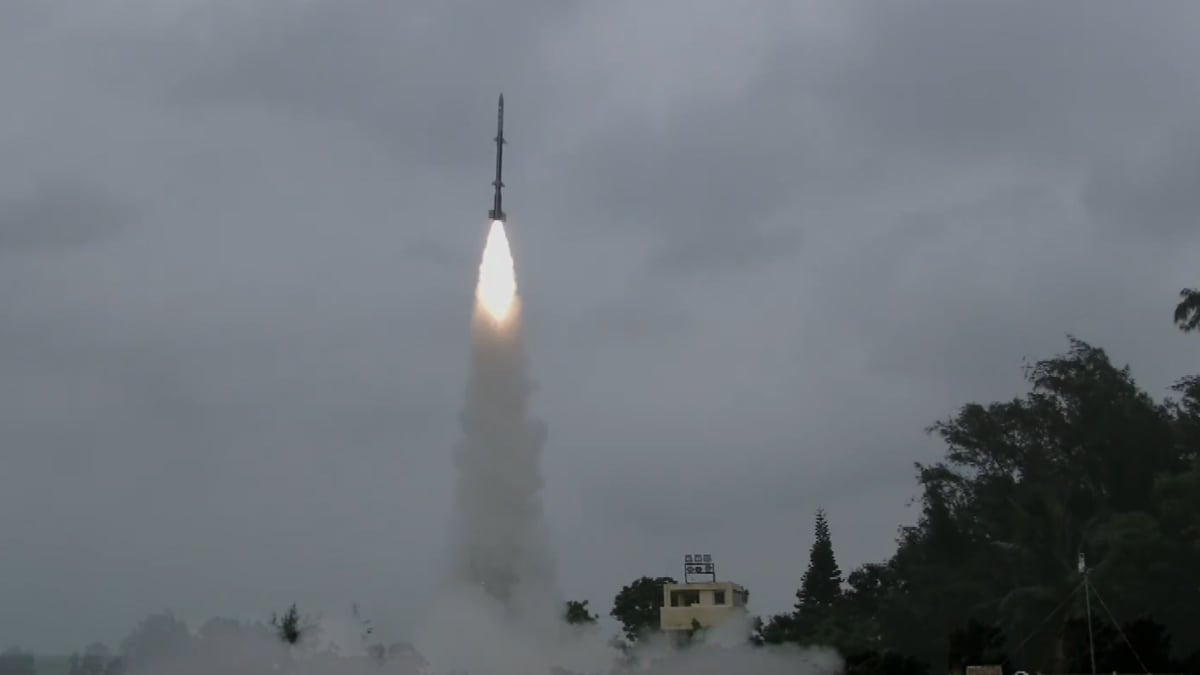
India's efforts to strengthen its long-range air defence capabilities received a major boost on Thursday as the Defence Research and Development Organisation (DRDO) successfully conducted the maiden flight test of the Long-Range Surface-to-Air Missile (LR-SAM) Kusha.
The first flight test of the missile was carried out from APJ Abdul Kalam Island off the coast of Odisha, marking an important milestone in the development of the indigenous long-range air defence system.
The Kusha missile system is designed to neutralise a wide variety of aerial threats, including fighter jets, missiles, UAVs and large enemy aircraft across a wide range and altitude envelope.
Project Kusha is being developed by DRDO as a multi-layered air defence shield capable of countering threats ranging from stealth aircraft and cruise missiles to hypersonic weapons.
A key feature of the system is its ability to deploy interceptors with different engagement ranges. The programme envisages three interceptor variants with ranges of 150 km, 250 km and 400 km, allowing the system to engage different aerial threats at varying distances.
At its maximum engagement range, Kusha is designed to take on aerial threats as far as 400 km away. The system has been designed to rival Russia's S-400 and is slated for operational deployment around 2028-2030.
Defence Minister Rajnath Singh described the maiden flight test as a significant achievement for India's defence research and development efforts.
"Today's successful test flight of Kusha marks an important milestone in Indian defence R&D. The capability in developing long range surface-to-air missile system is possessed only by a handful of nations," Singh said.
He said the indigenous system would also help eliminate India's dependence on imports for such long-range air defence capabilities.
"This will also eliminate the import dependency for such systems and signifies a giant leap in air defence capability of the nation. I congratulate DRDO and other stakeholders for this achievement," Singh said.
Singh had earlier highlighted the strategic importance of Project Kusha amid global instability.
"In times of global turmoil, programs like 'Kusha' and institutions like DRDL instil confidence in the nation's people, assuring them that we will neither bow before external instability nor allow any shortcomings in our preparedness," he had said.
