



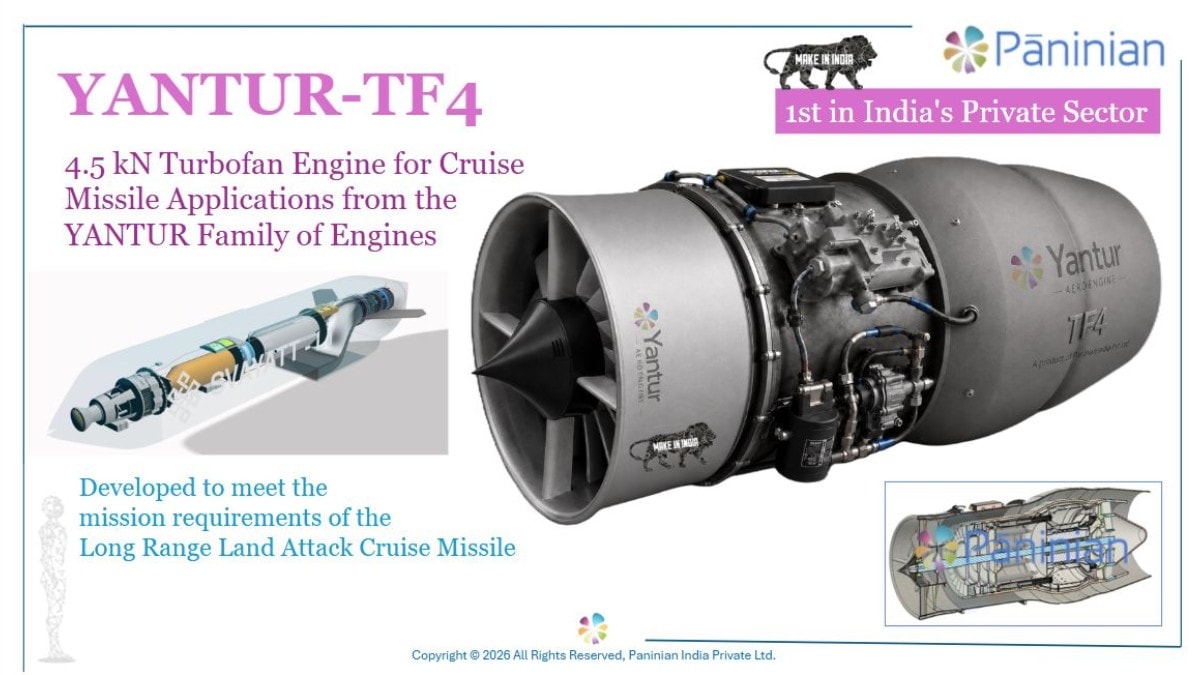
India's efforts to build indigenous propulsion systems have received another boost, as Paninian India Pvt Ltd unveiled the Yantur 4.5 kN turbofan engine, believed to be the country's first privately developed engine in its class.
The company said the engine has been designed entirely in India and can power its SVAYATT-L1 long-range land attack cruise missile. The engine's core architecture can also be scaled up to develop higher-thrust variants for Collaborative Combat Aircraft (CCAV) platforms in the future.
Announcing the development, Raghu Adla, founder of Paninian India, described it as a major milestone in India's push for sovereign propulsion technology.
"Yantur represents a pioneering private-sector effort to build sovereign Indian propulsion capability for future strategic autonomous systems. This milestone belongs to our young engineering team, advisors and partners who have transformed an ambitious vision into a credible engineering programme," he said.
He added that the company is now seeking support from the government, industry and investors to accelerate engine testing, subsystem qualification and full-system validation, while helping establish a sustainable indigenous propulsion ecosystem.
According to the company, from the conceptual stage, Yantur is the result of a 100 per cent indigenous effort. It said the programme has reached the detailed design phase and is now looking for access to specialised test facilities, including multi-stage compressor and turbine test rigs and high-altitude testing infrastructure, to take the engine towards certification.
The company said one of the major strengths of the engine is that its core can be extended to produce higher-thrust derivatives capable of powering future CCAV platforms.
The programme has been described as an important step towards establishing the country’s capability in compact turbofan propulsion, engine controls, accessory systems, advanced manufacturing and propulsion-airframe integration.
The SVAYATT-L1 is a long-range land attack cruise missile designed for precision strikes against high-value targets in heavily defended environments. According to the company, it features a low-observable airframe, terrain-hugging flight profile and advanced navigation and guidance systems that enable autonomous operations, including in GPS-denied environments.
The missile uses a dual-stage propulsion system, with a solid rocket booster powering the initial boost phase before the Yantur turbofan engine takes over during the cruise phase. It also incorporates AI-driven mission planning, allowing real-time route optimisation and threat assessment for deep-strike missions.
