



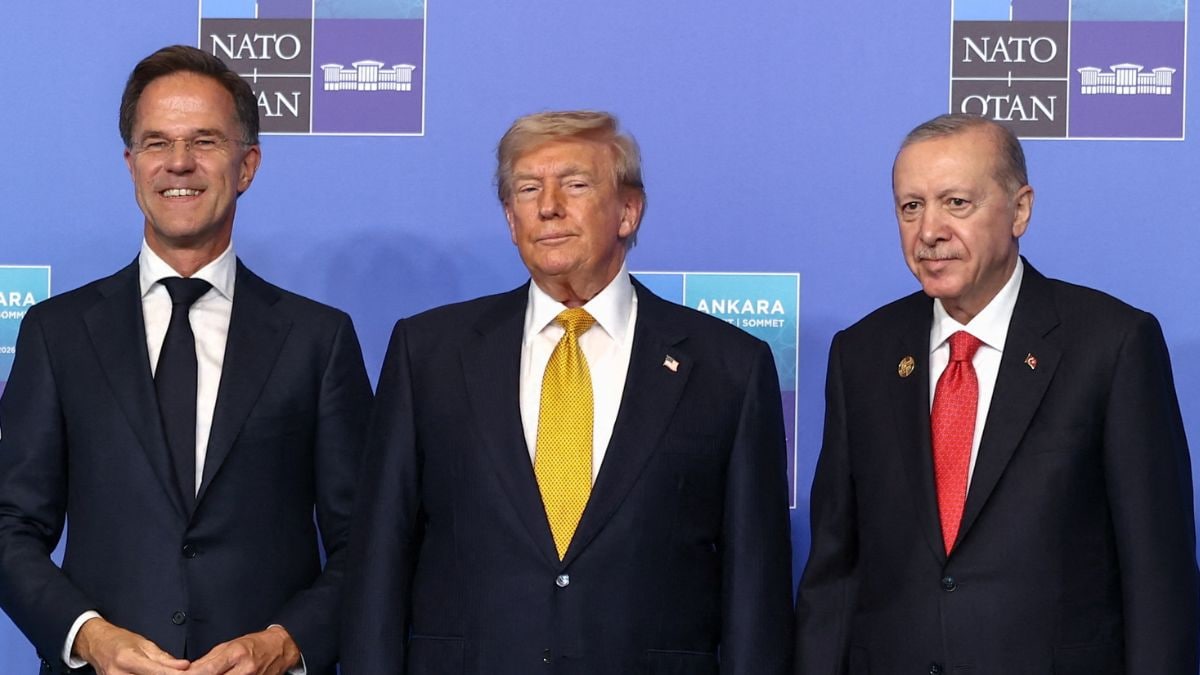
A red carpet is for the exalted VIP status and bestowing of the highest possible protocol for the guest. Whereas a blue carpet is about faith and trust. On July 7, there was a blue carpet laid out for US President Donald Trump by his host Turkish President Recep Tayyip Erdogan at the Etimesgut Air Base near Ankara on July 7.
Erdogan was himself at the tarmac to welcome Trump as a band played ‘The Star-Spangled Banner’ while cannons boomed and fighter jets flew overhead trailing streaking smoke of colours of the American flag. This was an honour accorded to none of the other 30 guests.
And as the proceedings of the two-day NATO Summit unfolded, what was apparent was the bridging of the trust deficit between the two countries. Faith and trust was more like it. And far away in New Delhi, India may have reasons to be worried.
That very day Trump announced the lifting of sanctions that were imposed on Turkey in 2019 after it went ahead to buy Russian S-400 air defence missile systems and indicated that the F-35, among the most formidable of cutting-edge fighter aircraft would be offered for sale to Turkey.
In a way it was about renewing faith in Turkey and Erdogan. In 2020, US had taken off Turkey from the F-35 stealth fighter jet programme.
Heaping praise on Turkey, Trump had said: “Turkey has been, in many ways, much more loyal than other countries that we think would be loyal ... It's a great plane (F-35), it’s the best, currently the best plane by far. And it’s certainly something we will consider (sale of the fighter to Turkey.”
On his part, Erdogan said: “We have discussed this before with the US and were promised five jets... I know that Mr Trump always keeps his promises.”
But then the decision on the S-400 and the F-35 have to pass the legislative test in the US Congress as well as concurrence of the Russians who may be bothered by the end-user clause in sale of military products and platforms.
Within NATO, Turkey has been like the disobedient child, often acting contrary to NATO’s collective stand and position on many issues.
But Turkey, being among the most militarily powerful countries in the NATO and the producer of the feared Bayraktar Akinci combat drone, cannot be ignored by the US for long. Hence the change in Trump’s demeanour in Ankara.
A high-altitude, long-endurance (HALE) combat drone, the Bayraktar Akinci created havoc among the Armenians in the Nagorno-Karabakh (2020) conflict and among Russians in the ongoing war in Ukraine.
But Turkey’s possible ownership of the F-35 has implications for India in an indirect way.
Along with Saudi Arabia and Pakistan, Turkey is part of an emerging bloc that is being called the ‘Islamic NATO’. A fundamental point of agreement in this alliance is that an attack on any one partner would be tantamount to an attack on the other two as well.
Which in effect means that a possible conflict between India and Pakistan would draw in Saudi Arabia and Turkey to fight on Pakistan’s side. And this is where the F-35 stealth fighter’s role allocates a key military advantage.
Notably, Erdogan had personally called Pakistan PM Shehbaz Sharif to declare his solidarity with Pakistan during Operation Sindoor last year when India and Pakistan had embarked in a military fight falling just short of a full-scale war between the South Asian neighbours.
