



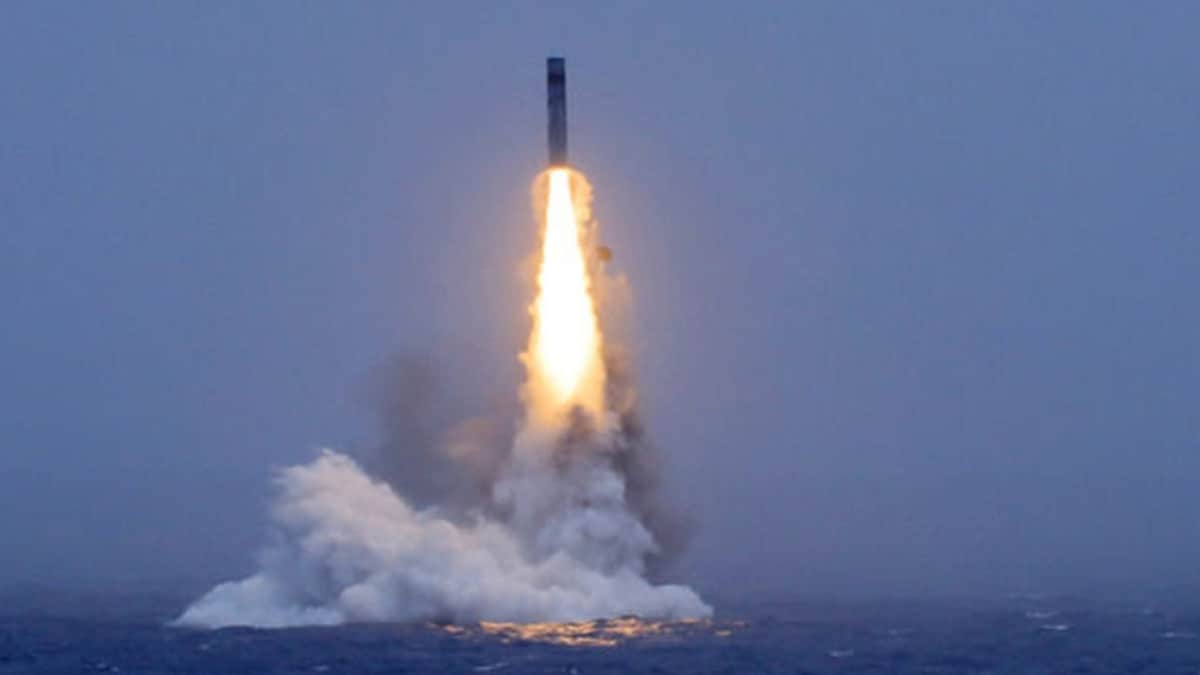
Indian defence experts have warned that China's successful test of a long-range strategic missile from one of its nuclear submarines, which is a significant development in its sea-based nuclear capabilities, could have important implications for India's security environment.
The Chinese People's Liberation Army (PLA) Navy, on Monday, announced that one of its nuclear submarines launched a missile carrying a dummy warhead into the Pacific Ocean. Although Beijing has not officially disclosed the missile's identity, Chinese military experts told state media that it appears to be the JL-3 submarine-launched intercontinental ballistic missile (ICBM), which is believed to have a range of more than 8,000 km.
Chen Xi, a spokesperson for the Ministry of National Defence, claimed that China had informed relevant countries in advance about the test launch. He said this was a routine arrangement of annual military training and adhered to all international laws.
Chinese military analyst Zhang Junshe described the test as significant because nuclear submarines provide the most survivable leg of a country's nuclear deterrent. Operating underwater for extended periods, they are hard to detect and can retain retaliatory strike capability even if land- and air-based nuclear forces are neutralised.
For India, however, defence experts believe the bigger concern lies in how the JL-3 could reshape China's submarine deployments.
According to Brig Arun Sehgal (Retd), the missile's long range means Chinese ballistic missile submarines would no longer need to sail deep into the Pacific to threaten distant targets. Instead, they could remain in relatively secure waters closer to China while retaining their strategic reach.
This, he pointed out, could free up more of the People's Liberation Army Navy's conventional attack submarines for deployment in the Indian Ocean Region, increasing Chinese naval activity closer to India's maritime interests.
Sehgal, speaking to Bharatshakti, said such a shift would add another dimension to India's security challenge by increasing Chinese military presence not only along the Himalayan frontier but also across the Indian Ocean.
He also highlighted the widening gap in sea-based nuclear capabilities. While China's maritime nuclear deterrent has reached operational maturity, he said India's own sea-based deterrent continues to evolve, a factor that could influence strategic stability in the Indo-Pacific.
Another area of concern, according to Sehgal, is China's expanding underwater surveillance effort. He said the growing use of tracking ships and oceanographic research vessels could improve China's understanding of the Indian Ocean's underwater environment.
Such hydrographic and acoustic mapping, he said, would help China improve submarine operations while also enhancing its ability to detect and track India's Arihant-class nuclear submarines.
Talking to the outlet, Naval analyst Captain Sarabjeet Singh Parmar (Retd) also questioned China's choice of conducting the missile test in waters covered by the Treaty of Rarotonga, arguing that it reflected a pattern of disregarding international commitments.
While the full implications of the test remain to be seen, experts believe it signals China's continuing efforts to strengthen its sea-based nuclear deterrent, and India will closely monitor any and all such developments because of their potential impact on the strategic balance in the Indo-Pacific.
