



The recent United States-Israel–Iran confrontation for 40 days, followed by a fragile ceasefire, has once again shown that instability in West Asia rarely stays confined to the region. For India, every major crisis in West Asia has immediate consequences for its energy security, maritime trade, the welfare of millions of expatriates, domestic political sensitivities, and broader geopolitical interests. India’s response to the war was cautious and diplomatic, but it also exposed a larger concern: New Delhi still lacks a clearly articulated regional strategy capable of shaping outcomes, rather than merely reacting to them.
As India seeks to emerge as a leading global power, West Asia can no longer be viewed simply as an energy supplier or a diplomatic theatre. It must be approached as a critical pillar of India’s national security strategy, which must also facilitate its rise as a regional leader and global power.
What Is West Asia?
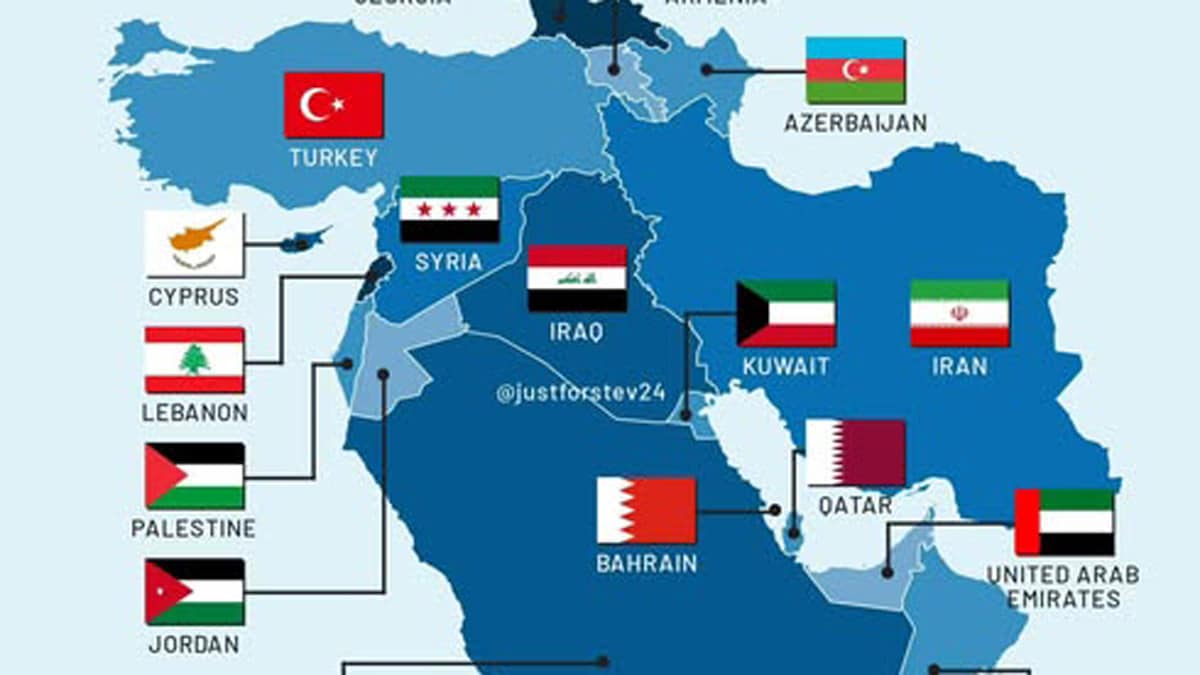
West Asia stretches from the eastern Mediterranean to the Persian Gulf and the Red Sea. It includes Israel, Iran, Saudi Arabia, the UAE, Qatar, Bahrain, Kuwait, Oman, Iraq, Syria, Jordan, Lebanon, Yemen and Egypt. Geographically, it sits astride the Strait of Hormuz, Bab-el-Mandeb and the Suez Canal—three of the world’s most important maritime choke points.
Politically, the region is shaped by the Iran–Saudi rivalry, the Israel-Palestinian conflict, the Arab–Israel conflict, Sunni–Shia competition, Iran-Israel confrontations and proxy wars, terrorism and external intervention. Economically, it is undergoing a profound transformation as Gulf states diversify into finance, logistics, technology, tourism, renewable energy and artificial intelligence. Culturally and as civilisations, India and West Asia have interacted continuously for centuries through trade, migration, religion and maritime commerce. In India, the presence of a large Muslim population also creates important social and political sensitivities regarding developments in Palestine, Jerusalem, Iran and the wider Islamic world.
West Asia is therefore not merely India’s extended neighbourhood; it is one of the principal external arenas where India’s security, prosperity and global ambitions intersect.
Competing regional and global interests
The region is characterised by overlapping fault lines. Iran and Israel remain strategic adversaries. Saudi Arabia and Iran compete for influence despite recent diplomatic rapprochement. Turkey and Pakistan seek larger regional roles, while Egypt, Qatar and the UAE pursue their own strategic visions. Fragile states such as Syria, Iraq, Lebanon and Yemen have become arenas for proxy competition, and non-state actors such as Hamas, Hezbollah and the Houthis add further instability.
The US continues to be the principal external security provider, seeking to protect Israel, secure energy routes and contain hostile actors. Russia maintains influence through Syria, energy diplomacy and defence cooperation. European powers remain focused on energy security, terrorism, migration and maritime stability. Increasingly, however, the region is also becoming an arena of strategic competition involving China and, indirectly, Pakistan.
India’s historical engagement
India’s engagement with West Asia predates the modern state system. Ancient maritime trade connected the Indian coast with Arabia, Persia and the Mediterranean. After independence, India cultivated close ties with the Arab world and strongly supported the Palestinian cause. At the same time, it gradually expanded relations with Israel, establishing full diplomatic ties in 1992.
In recent years, India has achieved a remarkable diplomatic feat: maintaining strong relations simultaneously with Israel, Iran, Saudi Arabia, the UAE, Oman, Qatar and other regional actors. This policy of multi-alignment has generally enabled India to pursue national interests without becoming a participant in regional rivalries.
India’s strategic interests
India’s interests in West Asia are extensive. The region remains a major source of crude oil and liquefied natural gas imports. Nearly nine million Indians live and work across the Gulf, and their remittances contribute substantially to the Indian economy. Trade with Gulf countries has expanded dramatically, while sovereign wealth funds from the UAE, Saudi Arabia and Qatar have become important investors in Indian infrastructure, manufacturing, technology and renewable energy.
Maritime security is another vital interest. A significant portion of India’s external trade passes through the Arabian Sea, the Gulf of Oman, the Strait of Hormuz and the Red Sea. India also relies on regional cooperation for counterterrorism, intelligence sharing, extradition of fugitives and disruption of extremist financing. Connectivity initiatives such as the India-Middle East-Europe Economic Corridor could further enhance India’s access to Europe and the Mediterranean.
The China challenge
China’s growing presence in West Asia represents one of the most significant long-term challenges for India. Beijing is now the largest energy customer for several Gulf states and has invested heavily in ports, industrial zones, telecommunications, digital infrastructure and transportation networks under the Belt and Road Initiative. It has expanded strategic partnerships with Saudi Arabia, the UAE, Iran and other regional actors, while simultaneously deepening defence cooperation and technology transfers. China’s mediation of the Saudi–Iran rapprochement and backing of recent Pakistani mediation efforts demonstrated its ambition to become a major diplomatic actor.
In the post-war environment, regional states seeking diversification of partnerships may increasingly turn to China for investment, technology and security cooperation. A sustained Chinese strategic footprint across ports, logistics hubs, digital networks and critical infrastructure could constrain India’s influence, complicate maritime cooperation in the Indian Ocean and potentially create a network of dual-use facilities that affects India’s security calculus.
The Pakistan challenge
Pakistan also seeks to leverage its historical, military and religious ties with West Asia to counterbalance India. It maintains close defence and security relations with Saudi Arabia and several Gulf states, has supplied military personnel and training to Jordan and Libya, and enjoys a particularly important strategic partnership with Turkey. Pakistan additionally seeks to align its regional diplomacy with China through the China-Pakistan Economic Corridor, linking Gwadar to broader Belt and Road networks.
Although many Gulf countries have substantially improved relations with India and increasingly view New Delhi as an indispensable economic partner, Pakistan continues to exploit Islamic forums, political narratives and security cooperation to limit India’s diplomatic space. In a post-war environment where regional security concerns may intensify, a closer China-Pakistan alignment in West Asia could create new challenges for India in areas ranging from maritime security and intelligence to strategic influence and defence partnerships.
India’s present approach
India’s current policy rests on several principles: maintaining balanced relations with all major actors; avoiding entanglement in regional conflicts; separating bilateral partnerships from ideological disputes; prioritising economic cooperation; and supporting dialogue and de-escalation. This approach has served India well. Only a few countries enjoy good ties simultaneously with Israel, Iran, Saudi Arabia, the UAE and Qatar.
However, strategic balancing has limitations. When regional actors engage in direct military confrontation, neutrality may preserve diplomatic flexibility but does not automatically translate into influence. India must therefore evolve from a policy of careful balancing toward one of selective regional shaping.
Toward a Comprehensive West Asia Strategy
India requires a coherent long-term strategy built on seven pillars.
First, preserve strategic autonomy.
India should avoid becoming part of any exclusive regional bloc, while clearly articulating its core interests: regional stability, secure energy supplies, freedom of navigation, counterterrorism and respect for sovereignty. Strategic autonomy should not mean strategic ambiguity.
Second, deepen differentiated partnerships.
India should continue expanding cooperation with Israel in defence technology, cybersecurity, innovation, water management and agriculture. Simultaneously, it must sustain engagement with Iran through Chabahar Port, the International North-South Transport Corridor and connectivity initiatives linking India with Central Asia and Eurasia. With Saudi Arabia, the UAE, Qatar and Oman, India should pursue long-term partnerships in energy, investment, digital infrastructure, artificial intelligence, food security and advanced manufacturing. Concurrently, in keeping with its ethical heft and aspirations to be a leader of the global South, it must not discard its historical backing for a ‘two-state solution’, including support for the creation of a viable Palestinian state.
Third, become a leading maritime security provider.
India should strengthen naval deployments, maritime domain awareness, anti-piracy operations and logistics arrangements across the Arabian Sea and western Indian Ocean. Protecting sea lines of communication is essential not only for India but also for regional partners that depend upon uninterrupted commerce.
Fourth, build a stronger defence diplomacy.
Joint exercises, officer exchanges, intelligence cooperation, defence exports, and collaboration in emerging technologies such as drones, artificial intelligence, space and cyber security should become major instruments of influence. India must be viewed as a reliable security partner capable of contributing to regional stability.
Fifth, secure energy and technology partnerships.
The future relationship with Gulf states should extend beyond hydrocarbons. Joint investments in green hydrogen, renewable energy, strategic petroleum reserves, semiconductors, critical minerals and AI infrastructure can create long-term interdependence that neither China nor other competitors can easily displace.
Sixth, strengthen crisis preparedness.
The recent conflict underscored the importance of integrated contingency planning for evacuations, cyber attacks, maritime disruptions, energy shortages and supply-chain shocks. India should establish standing mechanisms involving the armed forces, intelligence agencies, shipping authorities, energy companies and diplomatic missions to respond rapidly to regional emergencies.
Seventh, shape the emerging regional architecture.
India should actively support initiatives that encourage connectivity, economic integration and conflict reduction. Forums such as I2U2 and projects such as IMEC provide opportunities to connect the Gulf, India and Europe through trade, infrastructure, technology and energy cooperation. India must create the heft and image to become a formal mediator in regional disputes, as it possesses sufficient credibility with most major actors to facilitate dialogue and promote de-escalation - when conflicts break out.
The post-war opportunity
Paradoxically, major conflicts often create opportunities for strategic realignment. Many Gulf states increasingly prioritise economic transformation over perpetual confrontation. Israel seeks wider regional integration despite continuing security concerns. Iran will eventually require greater economic engagement with the outside world. Regional powers are diversifying their partnerships rather than relying exclusively on any single external actor.
India possesses a unique advantage in this environment. Unlike many major powers, it carries little colonial baggage, has not pursued interventionist policies, and enjoys broad goodwill across competing camps. Arab monarchies see India as a trusted economic partner; Israel values strategic cooperation; Iran views India as an important civilizational and geopolitical interlocutor; and the wider Global South traditionally perceives India as an independent and ethical voice in the post-colonial era.
This diplomatic and moral capital should not be squandered. If effectively leveraged, India can become not merely a stakeholder unaffected by regional crises but a significant contributor to a more stable regional order.
Conclusion
West Asia has become central to India’s energy security, maritime trade, diaspora interests, technological partnerships, connectivity ambitions and geopolitical competition with its adversarial neighbours. The emerging regional order is being reshaped by great-power rivalry, economic transformation, technological change and recurring military crises.
India can no longer rely solely on ad hoc responses and diplomatic balancing. It needs an integrated national strategy for West Asia that combines diplomacy, defence, moral heft, maritime security, economic engagement, technology cooperation, connectivity and crisis preparedness. Such a strategy must preserve India’s strategic autonomy while simultaneously countering the expanding influence of China and the disruptive potential of the China-Pakistan partnership.
The objective is not to choose between Israel and Iran, or between competing regional blocs. Rather, it is to position India as a just, trusted, capable and increasingly influential power that can protect its interests while contributing to a more stable, prosperous and cooperative West Asia. As India rises on the world stage, its role in West Asia must evolve accordingly—from balancing competing interests to helping shape a positive future for the region itself.
(Lt Gen Philip Campose (Retired) is a former Vice Chief of the Indian Army. He has authored a book titled ‘A National Security Strategy for India: The Way Forward’)
(The opinions expressed in this article are those of the author and do not purport to reflect the opinions or views of THE WEEK.)
