



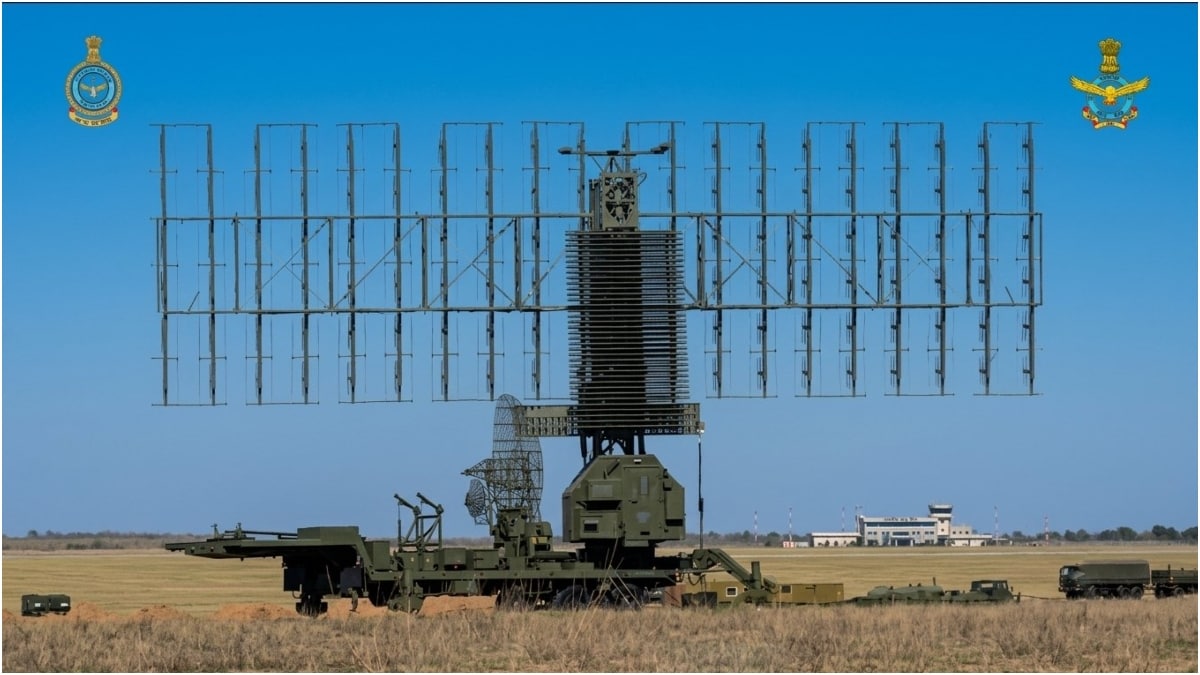
India’s deployment of the VHF 55Zh6ME Nebo-UM radar is being seen by global military analysts as a concerted effort to up its long-range detection and awareness game in light of potential threats that Chinese and Pakistani stealth fighter jets pose.
Beijing’s J-20 stealth fighter jets can trick conventional radar systems, and Pakistan’s access to them has intensified New Delhi’s need to induct appropriate anti-stealth surveillance technology. This is said to have resulted in the induction of the Russian Nebo-UM radar systems, which reportedly made a public appearance during the Indian Air Force’s Vayu Shakti 2026 exercise at the Pokhran Firing Range in Jaisalmer, Rajasthan.
The Nebo-UM can track stealth fighter jets at a distance of 250 kilometres if conditions are favourable. Other aircraft can be spotted at ranges as far as 600 kilometres, reports said. The Nebo-UM is reportedly capable of tracking aerial objects at speeds exceeding Mach 6.4. This means it can serve the double purpose of being a ballistic missile warning system as well as an anti-stealth surveillance expert. According to available information, these Russian machines are specifically designed to exploit weaknesses in stealth technology.
How stealth aircraft detectors work?
These modern radars operate in the VHF frequency spectrum, which uses long waves to interact differently with the physical structure of modern fighter aircraft. Unlike conventional high-frequency radar, VHF waves interact with large aircraft structures such as wings, vertical stabilisers, and the main fuselage, thus producing clearer radar reflections, Defence Security Asia said in a report.
They reportedly operate in the VHF frequency range between 133 to 144 MHz as well as 216 to 225 MHz. This allows the system to exploit the physical characteristics of stealth aircraft. “The modern digital signal processing architecture on Nebo-UM also enhances jamming rejection and electronic counter-countermeasure capabilities, allowing it to operate more effectively in contested electromagnetic environments.
The integration of the radar into India’s air defence network also reflects a global trend that increasingly favours sensor fusion, distributed surveillance architectures, and jamming-resistant early warning capabilities over high-cost static radar installations,” Defence Security Asia said in a report.
Mobile and resilient
The entire system is mounted on a BAZ-6909 high-mobility vehicle in an 8×8 configuration, meaning the operating force can quickly relocate the prized asset to a secure location in the event of a missile or electronic warfare threat. This is a crucial factor as both Pakistan and China have got enough firepower to target India’s permanent radar installations near the borders.
Nebo-UM radars can operate independently or can be integrated into the broader sensor network of the IAF. It has got dispersed radar nodes which make it harder for an enemy to disable air defence systems in the early stages of a high-intensity conflict, the report said.
