



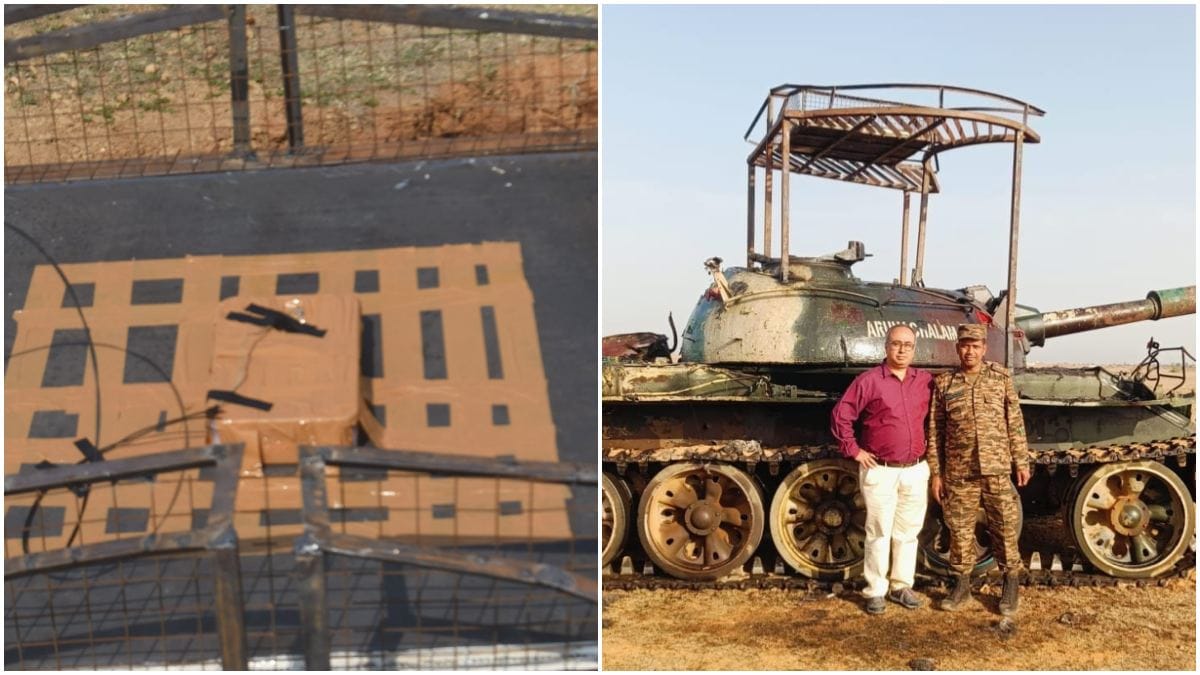
The rise of drones, loitering munitions and precision-guided weapons has fundamentally altered the battlefield, making tanks and armoured vehicles that once dominated open combat zones increasingly vulnerable. As anti-tank guided missiles and drone-delivered munitions become common, militaries across the world are searching for new ways to improve battlefield survivability.
Against this backdrop, an indigenous composite armour system developed by researchers at Amrita Vishwa Vidyapeetham has successfully completed multiple evaluations by the Indian Army and is now being considered for deployment on armoured platforms.
Known as the Maharana Pratap Singh Composite Armour, the technology has been developed under the leadership of Prof. Dr. Shantanu Bhowmik of Amrita Vishwa Vidyapeetham in collaboration with ACE Gas Conversions Pvt. Ltd., Mumbai.
Designed for the drone age
The armour system has been specifically developed to protect military platforms like tanks against drone-delivered explosives, improvised explosive devices (IEDs), battlefield blasts and ballistic threats, while maintaining a lightweight composite structure.
Its relevance has grown as armies increasingly look for ways to protect tanks from top-attack drone strikes.
A key application being explored by the Indian Army is the use of the composite armour as a protective "cope cage" shield. A cope cage, also known as slat armour or anti-drone mesh, is a metal structure mounted above a tank to act as a standoff barrier against incoming top-attack munitions and FPV drones.
The armour's strategic significance became apparent in 2025 when Brigadier Subhankar Sengupta of the Indian Army's Jhansi formation explored the use of the composite armour as protective "cope cage" shielding for tanks against top-attack drone munitions, according to a statement.
Army trials and validation
The project achieved a major milestone when blast trials were successfully conducted at the Terminal Ballistics Research Laboratory (TBRL) in Chandigarh under the defence ministry.
The technology was also reviewed during a high-level defence evaluation meeting at Amrita University's Coimbatore campus in September 2023, attended by representatives from the Indian Army, Navy, Air Force, Coast Guard and the national security establishment.
The evaluation process culminated in extensive technical assessments that received approval from senior defence and national security leadership, including National Security Adviser Ajit Doval.
Further momentum came in January 2026 when Brigadier Sumit Rawat of the Indian Army's White Tiger Division initiated field validation trials using composite armour panels supplied by the research team.
Most recently, the system received formal appreciation from the Indian Army's 31 Armoured Division after capability evaluation tests at the Babina Field Firing Ranges.
“During the trials, a 110-kilogram composite armour plate measuring one metre by one metre successfully withstood the impact of an improvised explosive charge comprising explosive and splinter components designed to simulate battlefield conditions,” the statement from Amrita University said.
According to an official communication issued by Major General Mandeep Singh, General Officer Commanding, 31 Armoured Division, the armour demonstrated the ability to sustain explosive impacts and showed significant potential for protecting military equipment against blast and IED threats.
Multiple layers of protection
According to the development team, the Maharana Pratap Singh Composite Armour combines several protection capabilities within a single platform.
The system is resistant to IED and blast impacts and is capable of providing ballistic protection against AK-203 assault rifle fire and Light Machine Gun threats. It has also been engineered with soundproofing characteristics and can be adapted for armoured vehicles, military infrastructure and other strategic defence applications.
Prof. Bhowmik said the armour was named after Maharana Pratap to symbolise resilience, strength and battlefield reliability. He added that the technology represents nearly a decade of research into advanced hybrid composites and indigenous protective materials.
With successful Army evaluations completed and deployment discussions underway, the Maharana Pratap Singh Composite Armour represents an indigenous effort to address one of modern warfare's biggest challenges: protecting armoured platforms from increasingly sophisticated drone and explosive threats.
“The innovation arrives at a time when militaries worldwide are reassessing battlefield survivability in response to the rapid proliferation of low-cost drones, loitering munitions, and top-attack explosive systems,” the Amrita University statement added.
