



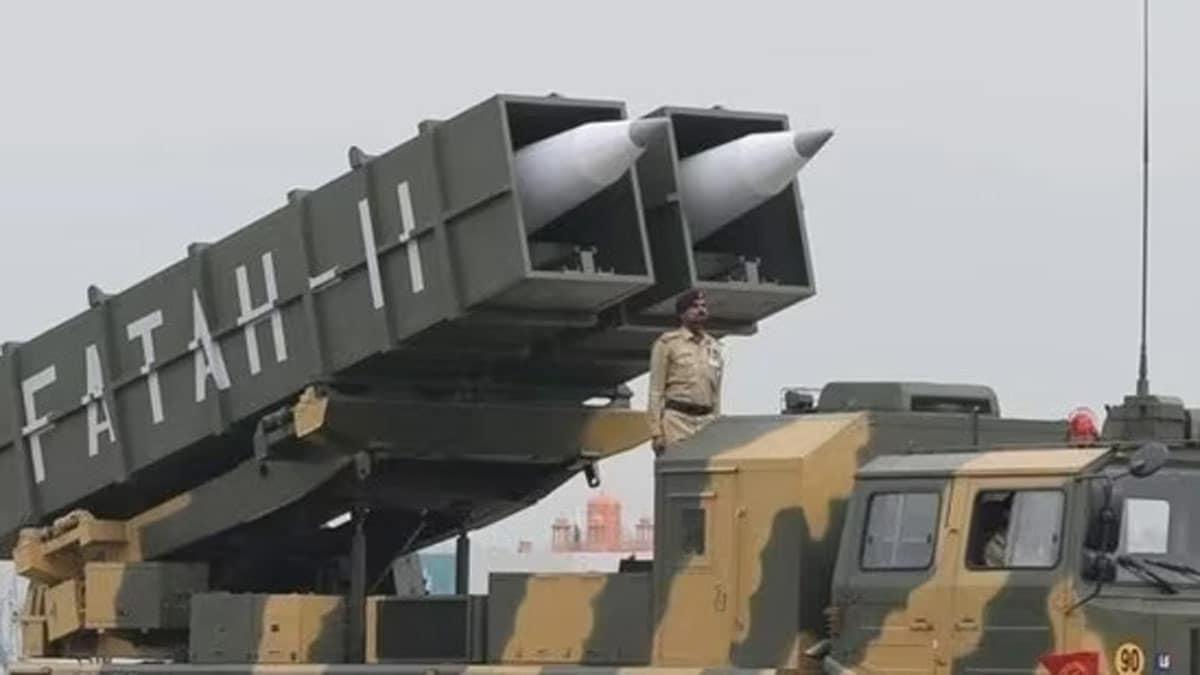
A strange video was doing the rounds last year during the 88-hour-long fight between India and Pakistan on land, air and sea. A battery of Pakistan’s well-publicised Fatah series rocket system was being fired at Indian positions amid lusty cheering by civilians, even as they crowded around the launcher. Yes, the gun battery was being deployed in the thickly populated area of Shakargarh in Pakistan’s Punjab.
The cheering civilians were seemingly least aware of the grave risks posed by the deployment of high-value military assets in close proximity to residential homes.
A top security establishment source familiar with Pakistan’s artillery and other gun positions told THE WEEK: “The Pakistan army has long followed a pattern of deploying firing detachments, artillery guns, rockets, missiles, air defence systems, and drone-launch infrastructure within densely populated civilian areas. This practice has been repeatedly observed not only during routine deployments along the LoC, but also during military operations such as Operation Bunyan-un- Marsoos in May 2025.”
Operation Bunyan-un-Marsoos was launched to retaliate against India’s Operation Sindoor. During the operation, multiple civilian localities and populated areas were also newly converted into active military sites.
Rather than being incidental, this systematic militarisation of civilian zones by the Pakistan army appears to form part of a deliberate operational two-fold strategy. Firstly, the presence of military assets amid civilian populations is intended to deter retaliatory action by the adversary due to the risk of collateral civilian casualties. Secondly, if these positions are targeted in response, any resulting civilian damage can subsequently be exploited for narrative warfare, propaganda campaigns, and the generation of domestic as well as international sympathy.
On the nights of May 8 and 9, 2025, Pakistan launched numerous drones towards India using infrastructure and launch sites situated within or adjacent to civilian zones. To cite examples, these included facilities at the Sialkot International Airport, a drone launch site near the Government Girls’ High School in Jandrot, Kotli, and at Padhar in Havelian district—both places in Pakistan-occupied Kashmir (PoK), and the use of Mai Bhakhtawar International Civil Airport at Islamkot as a drone-launching hub for military operations.
Similarly, the recently inducted Chinese-origin SH-15 Mounted Gun System was deployed at Bareela Sharif village in Punjab’s Gujrat district, on May 8, 2025, from where it conducted active firing missions. Another SH-15 deployment was reportedly identified near the Rawalakot Advanced Landing Ground (ALG), situated in close proximity to civilian habitations from where firing towards Indian civilian areas in the Poonch district was carried out.
Additional reports and visuals indicated the deployment of an air defence gun system in Kotla village, Gujarat, an RBS-70 MANPADS positioned on the roof of a civilian house in Zafarwal, Punjab, and artillery systems placed near Bunguna Sahib Singh School.
A common sight along swaths of the Line of Control (LoC) is that Pakistani villages are located just 100-200 metres from the de facto border while the Indian side of the LoC is very sparsely populated. This results in much collateral damage across the border to civilian lives and infrastructure during firings and military conflicts. That civilian houses have frequently been used as staging points and launch pads to facilitate infiltration attempts into Indian territory is a known fact.
