



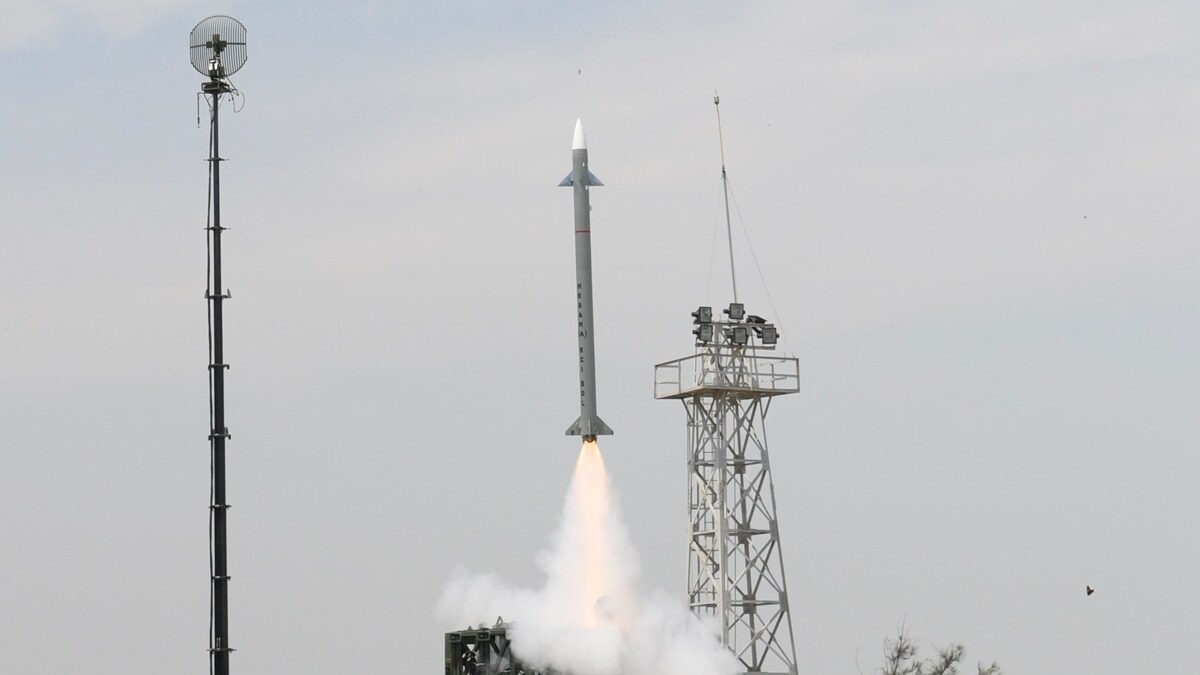
The Indian Air Force's Barak-8 is in the news again after it was revealed that the air defence system was used to bring down a Pakistani ballistic missile intended for New Delhi when Operation Sindoor was at its height. Reports said that what was presumably a Shaheen-II variant from Islamabad's arsenal met its end in Sirsa, Haryana, after being intercepted by a Barak-8, according to the IAF's Air Officer Commanding (AOC) of 45 Wing.
Barak-8 systems were developed jointly by Israel Aerospace Industries and the Defence Research and Development Organisation (DRDO), with the backing of Rafael, Bharat Electronics Limited, Bharat Dynamics Limited, and Larsen & Toubro. Israeli media reports stated that the sale of the missile system to New Delhi was made in 2017 for approximately $1.6 billion. A month later, a $630 million deal followed for the naval version, which had already been enrolled in the Indian Navy before the IAF variant was inducted.
An Indo-Israeli breakthrough
The Barak-8, a medium-range surface-to-air missile (MRSAM) system, was officially inducted into the IAF in September 2021. Defence Minister Rajnath Singh called it a "game changer," stating during the induction in Jaisalmer that “the system is capable of hitting multiple targets simultaneously up to a range of 70 km, even in bad weather. Its success in a string of stringent tests is proof of its reliability.”
Technical features and lethality
Designed to take out aerial threats—including fighter jets, missiles, helicopters, and unmanned aerial vehicles (UAVs)—the Barak-8 features a maximum speed of Mach 2 (approximately 2,470 km/h). While the standard operational range is 70 km, the introduction of the Barak-8 ER (Extended Range) has increased that capability to 150 km.
The missiles are powered by an indigenous rocket motor and control system designed for high manoeuvrability in the terminal phase. They are supported by advanced radar, command-and-control systems, and mobile launchers. The naval version, specifically, features the MF-STAR 360º radar system, which harnesses multiple sensors and launch platforms into a single, cohesive air defence network.
"By fitting a data link to each interceptor, missiles can be updated via data link after launch by any network member," a 2019 report noted regarding the system's sophisticated software. "With this capability, Barak-8 missiles can receive target updates on their mid-course... retasking the highest priority target until the missile enters the terminal engagement."
This capability prioritises missile utilisation and battle economy, allowing a single unit to orchestrate an entire air defence mission or allocate targets to other platforms as needed, The Jerusalem Post claimed. The significance of these deals held the record for Israel Aerospace Industries until the $3.5 billion sale of the Arrow-3 system to Germany in 2023.
