



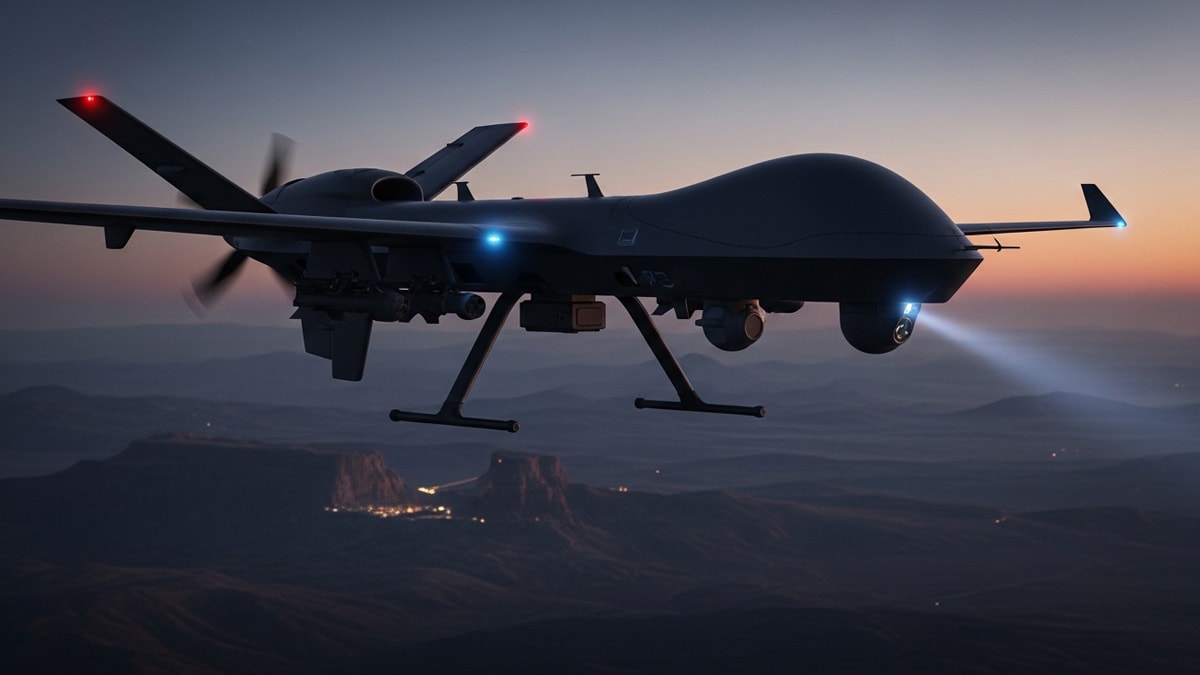
In a bid to enhance the war readiness of the security forces, the government is planning to design and develop an unmanned combat search-and-rescue aircraft for the Indian Air Force (IAF). The government is envisaging the platform as a runway-independent UAV capable of carrying out aircrew rescue missions without putting manned aircraft at risk.
According to officials, the proposed indigenous autonomous system is also intended to function as a logistics platform, capable of transporting supplies to forward locations and harsh terrains, including snow-bound high-altitude areas, where conventional helicopters face operational challenges.
The project, envisioned under Defence Acquisition Procedure (DAP) 2020, has been "approved in principle," news agency PTI quoted a senior officer as saying.
Under the proposed project, a "runway-independent UAV" (unmanned aerial vehicle) combat search and rescue (CSAR) drone is to be designed and developed that "can go into operations, and rescue aircrew without risking manned aircraft," the official said.
According to the outlined specifications, the proposed platform should be capable of operating from sea level up to 16,000 ft—extendable to 20,000 ft if required—and deliver a minimum operational radius of 200 km with an endurance that includes at least 45 minutes of loiter time, officials noted.
It must also be able to carry a payload of at least 400 kg, accommodating up to four personnel along with stretchers.
The runway-independent UAV is expected to feature autonomous take-off, navigation, and landing capabilities, along with the ability to search, locate, and touch down using an integrated Emergency Locator Transmitter (ELT), officials added.
Additionally, the platform should be capable of operating from unprepared surfaces and function effectively even in environments where Global Navigation Satellite System (GNSS) signals are unavailable.
Taken together, these requirements position the proposed “CSAR drone” as one of the most advanced indigenous UAV platforms in India’s defence ecosystem, combining AI-enabled autonomy, all-weather operability, and combat-focused functionality, a senior official said.
The project is structured under 'Make-I' category, under which the government supports 70 per cent of development costs while the vendors cover the remaining 30 per cent.
After successful development, procurement will follow the 'Buy (Indian-IDDM)' route, ensuring at least 50 per cent indigenous content in material, components, and software, the officials said.
