



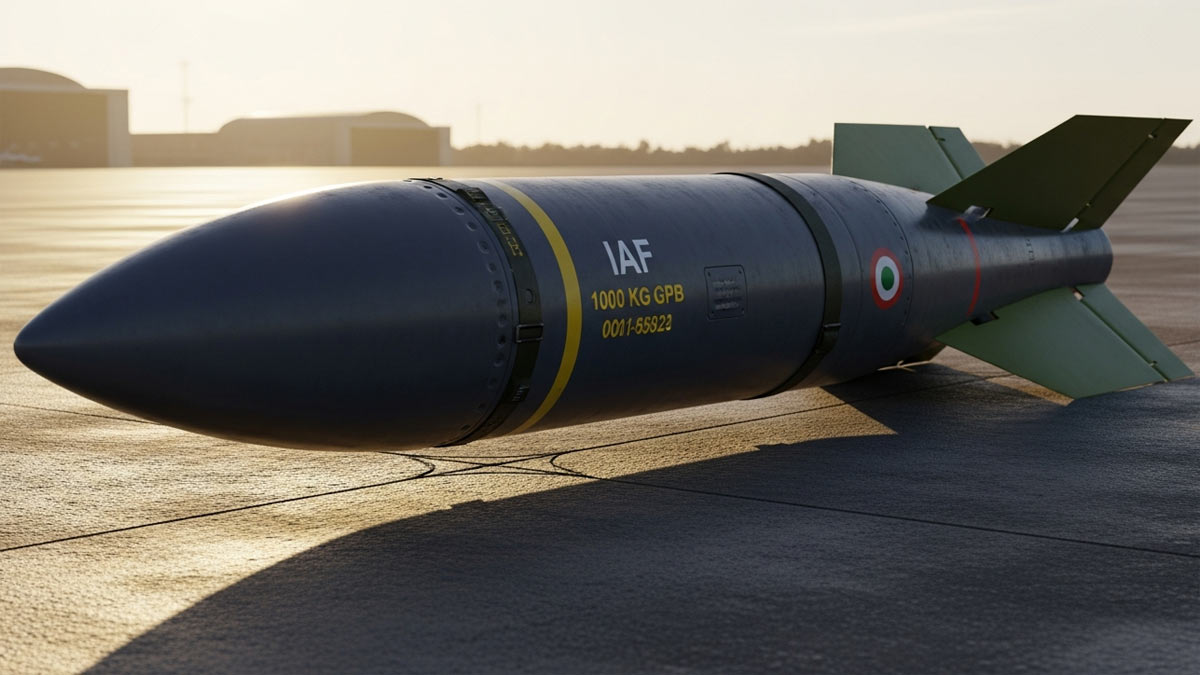
If all goes according to the plans of the defence ministry, India may soon begin development of a 1000-kg aerial bomb that is similar to the nearly 1000kg MK-84 general-purpose bomb from the US military's Mark 80 series, for the Indian Air Force. IAF already uses MK-84 bombs.
According to media reports, the ministry has begun the process for the indigenous design and development of such a bomb in line with the government's push for self-reliance in defence.
According to a senior official, the ministry has issued an Expression of Interest (EoI) for the design, development and procurement of 1,000-kg aerial bombs (akin to Mk-84) along with tail units and associated equipment under the provisions of the Defence Acquisition Procedure (DAP) 2020.
The project will be executed under the 'Make-II' (industry-funded) sub-category, followed by procurement under the 'Buy (Indian IDDM or Indigenously Designed, Developed and Manufactured)' category.
As many as 600 aerial bombs are planned to be procured under the 'Buy (IndianIDDM)' category in accordance with the DAP 2020 provisions.
Currently, Mk-84 class general-purpose bombs are procured for the IAF from foreign original equipment manufacturers and are in service with the IAF.
The proposed aerial bomb is described as a "natural fragmentation, high-calibre munition capable of generating high blast effect and significant peak over-pressure (PoP) against enemy targets", according to the officials.
The project is planned in two stages. The first stage covers the design and development of six prototypes—both live and inert—along with the required tail assemblies and related equipment, officials said. The second stage will focus on procurement, beginning with the issuance of a commercial Request for Proposal (RFP) to the shortlisted development agencies.
The development phase is required to achieve a minimum of 50 per cent indigenous content.
The estimated timeline for the project is about 2.5 years from the issuance of EoI to the signing of the contract, including prototype development, user trials, evaluation, commercial processes, and contract finalisation.
Indian defence players, including private defence contractors, can participate in the EoI with provisions for foreign collaboration under defined conditions, such as joint ventures, transfer of technology, or commercial off-the-shelf arrangements.
