



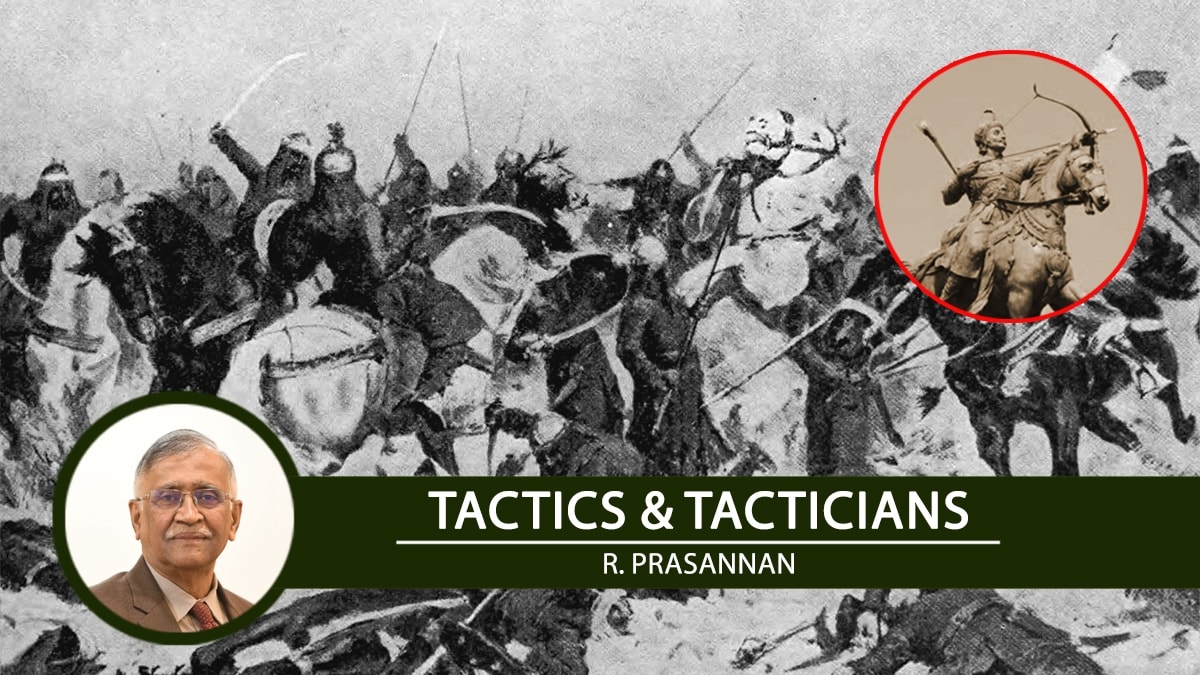
The tale of Prithviraj Chauhan, who ruled Delhi and Ajmer in the 12th century, is a stellar example to show that in war, strategy and cunning manoeuvres are more important than strength and valour.
In the history of India, there have been few warriors who could pose a challenge to this Rajput king in terms of personal courage, battle bravery and martial prowess. However, his reluctance to formulate strategic plans with diplomatic finesse and care, and a hesitation to craft tactics with cunningness, are widely regarded as key factors that led to his eventual downfall.
Learning lessons from past battles was a common practice among commanders worldwide. However, with the exception of a few unique geniuses like Shivaji, there is hardly any evidence to suggest that Indian kings followed this practice. Likewise, refraining from repeating a previously tried-out battle formation was a principle commonly upheld by military commanders. Prithviraj does not seem to have followed this either. When Prithviraj clashed the second time with the Afghan invader Mu'izz al-Din Muhammad ibn Sam, also known as Muhammad of Ghor or Muhammad Ghori, on the battlefield of Tarain (in modern-day Haryana), he deployed his army in the same pattern as he had in the previous battle. In other words, he presented his phalanxes before the enemy in the manner the enemy expected him to do.
Prithviraj’s first mistake was that he had alienated several fellow Rajput kings, and many of them had turned against him. It is said that his father-in-law, Raja Jaichand, himself was among his worst enemies, after Prithviraj had abducted his daughter Samyukta in ‘brave young Lochinwar’ style. Suffice it to say, he had few allies to aid him when the Afghan warlord threatened his kingdom.
Let’s examine what exactly happened in his two battles with Ghori. Ghori made his first attempt to capture Delhi in 1191. The Afghan and the Rajput armies clashed at Tarain, and Prithviraj emerged victorious. Ghori was wounded and felled from his horse, but a fast-riding Afghan cavalryman lifted him onto a horse and carried him to safety.
Despite the rout, Ghori, a veteran of many battles, made a thorough study of the Rajput army's battle order. He learnt that Prithviraj, like most Rajput kings, liked to deploy his army in large formations, giving prominence to the elephant corps, which was placed at the centre, and positioned the cavalry on the flanks and at the rear. Ghori had seen this in his 1191 battle.
When Ghori returned a year later to face Prithviraj in the same battlefield of Tarain, he saw that Prithviraj had repeated the same pattern of deployment. Accordingly, Ghori completely changed his own battle formation. He divided his cavalry-dominant army into smaller units and deployed them on the flanks, with his main cavalry and infantry in the centre.
The two armies stood facing each other again on the plains of Tarain. In the night, Ghori sent out a few horsemen to launch minor attacks on the Chauhan army so as to weary them out. Then in the morning, the Afghan launched his main assault. First, he sent a small cavalry unit to shower arrows on one flank of the Chauhan army. As soon as Prithviraj's cavalry moved to counter them, the Afghans retreated and attacked the opposite flank. When Prithviraj's army moved to counter this, they retreated again.
As Ghori repeated this manoeuvre four times, the Chauhan army was confused. As they shifted back and forth from left to right, a gap opened up in their centre. Seizing that opportunity, Ghori sent his large cavalry force, followed by the infantry, into this gap, while the smaller cavalry units attacked simultaneously from both flanks. With this, Prithviraj's army was split apart. It is said that between 50,000 and 70,000 Rajput soldiers fell on that battlefield.
There are differing accounts among historians as to whether Prithviraj was killed in the battle or was captured and executed. There is also a legend that he was taken prisoner to Kabul, where the blinded hero slew Ghori with a single arrow shot. Anyway, the fact is that this brave warrior could have carried the day – and the history of India would have been different – if he had shown a little more tact and battle cunning, along with his unparalleled personal courage and fighting prowess.
