



The war of 1971 was about to begin. Although the military campaign was planned jointly and executed by all three services together, the Indian Army and the Air Force were to play a more prominent role. The military objectives were: on the eastern front, defeat the Pakistani army in East Bengal (now Bangladesh) and force them to surrender before the Americans arrived with their 7th fleet and forced a ceasefire; on the western front, to hold back the enemy and, if needed, launch minor ground offensives into West Pakistan so as to prevent an enemy attack from there.
The Army would do the main ground job of reaching and capturing Dacca (now Dhaka), mainly by bypassing the enemy’s defensive formations on the way, and racing through the by-lanes. The IAF would guard the airspace, destroy enemy airfields and aircraft, do interdiction bombing of the enemy’s military installations, bridges, railheads, and give air support to the Army (bomb large enemy formations if the Army finds them too difficult to destroy with their guns, tanks, and helicopters).
The Navy was to play only a supporting role. In all the three previous wars of India (1947-48, 1962 and 1965), the Navy had no role to play, or a very limited role (1965) of simply guarding the Bombay (now Mumbai) Port and the western coast. As Chief of the Naval Staff, Admiral S.M. Nanda, told me many years later, “Every day we had meetings. The Prime Minister would be briefed first by the Army, then by the Air Force and then she would turn to me, asking, ‘Well, Admiral, I guess there’s nothing much to add from your side.’”
Nanda decided this was unacceptable. “My boys too wanted to have our war,” he said. He and his staff then devised a plan to attack Karachi.
ALSO READ: Water as weapon: How Brig. Theogaraj bogged down Pakistani Pattons
That was too daring a call. Karachi was the fortress of the Pakistani fleet, guarded by its prime warships. Even Vice-Admiral S.N. Kohli, the head of the Western Naval Command in Bombay who was responsible for protecting the Arabian Sea, was sceptical.
Nanda persuaded them on why Karachi had to be destroyed—only by hitting the enemy in his own base could India ensure he wouldn’t raise his head again. You have to beard the lion in his den.
But where were the warships suitable for such a mission? The only carrier India had, INS Vikrant, was in the eastern sea.
Vikrant will be in the east, Nanda explained. It serves two purposes. One, it could delay the American fleet coming to the aid of the Pakistani forces in the east. Two, when the Pakistani Navy learned that the Vikrant was in the east, they would lower their guard in Karachi. At that moment, India could send the small missile boats to destroy Karachi.
Then who will guard Bombay? Nanda was asked.
You answered that question, Nanda told them. If the Pakistani warships are guarding Karachi, who is coming to attack Bombay?
Soon, Indira Gandhi was convinced. “Go ahead, Admiral!” she told him.
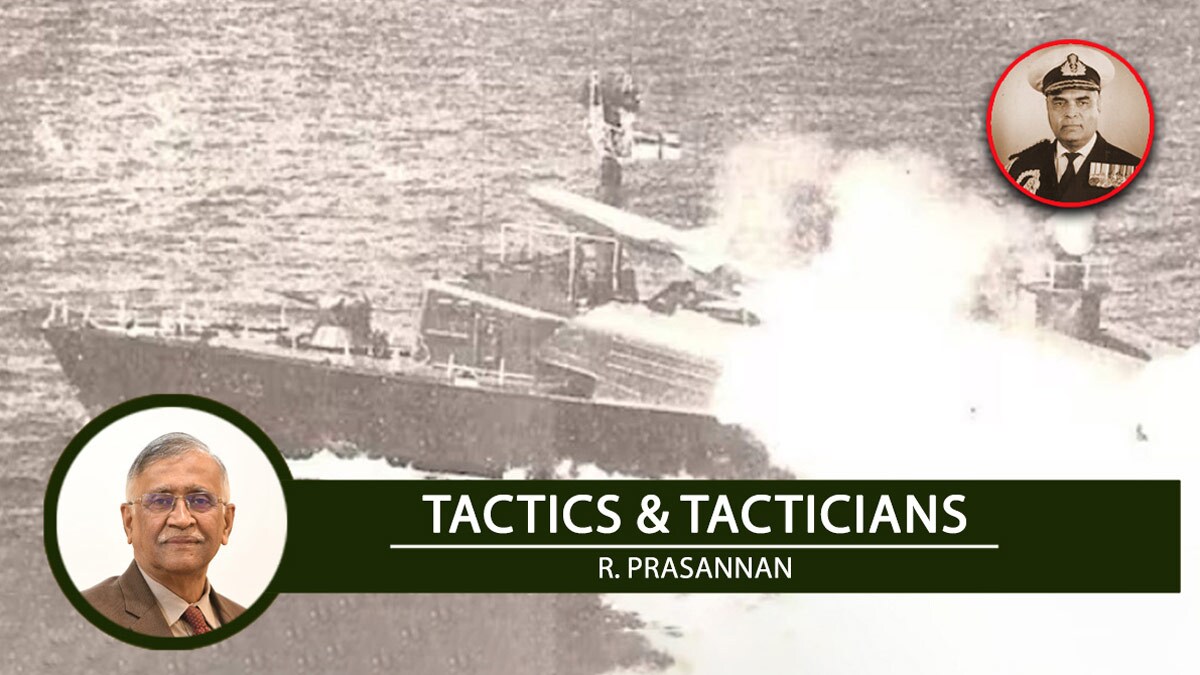
Everything happened just as Nanda had predicted. With INS Vikrant in the eastern sea, the Pakistani Navy, believing they were safe, lowered their guard around Karachi. Still, Nanda was careful. He didn’t want the enemy to spot any ship or boat movement from Bombay. The western fleet commander, Rear Admiral E.C. Kuruvila, ordered that the newly acquired Russian-origin Oza class missile boats be quietly towed from Bombay to Jamnagar, which was closer to Karachi. And then on the night of December 4-5, they inched closer to Karachi and, as they approached the vicinity of the port, raced full throttle towards the port and fired volleys of missiles. Together with two corvettes, they destroyed a Pakistani minesweeper, a cargo ship carrying ammunition, and all the oil tankers in Karachi. The operation, called ‘Trident’, was followed up with a similar one, ‘Operation Python’, three days later, which destroyed the Pakistani fleet and port almost entirely.
The bombardment of Karachi is still regarded as one of the most daring naval attacks in the post-World War era, and the only instance when a port was attacked twice within a week. The operation is celebrated by the Indian Navy on December 4 every year as the Navy Day.
