



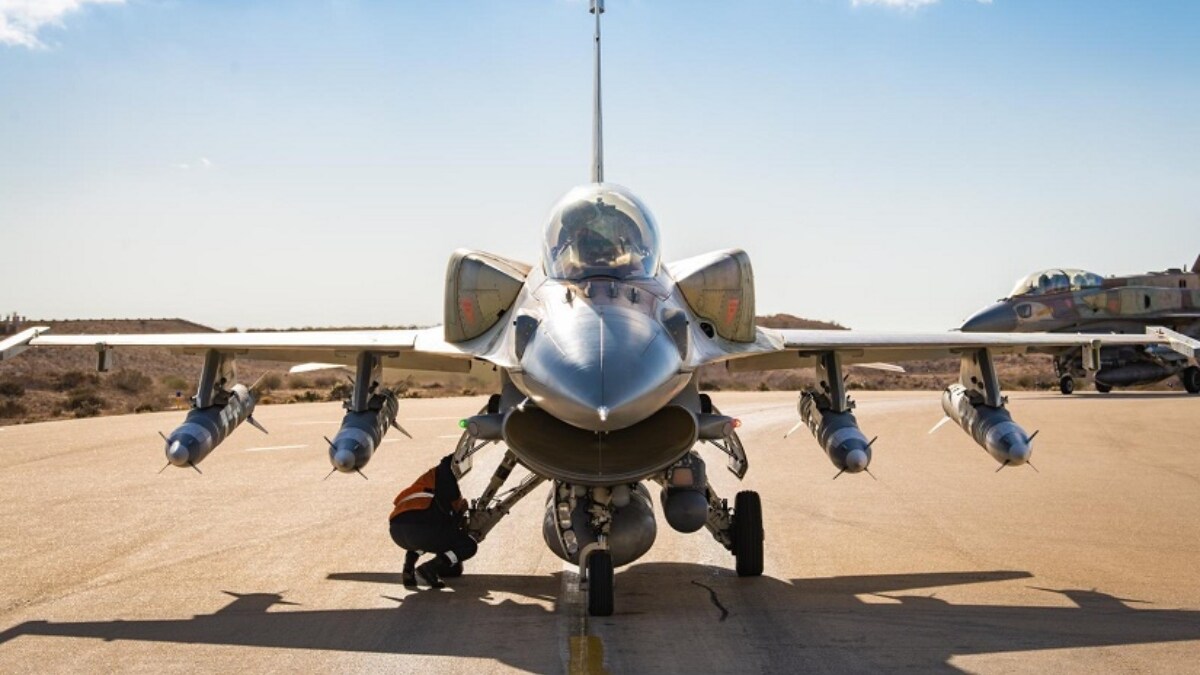
India is on the verge of buying a thousand units of SPICE-1000 precision-guided bombs from Israel as part of an $8.7 billion defence agreement. The Defence Acquisition Council, chaired by Defence Minister Rajnath Singh, approved the purchase, which reportedly also includes air-to-air missiles, loitering munitions, radars, simulators, and networked command systems.
According to international sources, India is the biggest customer of Israeli defence industries, accounting for about 34% of all exports between 2020 and 2024. News outlets in Tel Aviv, while reporting on the new defence purchase, also added that India is close to getting Air LORA ballistic missiles from Israel Aerospace Industries (IAI), a state-owned aerospace and aviation manufacturer. LORA ('LO'ng 'R'ange 'A'rtillery), the theatre quasi-ballistic missile, is already in use by India (along with Azerbaijan). In 2023, Bharat Electronics Limited (BEL) announced that it will be jointly producing the LORA surface-to-surface missile system in India with technical support from IAI.
AIR LORA, as the name indicates, is an air-to-ground variant of the weapon that is being described as a Deep Stand-Off Air-Launched Ballistic Missile (ALBM) by the manufacturers. They are produced by IAI's MLM (Missiles, Launchers, & Space) Division, located in Be'er Yaakov, to target missile sites, military bases, and air defence systems. Like the SPICE-1000 kits, Air LORA also works on a “fire-and-forget” principle, meaning it can operate without constant human control after launch. In July 2025, THE WEEK had reported that IAI claims Air LORA is a game-changer in air-to-ground missile technology, providing accurate and survivable attack capabilities.
The Israeli media claimed that India is also considering getting Rafael's Ice Breaker cruise missiles and IAI's Rampage missiles along with Air LORAs. Here are 10 things to know about the missiles that will further add teeth to the Indian Air Force's (IAF) arsenal if the defence deal is sealed:
Rampage
1. Long-range air-to-ground precise-strike Rampage missiles are already used by the Indian Navy and the IAF. Greece is also set to procure these systems, which are claimed to be "compatible with Western and Eastern fighters". According to IAI, typical targets of these projectiles include airbases and air defence assets, control towers, bunkers, command posts, and logistics centres.
2. Each Rampage unit weighs approximately 570 kg and has a total length of about 4.7 metres. It features a diameter of 306 mm and utilises a GPS/INS guidance system equipped with anti-jamming capabilities, and it comes with a Blast/Frag/Ground Penetration warhead.
3. A medium-sized combat aircraft can carry up to four missiles each and can either concentrate salvo fire on a single target or engage targets simultaneously. "Designed to launch from a stand-off distance, RAMPAGE minimises risks to aircraft and crew by enabling operations well outside enemy air defences," the IAI website said.
4. In 2024, the IAF inducted the Rampage into its fleet of Russian-origin aircraft, including the Su-30 MKI, MiG-29, and Jaguar fighter jets, ANI said. The Indian Navy, meanwhile, armed its fleet of MiG-29K naval fighter jets, the news agency added. During 'Operation Sindoor', Pakistani terror camps in Bahawalpur and Muridke were struck and damaged using the Rampage missile by the IAF.
Air LORA
5. Equipped with either blast fragmentation or deep penetration warheads, AIR LORA is optimised for stand-off range accuracy, capable of striking targets with supersonic velocity. According to the IAI, these Air-Launched Ballistic Missiles (ALBM) can be seamlessly integrated into any fighter jet as a stand-alone configuration or through existing avionics systems. Air LORA can strike targets up to 400–430 kilometres away—meaning the aircraft can stay far away from the range of enemy air-defence systems and launch precision strikes—Eurasian Times said in a report.
6. Air LORA is also known for its great accuracy, with a Circular Error Probable (CEP) of less than 10 metres. The lower the CEP, the more accurate the projectile. The typical CEP of a modern ICBM is said to be around 100 metres, while it is closer to 4 metres for a precision-guided missile. The official brochure states that these missiles come with a mission abort option and autonomous return home.
7. The missile weighs about 1,600 kilograms and measures 5.2 metres, with the capability to travel at approximately Mach 5.
Ice Breaker
8. The Ice Breaker, an advanced evolution of Rafael’s Sea Breaker, is a long-range, autonomous, precision-guided weapon designed to hit high-value land and sea targets. Rafael claims that "The system – which is resilient to electronic countermeasures and fully operational in GNSS-denied arenas – uses an advanced, all-weather electro-optical IIR seeker with scene-matching and Automatic Target Recognition capabilities".
9. The Ice Breaker system can counter modern Integrated Air Defence System (IADS) deployments, relying on late detection due to its passive seeker, sea-skimming flight profile, and the VLO (Very Low Observable) nature of the missile. VLO systems are designed to delay detection for so long that the enemy has no time to react before the missile reaches its target. They make the missile nearly invisible to enemy detection systems, particularly radar, infrared, acoustic, and visual sensors.
10. It has salvo attack capability, making even fortified targets vulnerable, as well as Automatic Target Recognition (ATR). Engineered to strike both stationary and moving targets, including radar systems, they are reliable even in complex or GPS-denied electronic warfare environments, Defence Security Asia said in a report. The missile is about 4 metres long, weighs under 400 kilograms, and has a range of up to 300 kilometres when flying at a low altitude.
