



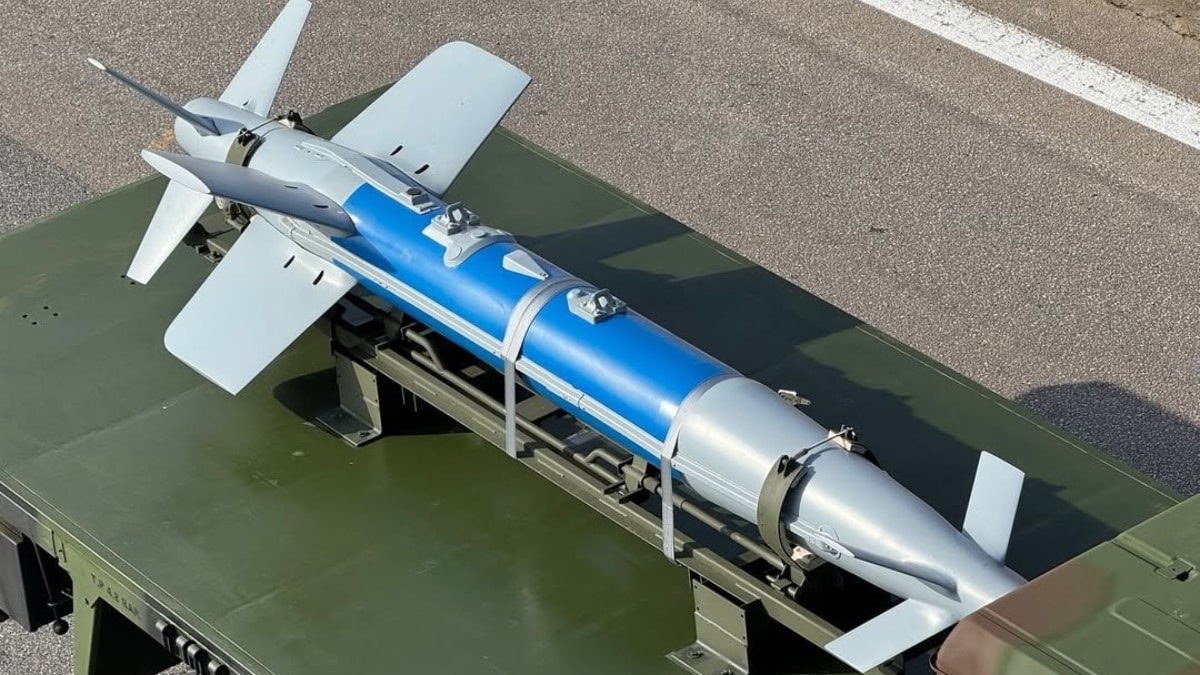
India is set to make an $8.7 billion defence purchase, including 1,000 Israeli SPICE-1000 kits, a report said. The Defence Acquisition Council, chaired by Defence Minister Rajnath Singh, approved the purchase, which reportedly also includes air-to-air missiles, loitering munitions, radars, simulators, and networked command systems.
SPICE stands for "Smart, Precise Impact, Cost-Effective" and is already being used by the air forces of Brazil, Greece, South Korea, Singapore, and Colombia, apart from India. The purchase of SPICE-1000 kits will extend the Indian Air Force’s (IAF) strike range to 100–125 kilometres while reducing the threat posed to the jets by beyond-visual-range weapons and surface-to-air missile systems.
Here are five things to know about the SPICE-1000 precision-guided bombs that India is set to acquire as part of the new defence deal:
1. Manufactured by Israel's Rafael Advanced Defense Systems, they belong to the glide-extended munitions class designed to exploit altitude, kinematics, and autonomous navigation rather than penetration by brute force, Defence Security Asia said in a report. Among the features that make SPICE dependable are the options to enable mid-course target verification, terminal image correlation, and autonomous stand-off capability.
2. In service since 2003, these combat-proven precision-guided bombs ensure first-strike capability with minimum collateral damage. It was on 31 December that the Jerusalem Post reported India's decision to get another thousand units of SPICE-1000. Citing the Stockholm International Peace Research Institute (SIPRI), the report declared New Delhi the biggest customer of Israeli defence industries, accounting for about 34% of all exports between 2020 and 2024.
3. Weighing approximately 500 kilograms, the SPICE-1000 kits "convert 1,000 lb and 2,000 lb class general-purpose and penetration warheads into precision, stand-off strike weapons that deliver multiple simultaneous attacks with pinpoint accuracy in a GPS-denied environment". While the SPICE-1000 kit has a stand-off range of 100 km, the 2000 kit has a stand-off range of 59 km.
4. "SPICE-1000 provides a level of strike confidence against hardened or time-sensitive targets that is difficult to achieve with purely inertial or GPS-guided alternatives," the Defence Security Asia report said. This capability becomes handy while going against high-value targets such as airbases, shelters, and command facilities, the report added.
5. According to the brochure released by the developers, SPICE-1000 systems are fully autonomous and work on a “fire-and-forget” principle, meaning they can operate without constant human control after launch. They are capable of automatically identifying and zeroing in on targets using advanced scene-matching technology. While approaching a target, these bombs can change direction and angle of attack. The platform can carry out multiple missions in a single sortie, is not affected by GPS jamming, and allows mission planning either before launch on the ground or while operating onboard.
