



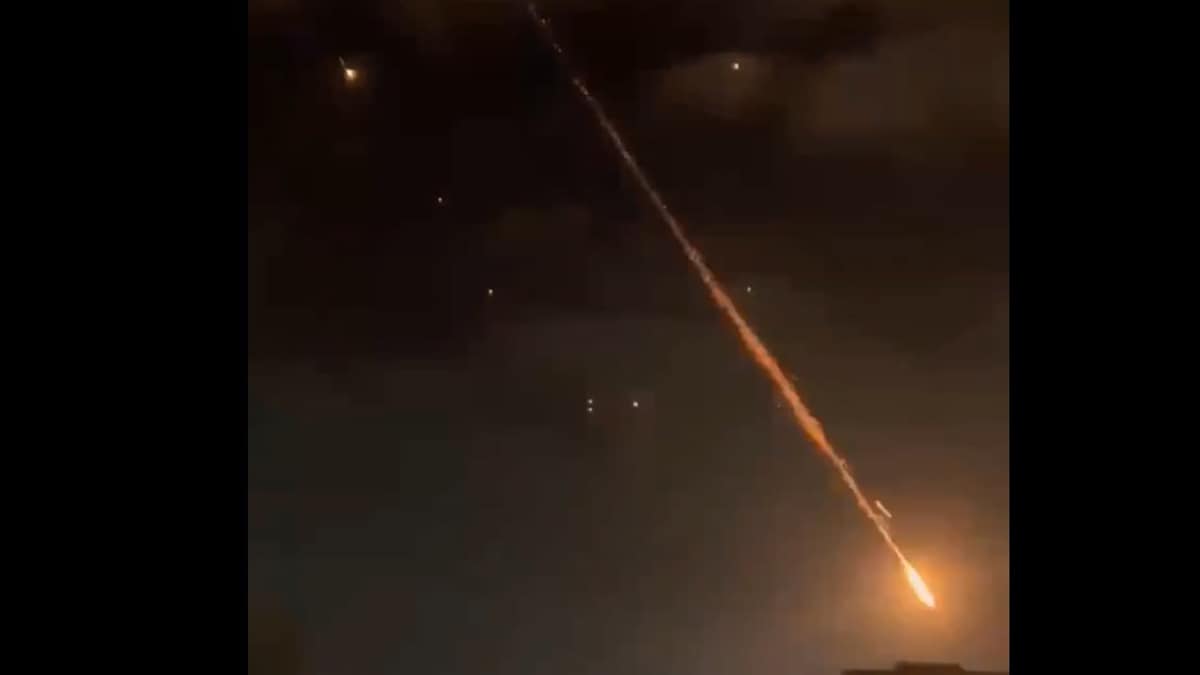
On Wednesday, Iran's Islamic Revolutionary Guard Corps (IRGC) said it launched hypersonic, medium-range ballistic missiles, Fattah-1, towards Israel. The missiles were part of the 11th wave of strikes in Iran’s operation Honest Promise 3. IRGC claimed that Iran “gained complete control over the skies of the occupied forces.
The country's first domestically made missile, Fattah-1 (Fattah means “conqueror”), named by Iran’s supreme leader Ali Khamenei, was unveiled in 2023. The IRGC had then called it an “Israel Striker.” Iranian state media had quoted Amir Ali Hajizadeh, the commander of the IRGC Aerospace Forces who was killed on June 13, saying that the 12-metre-long missile has a range of 1,400km, and can penetrate all defense systems.
The state media had said, “It (the missile) can bypass the most advanced anti-ballistic missile systems of the United States and the Zionist regime, including Israel’s Iron Dome.”
ALSO READ: Is Iran saving its ballistic missiles for ‘final fight’?
While some Western analysts observe that the Iranian state media claims on the capabilities of Fattah-1 missile may be exaggerated, hypersonic missiles have extreme speed, accuracy and ability to change course mid-flight.
Fattah-1 is reported to run on solid fuel and uses a single-stage propulsion system. The IRGC claims that the missile can travel at Mach 5, or five times the speed of sound. Multiple reports claim that the missile can hit targets at speeds between Mach 13 and 15.
Pakistan’s Fatah
Fattah-1 is not to be confused with Pakistan’s Fatah-I and Fatah-II, which are guided multiple artillery rocket systems. The missiles were developed and tested in December 2021. Fatah-II, with a range of 250-400km, is an updated version of Fatah-I which only had a range of 150km. The missiles are equipped with a terminal guidance system that helps adjust their path during the final phase of flight and use satellite guidance for mid-course correction.
During the recent India-Pakistan conflict, the Indian air defence systems had successfully intercepted a Fatah-II missile in Sirsa of Haryana.
How many missiles are left in Iran's stockpile?
Israel recently estimated that Iran might have around 1,200 missiles left in its stockpile. Danny Citrinowicz, who heads the Iran and Shia axis programme at the Institute of National Security Studies, spoke to Iran International saying Iran at the beginning had around 2000 missiles. Referring to the death of Amir Ali Hajizadeh, he had said, “With the air superiority of Israel and the assassination of the head of the missile programme in the first surprise attacks, he will be hard to replace.”
He also added “Iran is having a real problem to produce large salvos. They are calculating now in terms of what’s left, and they still have supplies but they know it’s going to be a lengthy war.”
